The State of AI in 2026: Key Trends and Predictions
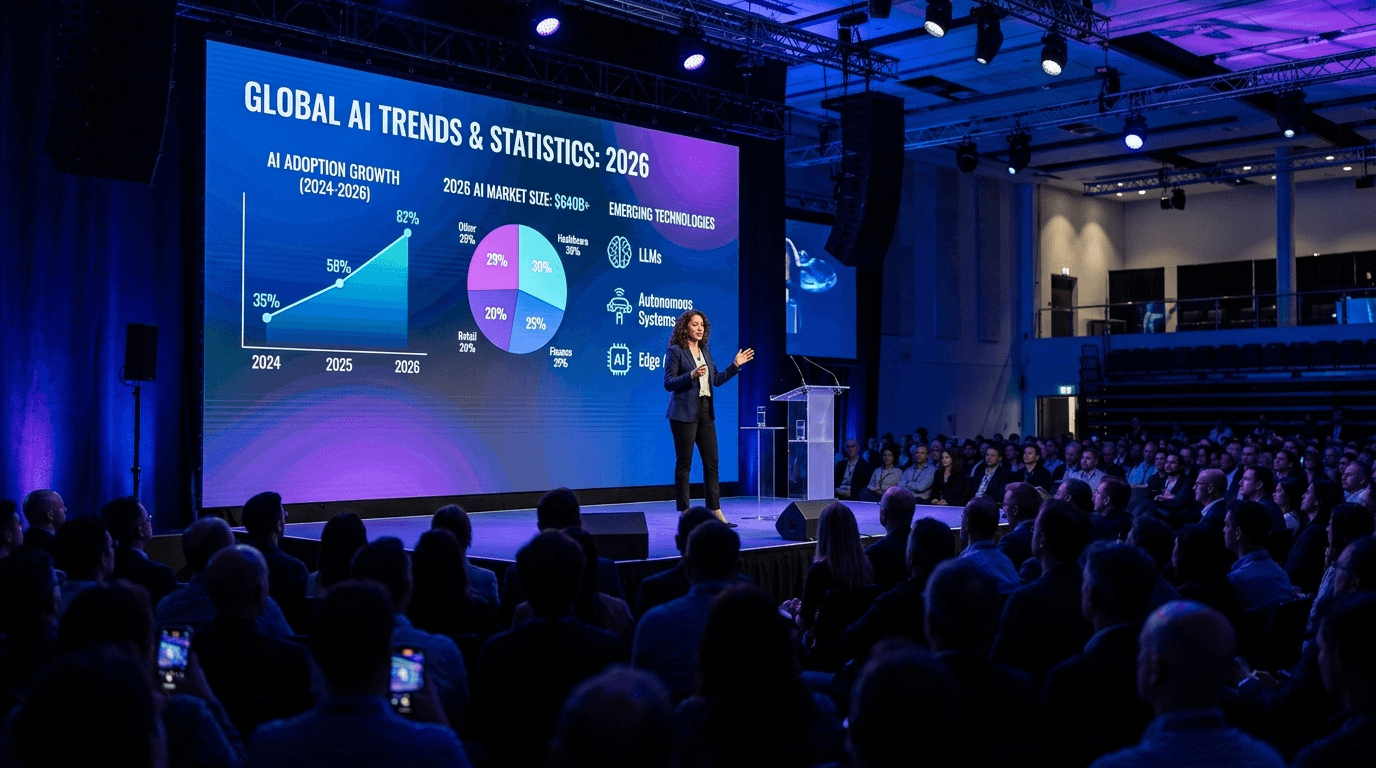
Two years ago, AI was something most businesses were "exploring." Today, it is something they are deploying — at scale, across functions, with measurable results. The shift from experiment to infrastructure has happened faster than most predicted and slower than the most breathless forecasters suggested.
In 2026, the AI landscape is both more mature and more complex than ever. Here is an honest assessment of where things stand and what it means for businesses making decisions about AI investment.
AI Agents Are Going Mainstream
The most significant development in the past 18 months has been the transition of AI agents from research concept to production reality. Companies are no longer just building chatbots — they are deploying autonomous systems that handle multi-step workflows, make decisions, and operate continuously without human supervision.
The numbers reflect this shift:
- According to Gartner, task-specific AI agents were embedded in fewer than 5% of enterprise applications in 2025 — a share the firm projects will reach 40% by the end of 2026
- McKinsey's 2025 State of AI survey found 23% of organizations already actively scaling an agentic AI system in at least one business function, with another 39% experimenting
- Developer interest in agent frameworks (LangChain, AutoGen, CrewAI) has continued to accelerate
What has enabled this mainstream transition? Three things: better models that can reliably follow complex instructions, more mature tooling that makes agents easier to build and monitor, and enough production deployments to demonstrate ROI and build organizational confidence.
The challenge that remains is reliability. Agents are powerful but imperfect — they make mistakes, get stuck in loops, and sometimes take unexpected actions. The businesses seeing the best results are those treating agents as capable-but-supervised systems rather than fully autonomous replacements for human judgment.
Voice AI Has Crossed the Uncanny Valley
For years, voice AI suffered from what researchers call the "uncanny valley" problem — voices that were almost but not quite human, triggering a discomfort that undermined trust and adoption.
That problem is solved. The latest generation of neural text-to-speech models produces voices that are indistinguishable from human recordings in controlled listening tests. Combined with near-real-time speech recognition that handles accents, noise, and domain vocabulary, the voice AI pipeline now delivers experiences that customers genuinely prefer for many interaction types.
Enterprise voice AI deployment has accelerated correspondingly:
- Contact center deflection rates through AI voice have climbed sharply at leading implementers, though reported figures vary widely by query type — well-structured, rules-based interactions see the highest deflection, while complex or sentiment-heavy calls still tend to route to human agents
- Voice interfaces are appearing in contexts beyond customer service: internal operations, healthcare, field services
- The "phone tree" IVR system is increasingly being replaced, not merely supplemented, at organizations further along in their voice AI rollout
What is left to watch is the pace: how fast incumbent IVR vendors get displaced, and which new use cases surface once the technology becomes cheap enough to deploy everywhere.
Multi-Modal AI Is Becoming Standard

The early generation of production AI applications was predominantly text-based. In 2026, multi-modal AI — models that understand and generate images, audio, video, and structured data alongside text — has become the baseline expectation.
This shift has practical implications across application types:
- Customer support: AI agents can analyze images of broken products, receipts, or installation configurations — handling queries that were previously impossible to resolve without human visual inspection
- Healthcare: Vision models can analyze medical images, forms, and clinical documentation alongside structured patient data
- E-commerce: Product discovery via photo search, virtual try-on, and AI-assisted visual merchandising are now standard features
- Manufacturing: Vision-based quality control and safety monitoring powered by the same foundation models used for language tasks
The integration of modalities within single models — rather than separate specialized systems — is simplifying architectures and reducing the engineering overhead of multi-modal applications.
Regulation Is Arriving — and It Is Complicated
The regulatory environment for AI has shifted from largely permissive to increasingly structured, with significant variation by geography.
European Union: The EU AI Act is now in full effect, creating tiered requirements based on risk classification. High-risk applications (healthcare, finance, hiring, critical infrastructure) face strict documentation, testing, and transparency requirements. Businesses operating in EU markets have adapted, though compliance costs have been significant — policy research from CEPS estimates that preparing a single high-risk AI system for compliance can run into the hundreds of thousands of euros for providers, with costs varying widely by company size and system type.
United States: The U.S. approach remains more fragmented — sector-specific guidance from FDA, FINRA, EEOC, and other regulators rather than comprehensive federal legislation. States are increasingly active, with California, Texas, and New York each developing their own AI frameworks.
Asia-Pacific: China has implemented specific regulations for generative AI services, requiring content review and registration. Southeast Asian markets remain largely unregulated, creating both opportunity and risk for rapid deployment.
For businesses, the practical implication is that AI governance — documentation, auditing, bias testing, and explainability — is now a non-optional part of deployment, not an afterthought. Organizations that built governance processes early are finding them to be a competitive differentiator, not just a compliance burden.
Open Source vs. Closed: A Maturing Equilibrium
The AI landscape has settled into a more stable equilibrium between open-source and proprietary models than the early years suggested.
Proprietary frontier models (GPT-5, Claude 4, Gemini Ultra) remain the strongest choice for tasks requiring maximum capability: complex reasoning, nuanced generation, and novel problem-solving. Their providers continue to invest heavily in safety, alignment, and enterprise features.
Open-source models (Llama 4, Mistral, Gemma) have reached the point where they are genuinely competitive for many production use cases — particularly those involving:
- Privacy-sensitive data that cannot leave your infrastructure
- High-volume applications where API costs accumulate significantly
- Specialized domains where fine-tuning delivers large accuracy gains
- Use cases in regulatory environments that require local model hosting
The practical decision framework has become clearer: use proprietary models for maximum capability; use open-source models for control, cost, and compliance.
Enterprise Adoption: Beyond the Pilot
The most significant qualitative change in 2026 is the shift in enterprise AI from pilot projects to production infrastructure.
In 2023 and 2024, most enterprise AI initiatives were pilots — small teams, limited scope, "learning" objectives. In 2026, leading enterprises have graduated: they have learned what works, built the governance frameworks, and are scaling successful patterns across the organization.
This matches the broader industry pattern: Deloitte's State of Generative AI in the Enterprise research found that, as of late 2025, only about a quarter of organizations had moved 40% or more of their AI pilots into production — meaning the pilot-to-production gap this section describes is still very much in progress for most of the market, not fully closed.
This maturation has revealed important lessons:
Data readiness determines AI readiness. Organizations with clean, structured, accessible data deploy AI faster and get better results. The unglamorous work of data infrastructure pays dividends.
Change management is as important as technology. The most common reason AI projects stall is not technical failure — it is organizational resistance or insufficient training and adoption support.
The build vs. buy calculation has shifted. In 2024, more companies tried to build their own AI capabilities. In 2026, the ecosystem of specialized providers, APIs, and platforms has matured to the point where buying (or partnering) is often faster and more cost-effective than building from scratch.
What This Means for Your Business
The state of AI in 2026 offers a clear message for business leaders: the window for "wait and see" has closed. Not because AI will immediately disrupt your business if you delay, but because your competitors are no longer waiting, and the compounding advantages of early, thoughtful adoption are becoming visible.
The businesses that are winning with AI in 2026 share several characteristics:
- They started with specific business problems, not technology capabilities
- They invested in data quality alongside AI tools
- They built cross-functional AI teams rather than isolated "AI labs"
- They iterated rapidly and were willing to kill projects that were not working
- They treated governance and ethics as enablers, not obstacles
The entry point does not need to be complex. A single well-deployed AI agent that saves your team 20 hours per week is a real win that builds confidence and capability for the next step.
Looking Ahead
The next 12-18 months will likely bring continued maturation on several fronts: more reliable agents, more capable multi-modal models, clearer regulatory guidance, and declining costs across the board.
What will not change is the fundamental dynamic: AI is becoming standard infrastructure. The businesses that get the most out of it will be the ones that adopt it thoughtfully and strategically, not the ones that move first.
The state of AI in 2026 is both promising and demanding. The tools are ready. The decision is yours.