A Surgeon Trusted AI Mid-Operation. A Patient Kept His Sight.
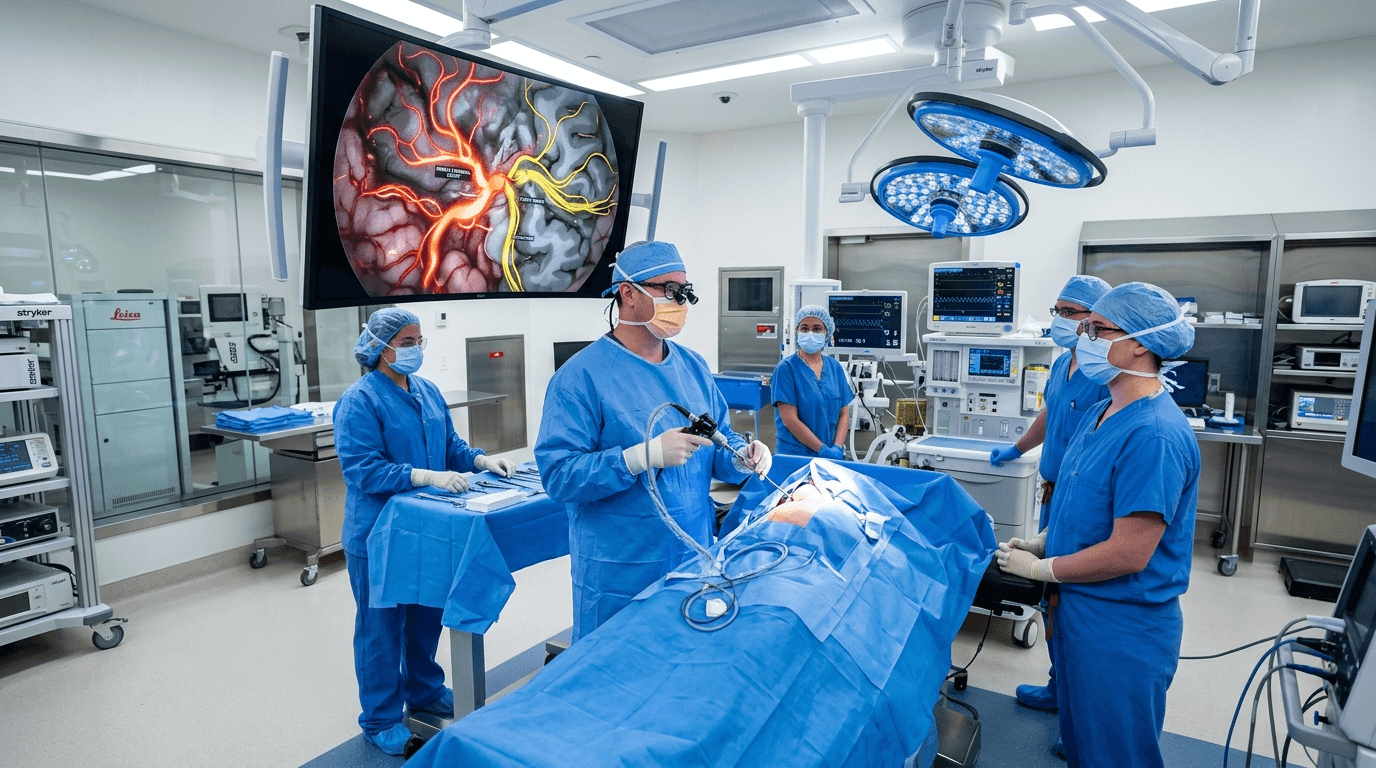
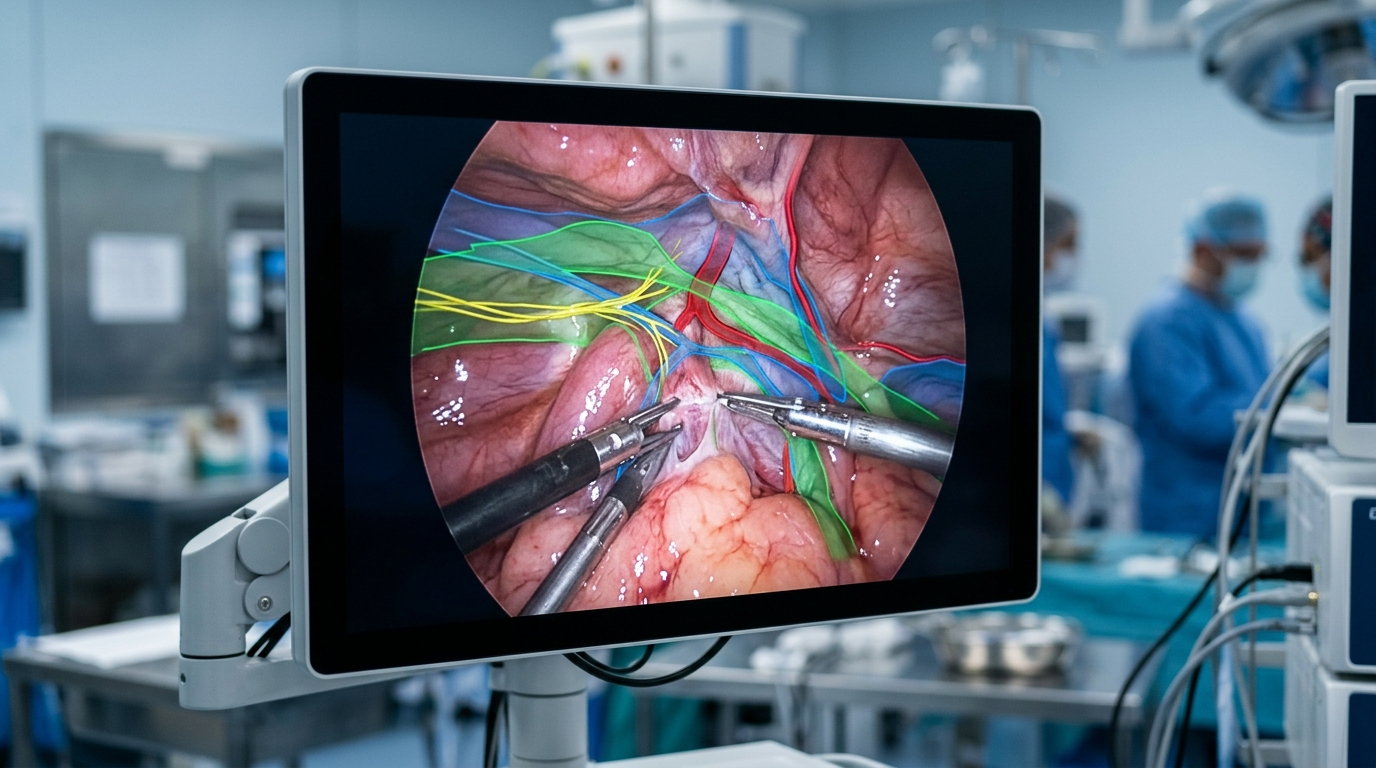
The AI tool analyzed a video feed of the operation as it happened. On a second screen, it tracked the surgical instruments and marked up areas where hidden blood vessels and nerves were most likely to be, highlighting the safest paths to extract the tumor.
"It is trained on more operations than most surgeons see or do in a lifetime and can act like an expert second pair of eyes," said Prof Hani Marcus, who helped carry out the procedure.
The Patient Who Said Yes
Rhys Hibbert, a 48-year-old customer services manager and father of two from Bedfordshire, was fit and healthy until 18 months ago. He walked two miles every lunchtime. On one of those walks, he fell unconscious and started fitting in the road.
A brain scan revealed an 11mm non-cancerous tumor growing on his pituitary gland -- a marble-sized organ at the base of the skull that secretes hormones regulating growth, metabolism, blood pressure, and temperature. The gland sits dangerously close to the carotid arteries and optic nerves.
As the tumor pressed on his optic nerves, his peripheral vision narrowed. He started tripping over things. He felt severely fatigued and dizzy. But he kept making his wife a cup of coffee every morning.
"For 18 years of married life I've always got out of bed and made my wife a cup of coffee, and I wasn't going to let this tumor stop that," Hibbert said.
When surgeons offered him the option to be the first person to try the operation with their bespoke AI tool, he didn't hesitate.
"If patients are not prepared to join research how can doctors ever learn and how can medicine ever progress?" he said.
The Hidden Map Inside Your Head
The surgery involved inserting an endoscope -- a thin camera on a flexible tube -- through the nose to the base of the skull. At that point, the tumor was close but hidden behind layers of bone and tough membrane.
The problem is that anatomy differs between individuals. An artery that sits one centimeter to the left in one person's skull might sit two centimeters to the right in another's. The average UK surgeon performs only 10 to 20 of these operations per year, relying on pre-operative scans to familiarize themselves with each patient's unique anatomy.
The AI tool changes this. Researchers trained their system on hundreds of videos of pituitary tumor removals, carefully drawing around the vessels and nerves on each frame. The result is a pattern-recognition system similar to facial recognition on a phone, but trained to recognize anatomical structures instead of faces.
During Hibbert's surgery, the AI ran on a separate screen, analyzing the live endoscopic feed in real time. It tracked the surgical instruments and projected the most likely location of hidden vessels and nerves onto the video, highlighting the safest route to the tumor.
Without the AI's assistance, the complication rates were stark: a 25-50% chance of incomplete tumor removal and a 0.5-2% chance of injuring a major blood vessel.
The Surgeon's Trust Decision
The team wants to make clear that the AI tool is just assisting. The surgeons retain full control. The technology was tested in the lab for years before being used on a live patient.
But the decision to trust an AI recommendation during a live operation on a conscious patient's brain is not a trivial one. In a field where a millimeter error can mean blindness, stroke, or death, the surgeon's willingness to follow the AI's guidance is itself the story.
"When I opened my eyes after the operation it felt like I had got 360-degree vision -- I hadn't seen that clearly for a year," said Hibbert.
The Road Ahead
The research was funded by the National Institute for Health and Care Research and Google, and developed by researchers at University College London. The team is now working on a larger trial.
Their long-term ambition is ambitious: to develop a kind of ChatGPT for surgeons, an AI expert that can be present in any operating room, offering advice that surgeons can accept or ignore.
"A tool that is another expert in the room they can turn to for advice if they want it -- or leave if they disagree with it," as one researcher put it.
The promise is real, but the approach is deliberately cautious. The AI is an assistant, not a replacement. It guides, but the surgeon decides. In a world of breathless AI hype, this measured trust may be the most important precedent of all.
Sources
- BBC News: World's first patient to undergo live AI-assisted brain surgery -- https://www.bbc.co.uk/news/articles/cjwg5n7y68xo
- The Guardian: London neurosurgeons perform first successful AI-assisted operation to remove brain tumour -- https://news.google.com/rss/articles/CBMiqgFBVV95cUxNSldrM0lCSVVfODk2T091ekNBdGZ6Y2RJbWg0WW5aLW5hQ21pdWtzdnZRVlcwUVJua3FVdmVJMzliSUpQcHk0eXJ4S3RnRnhnZFRGWmxGdEJaajU1WjRmV0s1ajVIcWlPazBNY2gtSm8ya0NaNUV5WG82MHJNTENqbUhvb2c2bnUtTzNmNF9NNkVZY0NCSzJVUkdnTTBDb1YyNkpxLWdpM0pHZw?oc=5