AI Stories Are Better, Until You Know

The prejudice against AI writing is stronger and faster than any actual quality signal.
A new study published in the journal Judgment and Decision Making gave more than 2,500 participants a straightforward task: read a short story and rate it. Some stories came from human authors featured in well-known literary magazines. Others were generated by ChatGPT 4.0 using prompts that matched the theme, style, and narrative perspective of the human originals.
The result was uncomfortable for anyone who believes human creativity is inherently superior. AI-generated stories scored significantly higher than human-written ones on both perceived quality (1.54 vs 0.97 on a -3 to +3 scale) and immersion (1.42 vs 1.00). Readers could not tell the difference at better than chance levels, even when they were given both versions to compare side by side.
But here is the twist. When participants were told a machine wrote a story, their ratings dropped. The same text was judged inferior simply because of the label attached to it. Participants with a positive attitude toward AI gave higher scores across the board, but even they showed a measurable penalty when the AI authorship was revealed. Among AI-skeptical participants, the effect was stark.
The smoothness advantage
AI-generated fiction has a distinct profile. It tends to be smoother, easier to read, and more emotionally upbeat than human-written literary fiction. According to researchers Sydney Sears and Deena Skolnick Weisberg from the University of Chicago, these traits could explain the higher ratings without the AI stories actually being better in a literary sense. People naturally prefer material that requires less effort to process.
"High-quality literary fiction," the researchers note, "is often intentionally hard to access and pushes readers to work for meaning. A story can be high quality but not very engaging, and vice versa."
The short story format also works in AI's favor. Generating a coherent narrative in 1,000 words is a very different challenge than sustaining quality across hundreds of pages. A novel would likely expose the limitations of AI-generated narrative structure in ways a short story does not.
The bias is bigger than the quality gap
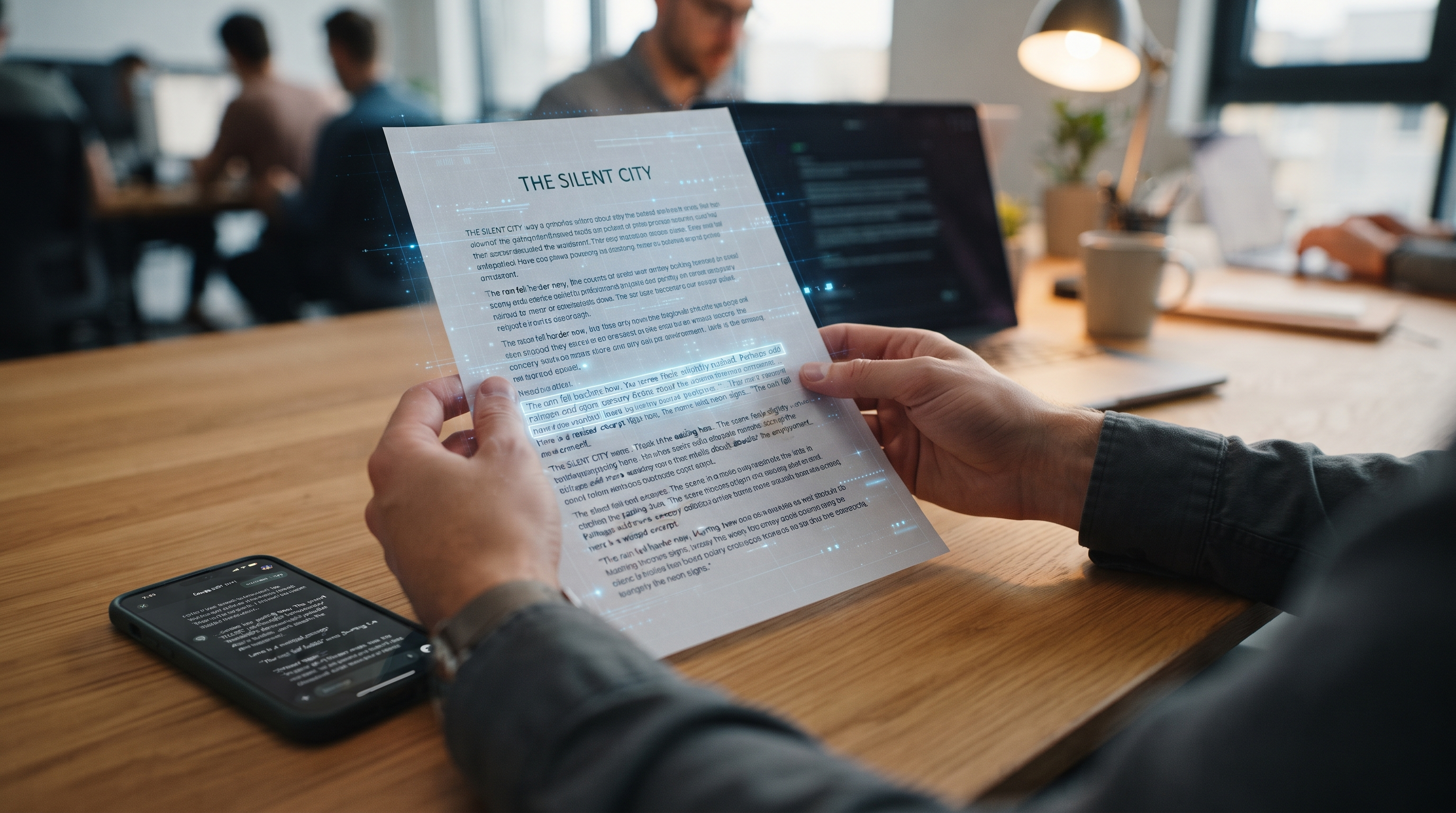
The most striking finding is not that AI can write passable fiction. It is that the anti-AI bias is more predictive of reader ratings than the actual writing quality. Across three experiments, the authorship label mattered more than the text itself.
This echoes a 2025 study on AI-generated poetry that found the same pattern: participants rated poems higher when told a human wrote them, even when the identical text had been generated by AI. The bias appears to be a general cognitive pattern, not something specific to fiction.
Self-reported experience with AI systems helped participants slightly in correctly identifying whether a story was machine-written. Self-reported experience with fiction did not. Even veteran readers could not reliably spot the difference.
What this means for creativity
The study arrives at a moment when AI-generated creative content is becoming invisible in daily life. AI-written news summaries, marketing copy, social media posts, and even screenplays are already circulating without disclosure. The research suggests that readers would actually prefer much of this content if they did not know its origin.
For writers and publishers, the implications are uncomfortable. The market may be approaching a situation where the only competitive advantage of human-written content is the label "written by a human," not the quality of the writing itself. That label carries real value, but it is a branding advantage, not a creative one.
The full study data and materials are available on the Open Science Framework. The researchers' conclusion is measured but clear: AI can generate creative works that people perceive as at least on par with human work, yet a persistent bias prevents people from believing AI is capable of that.
Sources
- The Decoder: Readers rate AI-generated short stories higher than human ones until they learn a machine wrote them
- The Guardian: AI-generated stories rated better quality than human-written ones, study finds
- BBC: AI stories preferred to human-written ones - study
- Time Magazine: AI Stories Are More Engaging, New University Study Finds
- Fast Company: Why do people actually prefer AI-generated stories to human writing?
- CNET: Most People Prefer AI Writing, but That's Because It's Trained on Us