How AI-Powered Websites Convert Better

Every business wants a website that converts. But most websites are built once, updated occasionally, and serve every visitor the exact same experience — regardless of who they are, where they came from, or what they actually need.
AI-powered websites break this mold entirely. They adapt to each visitor in real time, serve personalized content, optimize themselves through continuous testing, and engage users with intelligent conversational interfaces. The result is dramatically higher conversion rates, longer session times, and more revenue from the same traffic.
What Makes a Website "AI-Powered"?
An AI-powered website integrates machine learning and intelligent automation into its core functionality — not as a bolt-on feature, but as a foundational layer that influences content, design, and user flow.
Key capabilities include:
- Real-time personalization based on visitor behavior, source, and profile
- Dynamic content that changes based on context and intent signals
- AI-driven testing that continuously optimizes layouts and messaging
- Conversational AI that guides visitors toward their goals
- Predictive analytics that anticipate visitor needs before they express them
- Automated SEO optimization that keeps content competitive with minimal manual effort
None of these capabilities require a complete rebuild of your website. They can be layered onto existing infrastructure incrementally, delivering compounding returns over time.
Personalization: Serving the Right Experience to Every Visitor
A first-time visitor from a Google ad has different needs than a returning customer checking on an order. A developer evaluating your API wants different information than a CEO assessing strategic fit. Yet most websites serve them all the same homepage.
AI personalization solves this by analyzing signals in real time:
- Traffic source — where did this visitor come from? (organic search, paid ad, email campaign, referral)
- Behavior patterns — which pages have they visited? What have they clicked on?
- Device and context — mobile vs. desktop, time of day, geographic location
- CRM data — for known visitors, their full customer history
- Intent signals — scroll depth, time on page, hover patterns that indicate interest
Based on this analysis, an AI-powered website can dynamically adjust:
- Headlines and CTAs — a visitor from a competitor's pricing page sees a direct comparison CTA; a first-time visitor from a thought leadership article sees a softer introductory offer
- Featured content — highlight case studies relevant to the visitor's industry
- Pricing presentation — show annual vs. monthly pricing based on visitor signals
- Chat triggers — proactively engage visitors showing exit intent or confusion signals
According to McKinsey, effective personalization can lift revenue by 5-15% and increase marketing spend efficiency by 10-30%, while also cutting customer acquisition costs by as much as 50%.
Dynamic Content: Beyond the Static Page
Static websites publish content and hope it matches what visitors are looking for. AI-powered websites generate and surface content dynamically — responding to context rather than just displaying what was published.
Product Recommendations
For e-commerce sites, AI recommendation engines analyze purchase history, browsing behavior, and similar customer profiles to surface products each visitor is most likely to buy. The oft-cited claim that recommendation engines drive "35% of Amazon's revenue" traces back to a 2013 McKinsey estimate that has been repeated ever since without independent re-verification — some researchers have since called the figure into question. What is well-documented is the direction of the effect: retailers across the industry consistently attribute a meaningful, double-digit share of online revenue to recommendation and personalization systems.
Search Intelligence
Traditional site search matches keywords. AI-powered search understands intent — so a visitor searching for "something to help my team communicate better" surfaces team communication tools even if those exact words do not appear in product descriptions.
Content Adaptation
For SaaS and service businesses, AI can adapt landing page content based on the visitor's industry, company size, or role. The same page can speak directly to a healthcare provider and a financial services firm — with relevant examples, appropriate terminology, and industry-specific proof points.
AI-Driven A/B Testing: Optimization That Never Stops
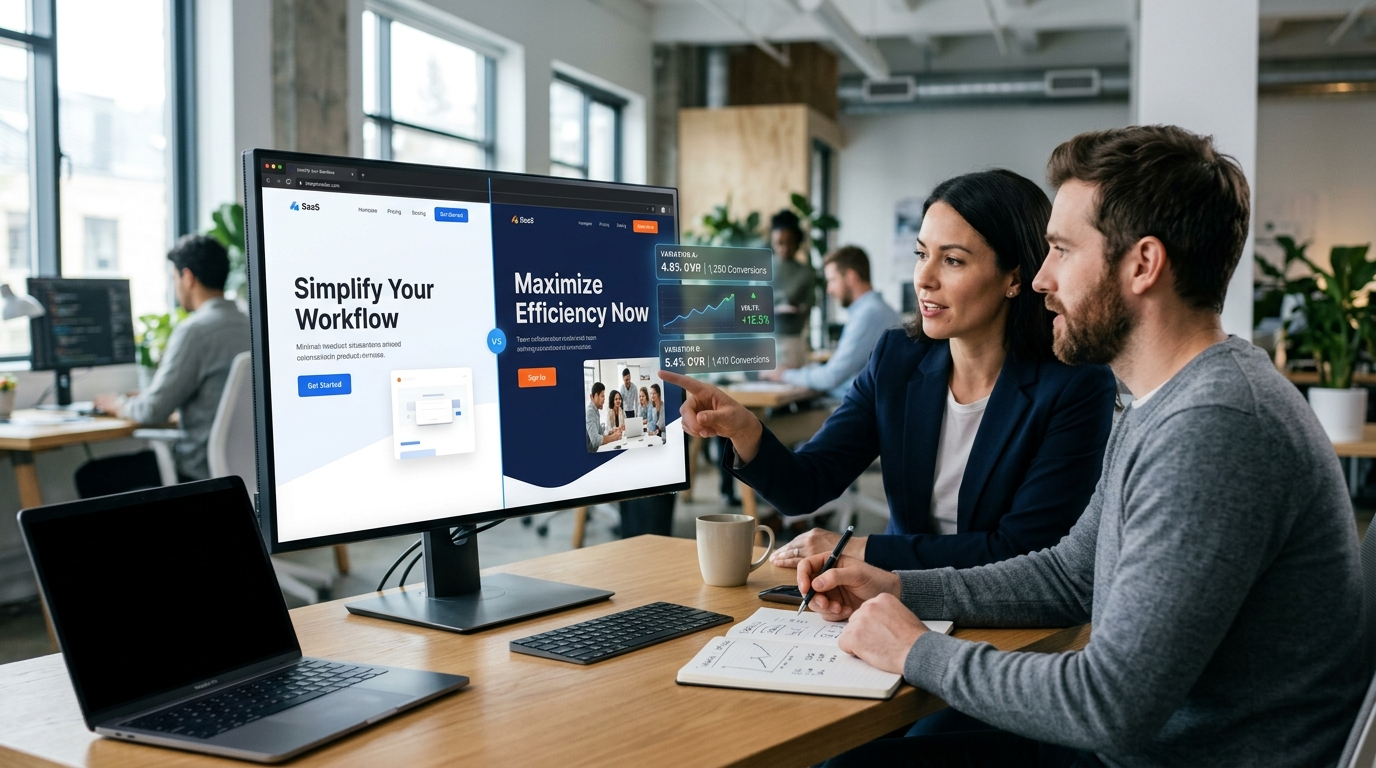
Traditional A/B testing is slow, resource-intensive, and captures only one variable at a time. You run a test, wait weeks for statistical significance, implement the winner, and move on to the next hypothesis.
AI-driven multivariate testing transforms this process:
- Simultaneous testing of dozens of variables across headlines, images, CTAs, layouts, and color schemes
- Continuous optimization — the system allocates more traffic to winning variants in real time, rather than waiting for a test to "end"
- Contextual personalization — different variants can win for different audience segments simultaneously
- Predictive modeling — the AI predicts which variants are likely to win before statistical confidence is reached, accelerating iteration
The result is a website that is always improving — not just when your marketing team has time to run a test.
Chatbot Integration: Turning Browsers into Buyers
The single most impactful AI addition to most websites is a well-designed conversational interface. Not a pop-up asking "Can I help you?" three seconds after a page loads — but a genuinely intelligent assistant that understands visitor context and helps them achieve their goals.
Effective AI chatbots on websites:
- Answer product and pricing questions instantly, 24/7, without making visitors hunt through documentation
- Qualify leads by asking the right questions and routing high-value prospects to immediate sales contact
- Guide decision-making by helping visitors compare options, understand fit, and overcome objections
- Capture leads from visitors who are not ready to convert yet — offering a relevant resource or demo in exchange for contact information
- Reduce support load by resolving common pre-sales questions without human intervention
The key difference between AI chatbots and traditional live chat is scalability: an AI chatbot engages every visitor simultaneously, at any hour, with consistent quality.
SEO Automation: Ranking Without the Manual Grind
Search engine optimization is critical for driving organic traffic, but it is also notoriously time-consuming. AI-powered SEO tools automate the most labor-intensive aspects:
- Content gap analysis — identify topics your competitors rank for that you do not cover
- Semantic optimization — ensure content covers related concepts that search engines use to assess topical authority
- Automated meta data — generate and A/B test title tags and meta descriptions at scale
- Internal linking — automatically surface and link to relevant content across your site
- Performance monitoring — detect ranking drops and diagnose causes without manual analysis
The compounding effect of AI-driven SEO can be significant, though results vary widely by starting point, competitive landscape, and execution quality — businesses that implement these systems systematically tend to outpace those relying on ad hoc, manual SEO efforts over a 6-12 month horizon.
Real Results: What the Data Shows
The business case for AI-powered websites is backed by directional evidence across industries, even where exact lift varies by company and execution:
- E-commerce: AI personalization tends to raise both average order value and conversion rates — McKinsey ties effective personalization programs to revenue gains of roughly 5-15%
- SaaS: AI chatbots cut time-to-first-contact for qualified leads by engaging visitors instantly, at any hour, instead of waiting on a sales team's availability
- Professional services: Dynamic content personalization tends to reduce bounce rates by making a page's opening message immediately relevant to who is reading it
- Content sites: AI-driven content recommendations tend to increase pages-per-session by surfacing more relevant next reads
These are not outlier results from companies with massive AI teams. They are achievable outcomes for businesses of any size when the right tools and strategy are in place.
How to Get Started
Implementing AI on your website does not require rebuilding everything from scratch. Here is a pragmatic approach:
Priority 1: Add a smart chatbot. This delivers immediate impact for lead generation and support, and the data you collect informs everything else.
Priority 2: Implement behavioral analytics. Tools like Hotjar, FullStory, or custom ML models help you understand where visitors are dropping off and why — the foundation for effective optimization.
Priority 3: Launch A/B testing. Start with your highest-traffic pages and test the elements with the biggest potential impact: headlines, CTAs, and hero sections.
Priority 4: Personalization. Once you have data and a testing infrastructure, begin personalizing based on traffic source and visitor behavior.
Priority 5: SEO automation. Use AI tools to scale your content strategy and maintain competitive rankings without proportionally scaling your team.
At AIgentic.media, we help businesses implement this stack systematically — building AI-powered web experiences that drive measurable commercial outcomes.
Sources
- McKinsey: What is personalization?
- McKinsey: How retailers can keep up with consumers
- University of Florida News: How helpful are product recommendations, really?
Conclusion
The gap between static websites and AI-powered ones is widening every month. Businesses that invest in intelligent personalization, automated optimization, and conversational AI are compounding their conversion advantages continuously.
Your website is not a brochure. It is your highest-leverage sales asset — and AI is the tool that transforms it from a passive information resource into an active, adaptive engine for growth. The time to upgrade is now.