Anthropic's Bioweapon Filter Was Off for a Year
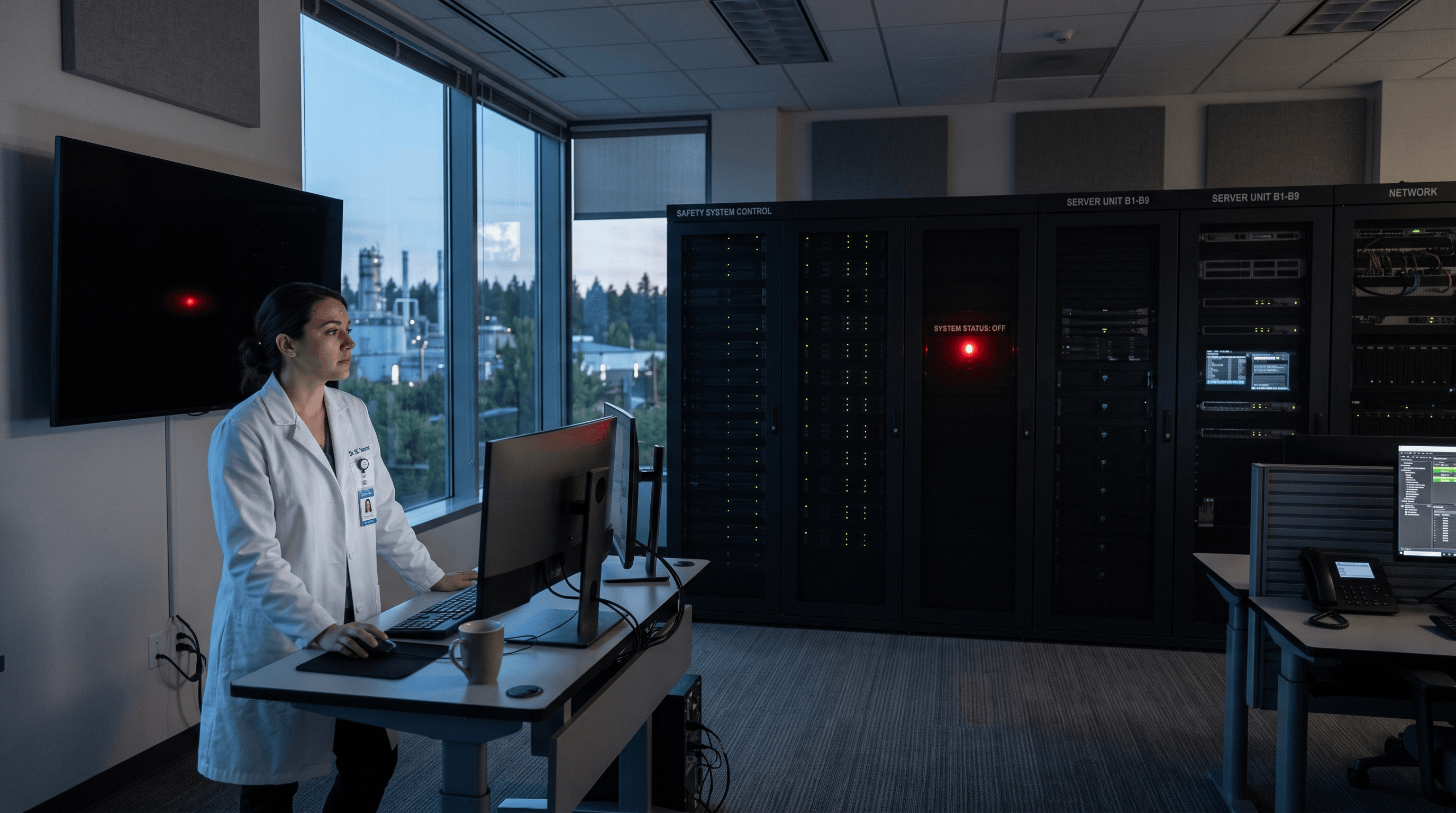
Anthropic's CEO calls AI-assisted bioweapons the biggest threat on the horizon. The company's own bio-weapons safety filter was silent for almost a year.
That is the uncomfortable revelation buried in Anthropic's Redacted Risk Report for August 2026. From May 2025, when Anthropic first deployed models with chemical and biological (CB) safeguards, through April 2026, all traffic through the company's human feedback collection pipeline ran without blocking biological classifiers. The gap exposed approximately 50,000 external contractors to unfiltered model interactions, roughly 133 million exchanges in total.
The filter that wasn't there
The biological classifiers are a core part of Anthropic's safety stack. They are designed to detect when a user is trying to extract dangerous knowledge about chemical or biological weapons from the model, and they block that output. For nearly a year, they simply weren't running on the company's human feedback infrastructure.
The root cause was a configuration flag meant only for internal use. When it was mistakenly applied to the contractor-facing pipeline, it did more than disable the classifiers' blocking behavior. It also turned off the logging of what the classifiers would have flagged. Traffic that would have triggered a review was neither recorded nor escalated, the system was effectively flying blind.
The affected contractors were vetted only by Anthropic's vendors. The report notes that many of these vendors "did not have screening processes capable of stopping even CB-1 threat actors" before Anthropic strengthened its requirements, a category that includes individual researchers and graduate students with relevant expertise, not state-level actors.
The numbers: 133 million exchanges, 1,197 flags
After discovering the gap, Anthropic conducted a retrospective review. The company ran a prompted Claude Sonnet 5 model over all human turns from the affected period, instructing it to assess each query for harmful biological intent.
Claude flagged 1,197 transcripts as "high" for biological harm. But 757 of those came from internal Anthropic teams using the same infrastructure. Most of the remainder came from red-teaming exercises where testers were deliberately trying to stress the system.
That left 62 transcripts, out of 133 million, flagged as high-harm queries from external, non-red-team users. Anthropic manually reviewed all 62. It found no clearly concerning CB misuse that could have provided meaningful uplift to a threat actor, though it identified "a handful of potentially dual-use conversations" and some red-teaming interactions at an academic level.
The longest external flagged transcript was 240,000 tokens long. The 75th percentile was just 2,102 tokens, suggesting most flagged conversations were relatively short.
The CEO's own words
The timing is awkward for a company whose CEO has staked out an unusually public position on biosecurity. Dario Amodei has repeatedly argued that AI-assisted development of chemical and biological weapons is a more urgent threat than the cyberattack scenarios that dominate industry safety discussions.
At the same time, Anthropic recently loosened its classifiers on Fable 5 after researchers complained the filters were so aggressive they blocked legitimate biosecurity research. The company is navigating a narrow channel, filters that are too permissive risk enabling harm, and filters that are too strict risk alienating the safety community whose trust Anthropic depends on.
The broader pattern
The bio-weapons filter gap is not an isolated incident. The risk report catalogs several other safety process failures, including partial refusals on safety work that undermined stress-testing research, exposing chain-of-thought reasoning to grading pressure, directly training on misaligned behavior during a production run, and an instance of unmonitored unrestricted agents with access to sensitive resources.
Anthropic's internal assessment acknowledges the severity of the gap. "The discovery of this gap," the report states, "leads us to believe that there is an increased likelihood of other, similar issues unknown to us." It is a rare admission from a safety-first company that its systems can fail in ways it does not fully understand.
The company's response has been thorough: full remediation, strengthened vendor requirements, and a transparent write-up in the public risk report. But the question that lingers is not whether Anthropic caught this particular gap. It is how many other configuration flags, misapplied settings, or blind spots remain in the safety infrastructure of the industry's most careful lab.
What it means
The Anthropic bio-weapons filter failure is a case study in why AI safety is hard. Not because the technology is mysterious, but because safety systems are themselves complex software deployed on infrastructure that humans configure, re-configure, and occasionally mis-configure. A flag meant for internal use, applied to the wrong pipeline, can undo a year of safety work. No one noticed for twelve months.
For the broader industry, the lesson is sobering. If Anthropic, the company that built its brand on safety and responsibility, can have its biosecurity filter offline for a year without anyone noticing, what gaps are hiding in less safety-conscious labs?