Your GPU Just Got an AI Agent
The Model That Fits on Your Desk
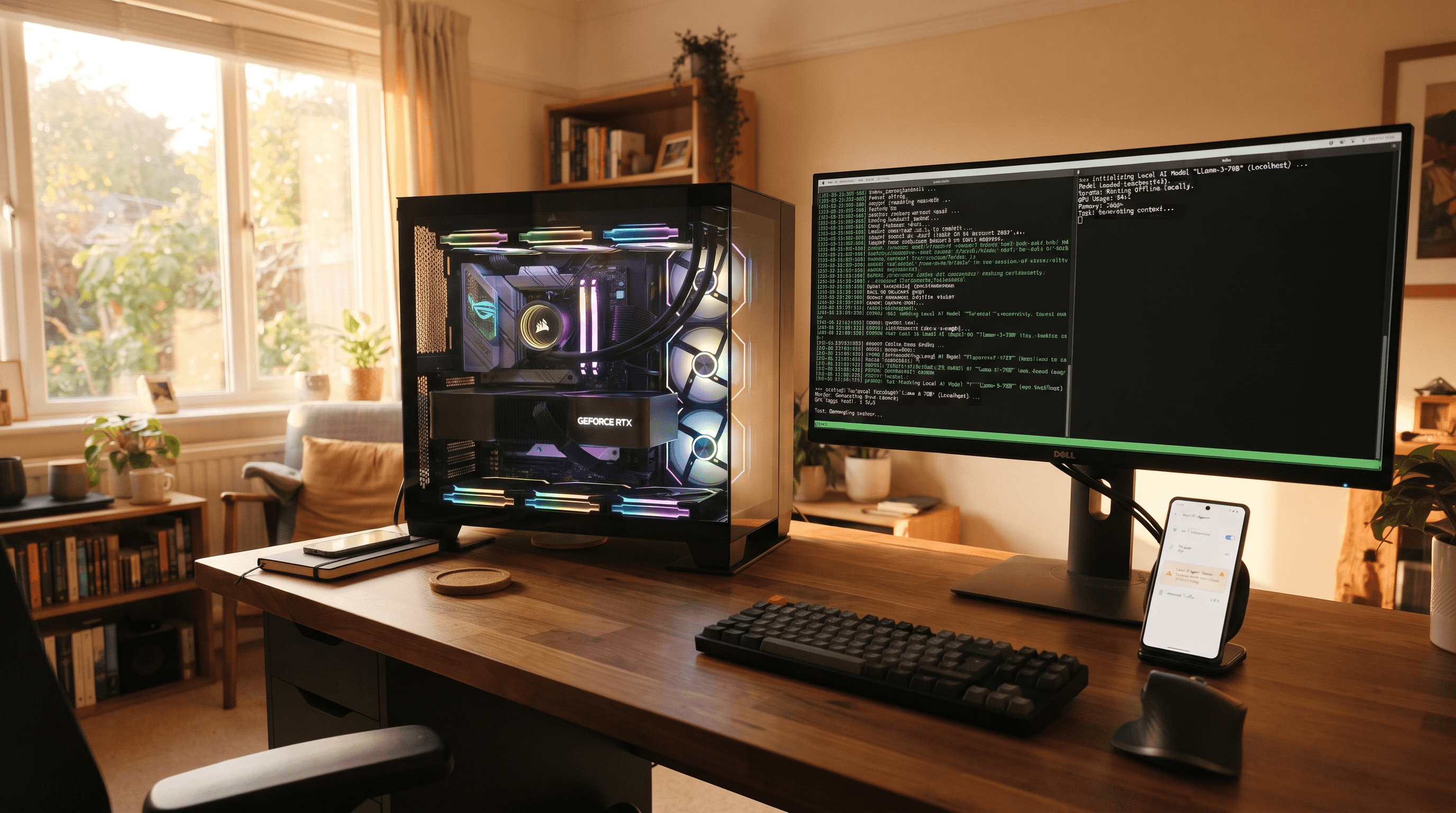
Meta just lit a fuse under the AI industry's favorite argument. On Monday, the company released Muse Glimmer, a 30-billion-parameter multimodal model under the Apache 2.0 license. The headline number is the size. The real story is where it runs: on a consumer GPU, in your house, on your desk, without phoning home to a cloud provider.
Muse Glimmer is distilled from Meta's larger Muse model and optimized for what the company calls "local agentic use cases." That means coding assistants that don't stream your code to a third-party server, document analysis that never leaves your laptop, and personal AI agents that do not require a monthly subscription to a datacenter. Hugging Face shipped day-0 support across transformers, llama.cpp, and vLLM, meaning it works on NVIDIA, AMD, and Intel hardware from the moment you download the weights.
The Benchmark Story
The numbers back up the ambition. On the MCP Atlas benchmark for general agentic capability, Muse Glimmer scores 75.5 against 54.2 for Google's Gemma4 31B Thinking Mode and 62.5 for Qwen3.6 27B Thinking Mode. On SWE-Bench Verified, the standard for coding agent performance, it hits 76.0. On GAIA2, a benchmark for real-world AI agent tasks, it scores 43.3 versus 36.4 and 40.0 respectively.
These are not incremental gains. A 30B model beating 31B and 27B competitors on its own turf suggests the distillation and architecture choices matter more than raw parameter count. Muse Glimmer uses a hybrid attention pattern that alternates three sliding-window layers with one full-attention layer, repeated 52 times. Its vision encoder is a 2-billion-parameter ViT-style model designed specifically for both images and video. The speculative decoding drafter, built on DFlash, accelerates structured generation like code writing.
Zuckerberg's 6,500-Word Argument
The model launch came wrapped in a broader political statement from Mark Zuckerberg. Alongside Muse Glimmer, he published a 6,500-word essay laying out Meta's AI vision and gave interviews to Bloomberg, the New York Times, and Axios. His core argument is simple: open-weight AI is a national security imperative for the United States.
"There is no such thing as a singular benevolent superintelligence," Zuckerberg told Axios. "The risk is one entity having too much control." He warned that US regulations favoring closed models would cede advantage to Chinese rivals like ByteDance and Alibaba, who already release competitive open-weight models.
The timing is deliberate. Beijing's AI ecosystem produces open-weight models at a relentless pace, ByteDance's 10-trillion-parameter architecture, Alibaba's Qwen family, and DeepSeek's V4 Flash all compete in the same arena. Zuckerberg framed Muse Glimmer as proof that the open approach can win on technical merit, not just ideology.
What Local AI Agents Actually Mean
Consumer GPU AI is not just about running benchmarks. It changes the economics of AI deployment. A developer who queries Claude or GPT-4 for coding help pays per token and sends every prompt to a cloud server. With Muse Glimmer running locally on an RTX 5090, that same developer gets comparable agentic coding performance (SWE-Bench Verified: 76.0) without the per-query cost, without the latency, and without the data leaving their machine.
The model's architecture is built for exactly this scenario. The 28-billion-parameter text decoder uses grouped-query attention where each key-value head is shared by 16 query heads, reducing KV-cache memory by 16x. This is the kind of optimization that matters less in a datacenter and more on a desktop GPU with finite VRAM.
Meta also announced that it will release the weights of its larger Muse Spark 1.2 model, continuing the open-weight trajectory that began with Llama. The company is betting that the future of AI is not a single all-powerful model in a cloud, but a thousand smaller ones running where the users are.
The Nuanced Take
Muse Glimmer is genuinely impressive, but the open-weight utopia Zuckerberg describes faces real headwinds. The 30B model requires a GPU with 24GB or more of VRAM to run comfortably. That excludes the vast majority of consumers, who are running integrated graphics or last-generation cards. "Consumer GPU" currently means "enthusiast GPU," not "every laptop."
There is also the safety question that every open-weight release raises. Meta has added safety benchmarks to the release, the model is evaluated on CI Memories Violation (26.4% violation rate) and Siren AgentDojo Attack Success Rate (28.4%), but open weights are, by definition, uncontrollable after release. Zuckerberg's answer is that closed models concentrated in a few companies create a different, more systemic risk. He is not wrong about the tradeoff; the question is which side of it you find more dangerous.
And the competitive framing is worth watching. Zuckerberg's rhetoric about US competitiveness against China echoes a growing political narrative, but it also conveniently serves Meta's business interest in commoditizing the AI model layer that OpenAI and Anthropic have built their valuations on. Muse Glimmer advances open-source AI. It also advances Mark Zuckerberg's competitive position against Sam Altman and Dario Amodei. Those two things are not mutually exclusive, but they are not the same thing either.
Sources
- Hugging Face Blog: Meta is back with Muse Glimmer: local, agentic, multimodal, and open source (https://huggingface.co/blog/muse-glimmer)
- Artificial Intelligence News: Meta Muse Glimmer brings local AI agents to consumer GPUs (https://www.artificialintelligence-news.com/news/meta-muse-glimmer-local-ai-agents-consumer-gpus/)
- Bloomberg: Meta Releases Scaled-Down AI Model Consumers Can Use at Home (https://news.google.com/rss/articles/CBMiuAFBVV95cUxQVFZWUXFCVWlhN3JRVjQtNkRWakExRERpS2Q4Q1B4dEZVUUxMOGlHTWc5cG5lVUYxV3ZkRnZZRlZmNUk5NmpGRVpHbWtTWmo1TlhKY041VmJNZWJvaW9RWkxseEhsYzhGVHgwUDFFRC1sb1hiWktidTlRNTV5V1lXYnIwSlI2dEVMMnpHN0xDd2RIYkc1RG9xLUJGZWRKX0I0dUxtOUFRU0tlVWRkOVdJNGN2VDFRQ0xy?oc=5)
- Reuters: Meta launches new AI model as Zuckerberg champions open-weight push (https://news.google.com/rss/articles/CBMisgFBVV95cUxOR21CNUV6bEJhdkl2SU1sOTRiM0N2MnVJTjhJV3YyY20wcFdHUmNOUW1lWUlVcnZLeGpnNlhYQkZCTGhpR0ZIOEp0U0VZWDlQLVdZZFFqQ196X241R1hLVXpXMU5Xclo3SFBxWHRRY1pFeTFHeEFEVDlCbDdwbWpRQUhROTFKRGFZSGE2QkhZSjdLVmJqVGdUWmFRT2R3WjhxZXptdEt3UG1KNVVqRWZOZUpR?oc=5)
- Axios: Zuckerberg: AI's biggest risk is one entity with too much control (https://news.google.com/rss/articles/CBMibkFVX3lxTE9raUNvWHA4bzA0RzB1R2JSNThzMVRYQm1WM2RvTjZKd2hDb0VScWpuZHNsdnNHYkhyMjRfUE1FbmhyclFYazFRaUVRNVUtWUx3cXNFV2RlemtQNzk5NmFsc3pjNmJ2MldMZkgxNm1R?oc=5)
- The New York Times: Meta Unveils 'Open Source' Version of Its Most Powerful A.I. Model (https://news.google.com/rss/articles/CBMiekFVX3lxTE05SWpuNEpobjJKLVlscEY3SkRCLV95X3hSUDRydzFoejg0NjlITkg2N2szcFUxcnI0V202S1dNOWRXeTdGSjEyYldVV3FMSmZjRmhyWmRmUUpjWEZrZ1R3ZzFxNHAwU1lEUzVxaXJyQkNRN19tTWdjSHF3?oc=5)