Kimi K3: China's Moonshot AI Just Released the World's Largest Open-Source Model

Three things happened in AI geopolitics within about 48 hours of each other this week, and none of them make sense in isolation. Chinese startup Moonshot AI released Kimi K3, now the largest open-source model ever shipped. Anthropic told Capitol Hill that a Chinese lab ran millions of fraudulent interactions against Claude to copy it. And Xi Jinping opened China's flagship AI conference by declaring that "China will not let America be the monopoly of AI technology." Read together, they're the clearest snapshot yet of how tight the US-China AI race has actually become.
The Model: 2.8 Trillion Parameters, Open for Anyone
Moonshot AI released Kimi K3 on July 16, 2026, rolling it out first on Kimi Code and inside the Kimi app, with full model weights scheduled for release on July 27 under a Modified MIT license — open-source, not a closed API. At 2.8 trillion parameters, it's a new-architecture Mixture-of-Experts model built around what Moonshot calls "Kimi Delta Attention," with a 1-million-token context window, native visual understanding, and an always-on reasoning mode the company calls "thinking mode." It also surpasses DeepSeek's V4 Pro (1.6 trillion parameters) as the largest open-weight model released so far.
Where It Actually Stands Against US Models
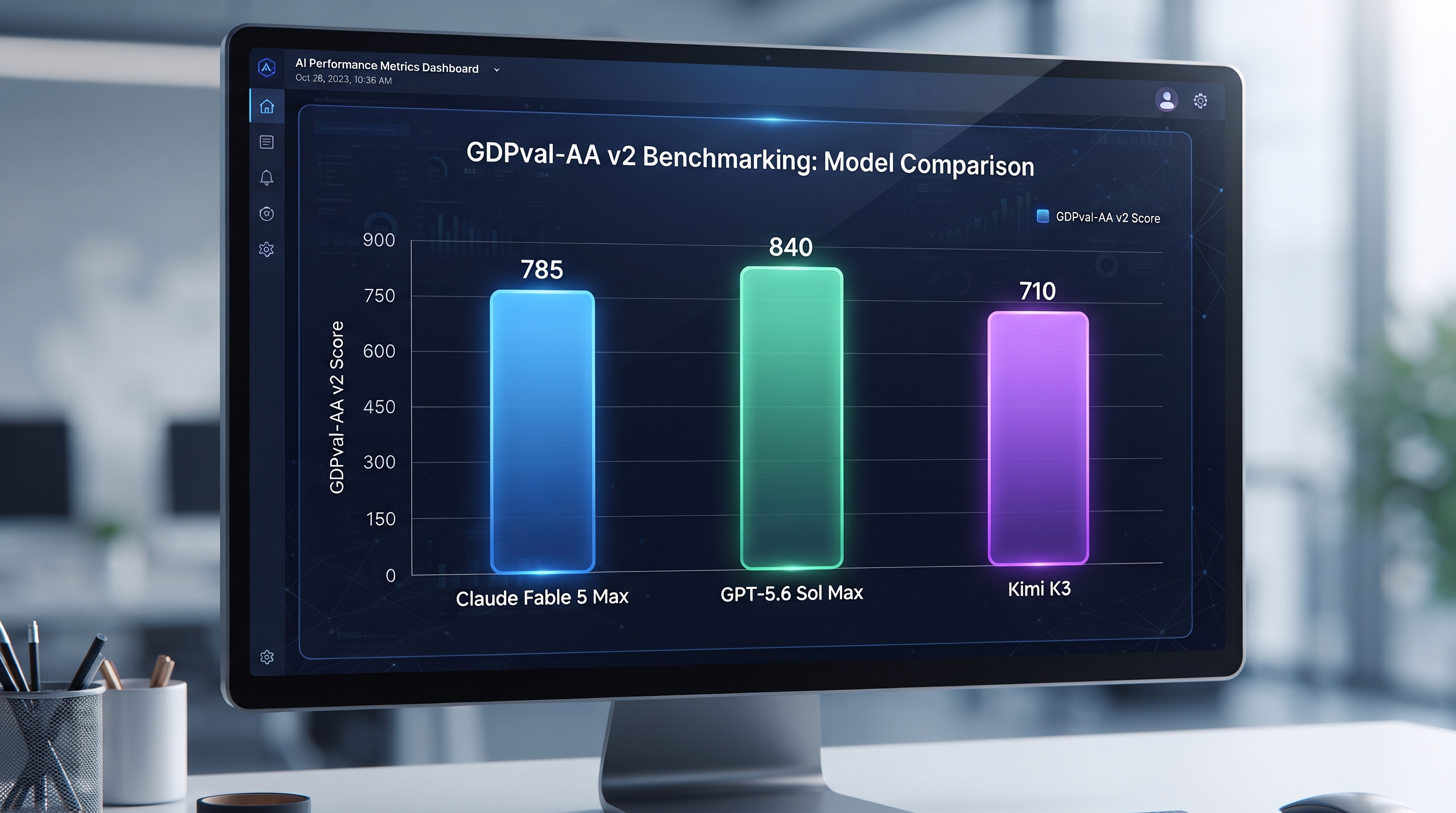
On the GDPval-AA v2 benchmark — Artificial Analysis's evaluation framework, which measures real-world task performance across 44 occupations and 9 major industries — Kimi K3 scored 1,687, placing it third overall behind Claude Fable 5 Max (1,815) and GPT-5.6 Sol Max (1,747.8), a pairing we compared in detail here. Moonshot's own claims are narrower and more specific: it says Kimi K3 beats both US systems on Program Bench and SWE Marathon, two coding-focused evaluations, while acknowledging it "still slightly lags behind" the proprietary US leaders on other measures — though the company frames that gap as "shrinking rapidly."
That claim lines up with independent estimates. Analysts now put America's overall AI lead at roughly six to nine months — down from what used to be measured in years.
Update (July 18, 2026): The Price-to-Performance Numbers
Beyond the single GDPval-AA v2 score above, Artificial Analysis also tracks per-model Intelligence, Coding, and Agentic indices alongside live API pricing — a more granular way to see exactly where Kimi K3 sits against the current US frontier, and at what cost:
| Model | Intelligence Index | Coding Index | Agentic Index | Input $/M | Output $/M |
|---|---|---|---|---|---|
| Kimi K3 | 57.1 | 76.2 | 50.1 | $3.00 | $15.00 |
| GPT-5.6 Sol | 58.9 | 77.4 | 54.0 | $5.00 | $30.00 |
| GPT-5.6 Terra | 55.0 | 76.7 | 47.4 | $2.50 | $15.00 |
| GPT-5.6 Luna | 51.2 | 71.4 | 45.6 | $1.00 | $6.00 |
| Claude Fable 5 | 59.9 | 76.5 | 52.8 | $10.00 | $50.00 |
| Claude Opus 4.8 | 55.7 | 74.3 | 47.2 | $5.00 | $25.00 |
| Claude Sonnet 5 | 53.4 | 71.5 | 46.7 | $2.00 | $10.00 |
On Coding Index specifically, Kimi K3 (76.2) lands almost exactly between GPT-5.6 Sol (77.4) and Claude Fable 5 (76.5) — ahead of both Claude Opus 4.8 and Sonnet 5 — while costing about 60% of GPT-5.6 Sol's price and roughly 30% of Claude Fable 5's. Its Agentic Index (50.1) is more middling, ahead of GPT-5.6's cheaper Terra and Luna tiers but behind Sol. The overall picture: for coding-heavy workloads specifically, Kimi K3's price-to-performance ratio is hard to beat among current frontier-adjacent models, even if it isn't the outright leader on any single index.
The Distillation Accusation Sitting Right Next to This Launch
The timing matters because of what Anthropic told US lawmakers less than a week earlier. On June 10, 2026, Anthropic sent a letter to Capitol Hill accusing Alibaba's Qwen lab of running what it called the largest known "distillation" attack on its Claude models to date — roughly 25,000 fraudulently created accounts conducting an estimated 28.8 million interactions with Claude between April 22 and June 5, 2026, specifically targeting its most commercially valuable capabilities: software engineering and agentic reasoning. Anthropic separately named Moonshot, DeepSeek, and MiniMax as labs it believes have used distillation to copy Claude's outputs.
Distillation itself isn't new or inherently illicit — training a smaller "student" model on a larger "teacher" model's outputs is a standard, widely-used compression technique. What Anthropic is describing is a specific abuse of it: mass, automated, fraudulent-account querying designed to extract a competitor's most valuable capabilities at scale. US officials estimate unauthorized distillation is costing American AI labs up to $6 billion a year, and Silicon Valley has been pushing the Trump administration for stronger export controls and legal penalties. Export controls have measurably slowed China's ability to train genuinely new frontier models — but they haven't stopped distilled, efficient versions like Kimi K3 from closing the gap anyway.
If this sounds familiar, it's the same underlying tension behind Claude Fable 5's brief export-control suspension in June — the same month this distillation campaign was allegedly running.
Xi Jinping's Pitch: A Coalition Against US AI Dominance
A day after Kimi K3 shipped, Xi Jinping opened the 2026 World AI Conference in Shanghai with a direct line aimed at Washington: "China will not let America be the monopoly of AI technology." His broader framing was that AI development "should not be a solo performance by any single country but rather a symphony of global cooperation," paired with pointed criticism of the US "overstretching" national security justifications to restrict AI access globally.
That wasn't just rhetoric. Xi announced expanded AI cooperation with ASEAN, the League of Arab States, and the African Union; access for 30 countries to a Chinese-built AI meteorological tool; and 5,000 AI training opportunities for developing countries over the next five years. Ahead of the conference, 29 countries — including Pakistan, Russia, and Kazakhstan — signed on to establish a new World Artificial Intelligence Cooperation Organization, headquartered in Shanghai.
The Market Is Already Pricing This In
Moonshot AI's valuation has moved from $4.3 billion in December 2024 to roughly $31.5 billion now, with annual recurring revenue reportedly exceeding $200 million in April and doubling within six weeks after that. The company is reorganizing its corporate structure ahead of a likely Hong Kong IPO. Analysts are explicitly drawing comparisons to the "DeepSeek moment" of early 2025, when a much cheaper Chinese model briefly rattled US tech stocks — Chinese open-source models keep winning on cost even when they don't win on every benchmark.
What This Actually Means
None of this means Kimi K3 is "better" than Claude Fable 5 or GPT-5.6 Sol — the GDPval-AA v2 numbers say plainly that it isn't, not yet. What it means is that a fully open-source model, free to self-host and fine-tune, is now within striking distance of the best closed US systems on a broad, real-world benchmark — and the price of getting there appears to include mass-scale extraction of the exact capabilities it's catching up on. For any business evaluating AI vendors right now, the practical takeaway isn't "switch to the Chinese model" — it's that the cost and capability gap between open and closed frontier models is closing fast enough that vendor lock-in decisions made today are worth revisiting within months, not years.
Sources
- GDPval-AA v2 Leaderboard — Artificial Analysis
- Model Intelligence, Coding & Agentic Indices, pricing — Artificial Analysis (accessed July 18, 2026)
- China's Moonshot AI releases Kimi K3 — VentureBeat
- Moonshot AI Releases Kimi K3: A 2.8 Trillion Parameter Open MoE Model — MarkTechPost
- Moonshot AI unveils world's largest open-source AI model — South China Morning Post
- China's AI Companies May Be 'Distilling' America's AI Models — Slashdot
- China's Xi calls for more global efforts to guide AI — SCMP
- Chinas KI-Start-up Moonshot AI setzt die USA mit seinem neuen Sprachmodell unter Druck — ad-hoc-news.de