NASA Put Google's Gemma 3 in Orbit. The Satellite Can Now Think for Itself.
The 4-Billion-Parameter Model That Left the Datacenter
The viability of orbital data centers hosting thousands of GPUs remains a hotly debated question. But it turns out you don't need a megawatt-scale facility in space to make LLMs useful there. You just need the right model.
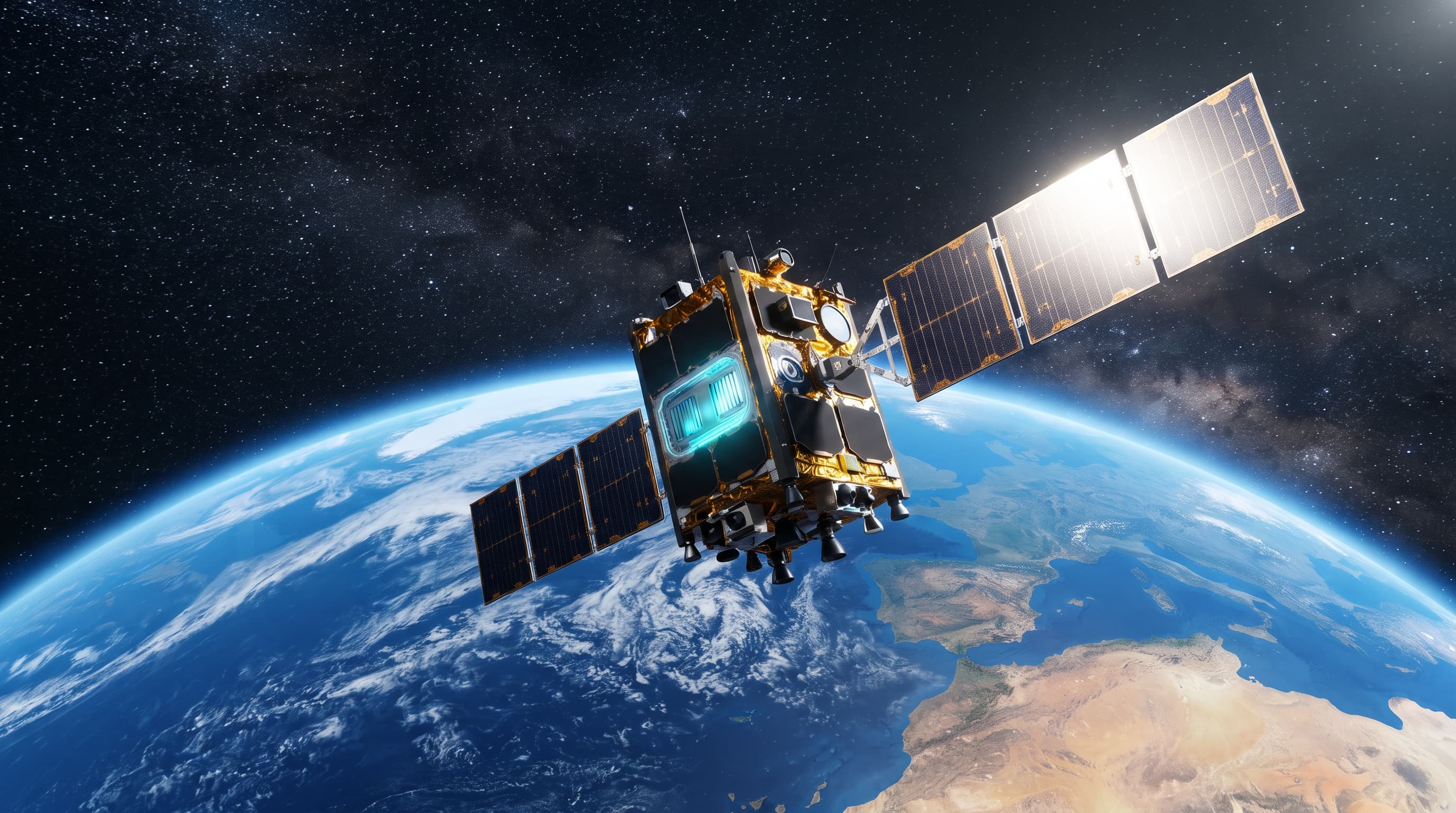
NASA's Jet Propulsion Laboratory recently sent Google's Gemma 3 to space aboard a YAM-9 satellite built by Loft Orbital, achieving the first in-orbit demonstration of a vision-language model analyzing imagery from a satellite's own sensor. The system, called NAVI-Orbital, uses Gemma 3 to examine images captured by the satellite's camera and produce plain-text descriptions — all without beaming raw data back to Earth.
The model running this analysis is not a custom spacecraft AI. It's the same base Gemma 3 that any developer can download today, quantized to 4-bit precision and running on an Nvidia Orin AGX module with just 8GB of memory. No fine-tuning, no special training. It just works.
Why "Semantic Compression" Changes the Economics of Space
Satellites face a fundamental bandwidth problem. They can only deliver data to ground stations at set intervals based on their orbit. A satellite in low Earth orbit might pass over a receiving station for a few minutes every 90 minutes. During a wildfire, a flood, or a military escalation, that delay is the difference between actionable intelligence and a historical record.
NAVI-Orbital works around this with what Loft Orbital general manager Antoine Lasserre calls "semantic compression." Instead of sending large amounts of raw image data, the satellite reports a text summary of noteworthy information.
"It doesn't matter if the link is slow, because you're downlinking dozens of kilobytes instead of dozens or hundreds of megabytes," Lasserre told IEEE Spectrum. "It lets you use your satellite in a tactical way, which until now was only in the realm of the imagination."
JPL engineer Delfa expanded on this with a real-world example: wildfire detection. Satellites today can detect hotspots, but getting the data to a human decision-maker requires passing through multiple ground stations, processing pipelines, and analyst queues. A satellite capable of analyzing an image in space and immediately reporting a plain-text warning removes that delay entirely.
88% Accuracy With Zero Training
In testing, NAVI-Orbital was 88% accurate when classifying images in a benchmark dataset of 7,960 images. The notable detail: Gemma 3 achieved this without being trained or fine-tuned on the dataset or its categories. It used the same base weights available to any developer through Google's AI platform.
Once in orbit, NASA performed two live capture tests. The satellite's camera acquired images — one over Argentina, another over a coastal region — and Gemma 3 generated text descriptions of each. The system also answered a set of scripted questions about the images: whether they contained commercial or residential areas, whether they showed natural features, and what the notable characteristics were.
The satellite runs on solar panels providing between 150 and 500 watts. The Nvidia Orin AGX, a module originally designed for robotics and edge AI, fits comfortably within that budget. "It conveys the message of how lightweight it is," Delfa said. "You can run it in a tiny, tiny computer."
From Image Analysis to Astronaut Companions
NAVI-Orbital is deliberately walled off from the satellite's flight software. It reads images, produces descriptions, and makes decisions about how images are analyzed — but it has no access to propulsion, orientation, or communications systems. This safety isolation is intentional: the team wants to prove the AI works reliably before connecting it to anything that could change the spacecraft's behavior.
The long-term vision goes well beyond uncrewed satellites. Delfa said NAVI was conceived with astronauts in mind.
"Robots aren't yet at the level of humans in terms of dexterity, so we conceived this idea of having NAVI as a companion to the astronaut, to allow interaction via natural language," Delfa explained. "This is the concept that we definitely want to push forward."
That vision is years away. But NAVI-Orbital has already demonstrated that two fundamental pieces — deploying a capable LLM in space and controlling it with natural language prompts — are possible today. The rest is engineering.
A Grounded Take
The 88% accuracy figure is impressive, but it comes from a curated benchmark, not from the chaotic, low-light, variable-angle conditions of real orbital operations. The two live captures were controlled tests. And the model is deliberately constrained to reading rather than acting — a sensible safety choice that also limits its practical utility in the short term.
Still, the demonstration matters because it challenges an implicit assumption: that AI in space requires orbital data centers. The Gemma 3 deployment shows that a 4-billion-parameter vision-language model, running on off-the-shelf edge hardware, can do useful work within the tight power and thermal budget of a small satellite. That changes the design space for every future Earth-observation mission — and, eventually, for every spacecraft that needs to decide what's worth telling home about.