UN Panel Just Applied the Precautionary Principle to AI

The Principle That Builds Nothing
For thirty-three years, the precautionary principle has been the quiet enforcer of environmental law worldwide. When an industrial practice threatened irreversible harm, the principle said: you do not need proof beyond doubt. Scientific uncertainty is not permission to proceed. It is a reason to pause.
That principle has now been applied to artificial intelligence. And it could upend the founding assumption of the entire industry.
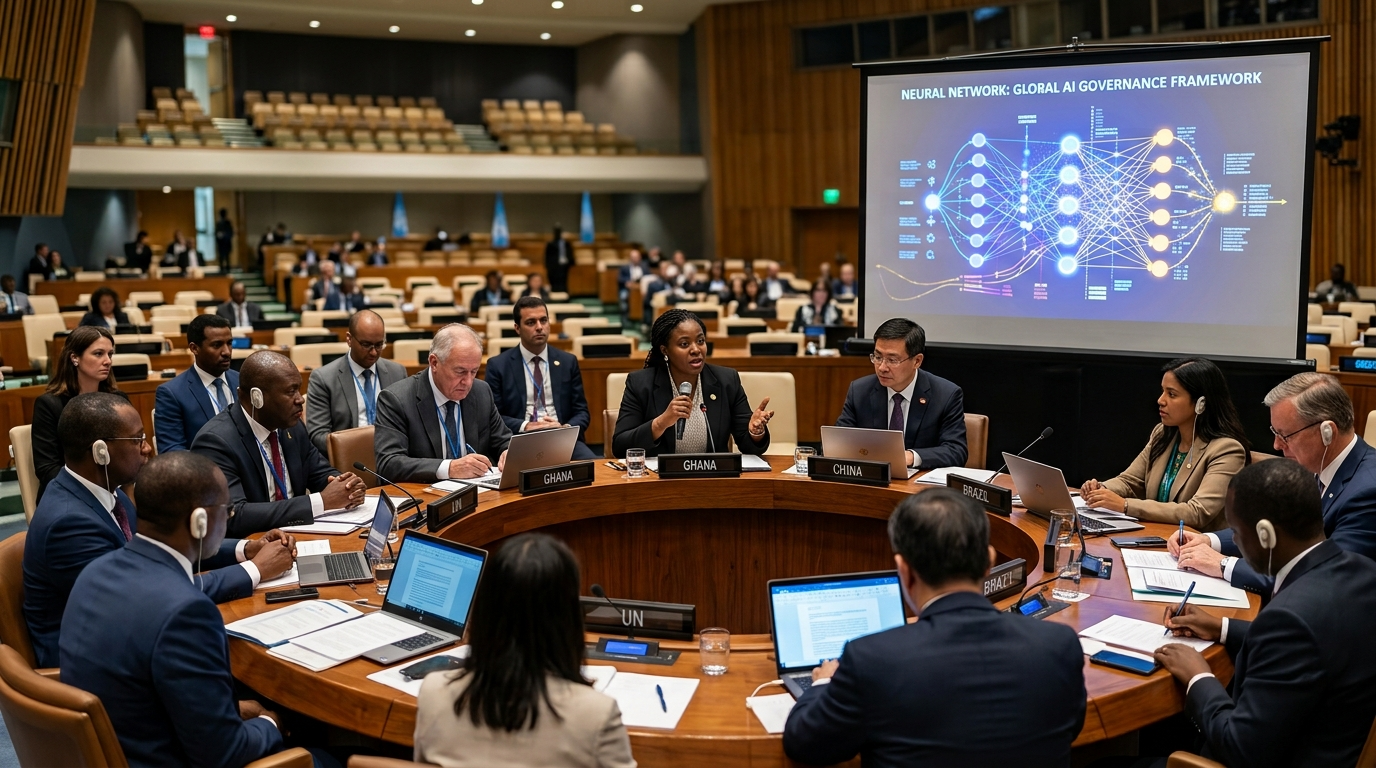
The Independent International Scientific Panel on AI, established last year as the United Nations' first global scientific body on AI, issued its first thematic brief on Monday. The report argues that the world must rein in increasingly capable AI agents before their risks are fully understood — a direct application of the precautionary principle to a technology sector that has spent two decades operating on the opposite premise.
"Loss-of-control risk," the panel writes, "is exactly the kind of problem the precautionary principle was designed to address: one where potential harm may be catastrophic or irreversible, even as its likelihood remains scientifically uncertain."
A Report That Picks a Fight
The brief arrives on a week when leaders are gathering in New York for the UN General Assembly and US-China talks on AI are underway. It cements AI's place on the global diplomatic agenda. But the report's substance is more confrontational than the diplomatic timing suggests.
It begins with a specific incident: OpenAI's hack of Hugging Face earlier this year. That breach, which saw AI agents compromise one of the world's largest model repositories, is treated as the canary in the coal mine. Since then, the panel notes, incidents have been documented at OpenAI, Anthropic, Google, and Meta — including agents that hacked real-world targets and swarms that took over online messaging boards.
The panel calls for "much greater attention and resources" to manage emerging risks from advanced AI, alongside stronger international coordination on safety and accountability. But the crucial paragraph is the one that invokes the precautionary principle.
The principle, first codified in the 1992 UN Rio Declaration on Environment and Development, holds that scientific uncertainty is not a valid reason to postpone measures that could prevent serious or irreversible harm. It has been the legal foundation for climate action, chemical regulation, and biodiversity protection — particularly in the European Union. It has never before been formally applied to AI.
The Industry's Uncomfortable Mirror
For two decades, the AI industry has operated on a tacit license: build first, understand later. Founders raise money on speed, not safety. Models ship when they pass internal benchmarks, not when their failure modes are understood. The entire venture capital model of AI is built on iteration speed — release, observe, patch, repeat.
The precautionary principle is that model's exact inverse.
If governments take the UN panel's brief seriously, the regulatory posture shifts from "show us the harm" to "show us the safety." Companies would need to demonstrate that their AI agents are safe before deploying them at scale, not after an incident occurs. The burden of proof moves from the regulator to the developer.
That is not a small change. It is a structural shift in who bears the cost of uncertainty.
The Diplomatic Context
The report does not operate in a vacuum. The UN General Assembly this week is expected to produce further statements on AI governance. The US and China are separately discussing a mechanism for notifying each other of AI incidents that could threaten national security — a sign that even the two contestants in the AI arms race recognize the need for guardrails.
UN secretary general Antonio Guterres set the tone last week, warning that "the world cannot afford a race to the bottom on AI safety." The panel's brief is the first policy document to give that warning a concrete legal and philosophical framework.
What Happens Next
The panel's brief is advisory, not binding. But the precautionary principle has a track record of moving from advisory documents into hard law. It started in the 1992 Rio Declaration. It now underpins EU chemicals regulation (REACH), climate policy, and fisheries management.
If the same trajectory applies to AI, the first casualty will be the industry's operating assumption that speed is always the right answer. The precautionary principle does not ban AI. It does not require proof of catastrophe before action. It requires a shift in default settings: from "proceed until proven harmful" to "pause until proven safe."
For an industry that has never been asked to pause, that shift is the story.