The Great AI Data Center Revolt
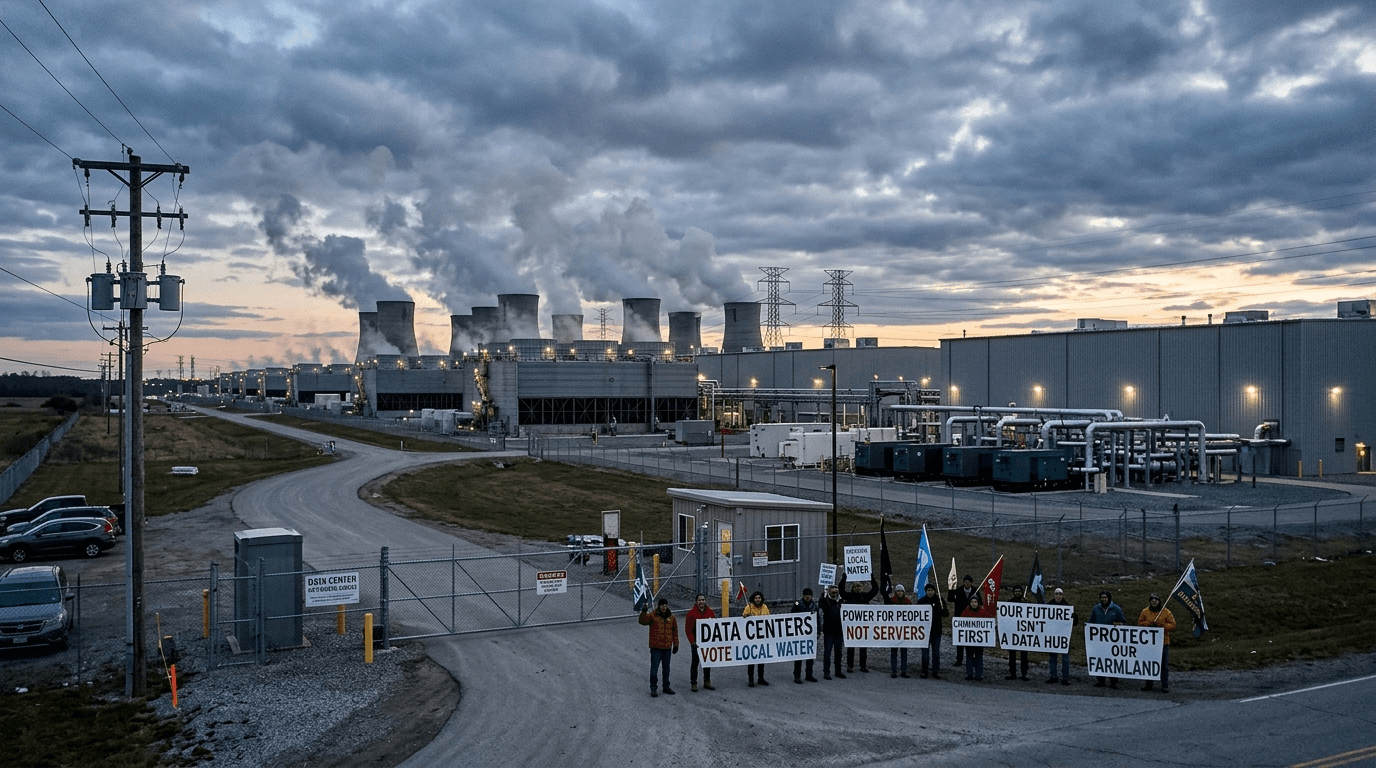
The AI industry spent the last two years telling investors that the only thing standing between them and infinite intelligence was more GPUs, more power, and more land.
Turns out they forgot to ask the people living on that land how they felt about it.
The answer, it turns out, is not great. A grassroots revolt against AI data centers is sweeping across America, uniting environmental activists in Bernie Sanders t-shirts with MAGA populists who think data centers are the "neurons of the Antichrist." In July alone, protestors staged 142 demonstrations across 42 states. Energy analyst Robert Bryce counts 275 rejected or blocked data center projects in 2026. Forbes pegs the value of stalled construction at $130 billion.
The industry has a politics problem — and it didn't see it coming.
The strange new coalition
What makes this backlash unusual isn't its size. It's who's in it.
In Troup County, Georgia, an environmental advocate named Gage Bailey runs a 4,000-person Facebook group fighting a Google data center. He's a Democrat with a degree in environmental science, can't find work in his field, and spends his days filing public records requests and teaching neighbors how to oppose utility easements. His co-moderator is running for local office as a Democrat on an anti-data-center platform.
A few counties over, a woman goes viral on right-wing media claiming Georgia Power is destroying her home to run transmission lines for a data center. Marjorie Taylor Greene tweeted that data centers are "Skynet." Steve Bannon's War Room podcast, under the guidance of anti-tech prophet Joe Allen, has been railing against AI infrastructure for months.
They're on the same side.
"Any enemy of my enemy is, at least, my temporary ally," one protestor told WIRED at a New Jersey demonstration.
70 percent say no
The data backs up the street-level fury. A Gallup poll from May found that 70 percent of Americans would somewhat or strongly oppose data center construction in their area. That's not a niche opinion — it's a supermajority.
The reasons vary by political tribe. On the left, it's about energy consumption, water usage, and the environmental cost of powering thousands of GPUs 24/7. On the right, it's about eminent domain, tech oligarch overreach, and a growing fear that AI will replace human jobs and identity.
Both sides keep arriving at the same conclusion: we don't want this in our backyard.
The movement's reach into the 2026 midterm elections is already visible. NBC News reported in late July that candidates in multiple states are running on anti-data-center platforms. In New York, the state passed the first statewide data center moratorium. At least a dozen other states have introduced similar measures.
The bottleneck no one planned for
When the AI buildout began in earnest in 2024-2025, the narrative was straightforward: build more data centers, train bigger models, win the future. The Trump administration rolled back environmental regulations to accelerate permitting. Elon Musk reportedly trucked unpermitted gas turbines to his Memphis xAI campus. The Washington Post estimated a single ChatGPT search consumed the equivalent of a bottle of water.
People started paying attention to their electric bills.
Then the backlash began. In Indianapolis, a pro-data-center council member was attacked. In northern Virginia's Data Center Alley — the densest concentration of data centers on the planet — residents report a constant low hum from cooling systems that never stops. The buildings are so massive that they're visible from miles away, looming over the manicured lawns of wealthy suburbs.
"This is like watching a fetus grow and seeing the brain and neurons forming," Joe Allen, the Bannon-aligned author and anti-tech crusader, told a packed audience at Georgia Tech. "Data centers, if you think about them as neurons of the Antichrist — that's what we're witnessing."
Allen is one half of a fascinating political story. His organization, Humans First, was founded with bipartisan backing from the Center for AI Safety. It split along partisan lines in March 2026 — the conservative wing kept the name, the progressives went their own way — but the underlying anger it channels keeps growing.
The consent problem
For the tech industry, the math is suddenly brutal. Building a hyperscale data center takes 3-5 years from planning to operation. That timeline assumes communities say yes. What happens when they say no, or when the permitting process becomes a years-long legal battle?
The industry is waking up to the problem. In a statement to WIRED, Google said it was focused on "direct, collaborative engagement with local schools, nonprofits, and civic organizations." But Bailey, whose Facebook group grew from nothing to 4,000 members in months, has a harsher take after Google went silent following a single meeting.
"I don't see a scenario, at least in the immediate future, in which we're going to be able to trust these tech companies," he said.
That's the real headline. Not that data centers are loud or ugly or thirsty — though they are all three. It's that the people whose consent the industry needs have decided they don't trust the people asking.
The Unabomber's manifesto, quoted by figures across the political spectrum, has a strange afterlife in this movement. Ted Kaczynski wrote that technology would erode human freedom and that resistance was necessary. Most people citing him today would stop well short of his methods. But the sentiment — that technology is being imposed on communities without their consent — has found an audience that spans the political map.
What happens next
The industry will adapt. Data center operators are already promising carbon-free energy, water-free cooling, and community benefit agreements. Some projects will get built. Many already have.
But the genie is out of the bottle. Communities have discovered that they can say no. They've built networks, filed FOIA requests, and learned the arcane rules of zoning boards and utility commissions. That knowledge doesn't disappear when a developer cuts a check.
The $130 billion question is whether the AI industry can learn to build with community consent rather than around it. The bottleneck has shifted from GPU supply and power capacity to something harder to fix: trust.
Sources
- How Data Centers Broke American Politics — WIRED
- Data centers have a politics problem — and industry knows it — Politico
- How the booming backlash to AI data centers is shaping the midterm election — NBC News
- Community Backlash to AI Data Centers Is Growing Across the U.S. — TIME
- 2026 Data Center Rejections Hit 275 — Robert Bryce
- $130 Billion In AI Data Centers Stalled — Forbes
- Americans Oppose AI Data Centers in Their Area — Gallup