US Bans Chinese Humanoid Robots Over AI Security Fears
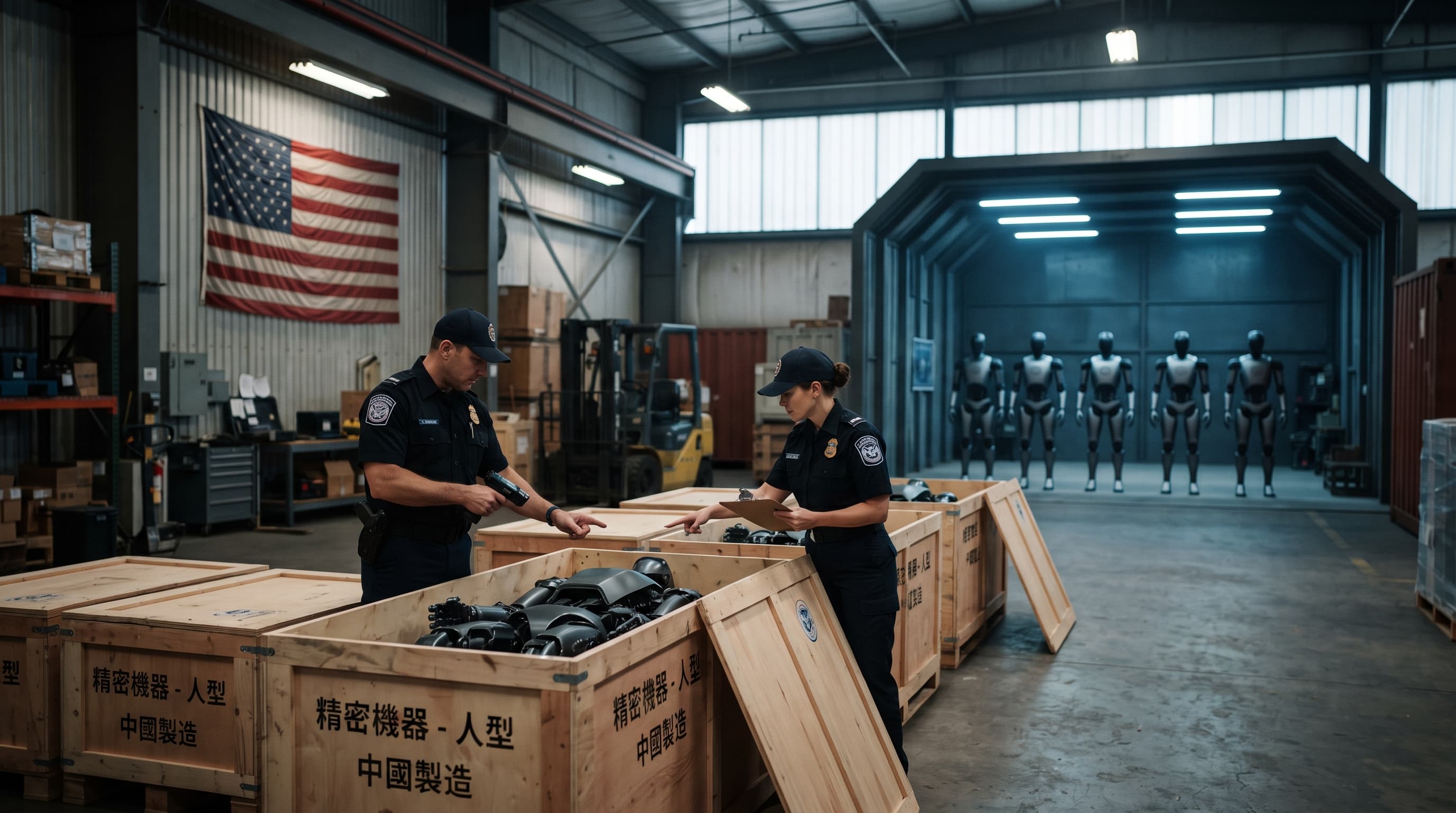
The world's most powerful military just banned a robot shaped like a person.
Not because it carries a weapon. Not because it can run faster than a soldier. But because when you give a humanoid machine cameras, sensors, and AI, and then plug it into a country's power grid, data center, or factory floor. The line between a factory tool and a national security liability gets very, very thin.
On July 28, the Trump administration banned imports of new Chinese humanoid robots and power inverters, citing what officials called "unacceptable national security risks." The FCC and Commerce Department jointly enforced the measure, targeting what the government described as foreign-made robots that "resemble humans in form and could be used for surveillance, espionage, or critical infrastructure disruption."
The ban is the first major US policy to treat human-shaped machines as a distinct security category, separate from general industrial robots or consumer electronics. It covers an estimated 85% of global humanoid robot production. China is the dominant manufacturer.
The robots that look like us
Chinese companies like Unitree, Fourier Intelligence, XPENG Robotics, and Xiaomi have aggressively expanded humanoid robot production over the past two years. These are not the clunky, cable-tethered prototypes of a decade ago. Modern Chinese humanoids run on AI models with real-time navigation, object recognition, speech interaction, and remote-control capabilities. Unitree's H1 can walk, run, jump, and carry payloads through uneven terrain. Fourier's GR-2 has 53 degrees of freedom and is marketed for both industrial and home deployment.
The US argument is straightforward: a robot with that level of sensing and mobility, if manufactured under Beijing's influence, could be repurposed for surveillance or data exfiltration once inside a sensitive US facility. The FCC specifically flagged the risk of Chinese-made robots being "remotely accessed or repurposed after deployment, a concern that mirrors earlier warnings about Huawei networking equipment.
Reuters reported the ban is also tied to protecting the US AI buildout, the massive data center and energy infrastructure push driven by the generative AI boom. Power inverters, the other banned category, are critical components in data center power systems and renewable energy grids, both essential to meeting AI's growing energy demands.
China fires back
China's foreign ministry did not wait to respond. Spokesperson Lin Jian called the ban a "serious violation of market economy principles" and said Beijing would take "necessary measures to safeguard the legitimate rights and interests of Chinese companies." The Global Times, a state-affiliated tabloid, went further, framing the ban as proof that Washington fears Chinese technological competition at every level: chips, software, and now hardware shaped in our image.
The timing is notable. The ban lands ahead of a planned Trump-Xi meeting, adding a layer of diplomatic tension to what is already the most aggressive period of US-China tech decoupling since the semiconductor export controls of 2023-2024.
A new kind of tech war
This ban represents something genuinely new in the US-China technology conflict. Previous restrictions focused on semiconductors (Huawei, SMIC), AI chips (Nvidia A100/H100 export controls), and software (TikTok). Humanoid robots are the first category where the US has banned a class of physical machines based on the combination of their form factor and their country of origin, not just their components or their software.
It sets a precedent: from now on, a robot that looks like a person is a potential national security threat before it's a piece of hardware. That distinction will shape how robotics companies, data center operators, and military contractors approach procurement for years to come.
Some analysts argue the ban will accelerate domestic humanoid robot development in the US, a market currently dominated by companies like Tesla (Optimus), Agility Robotics (Digit), and Apptronik (Apollo). Others warn it could fragment the global robotics supply chain, making it harder for anyone to build affordable humanoid robots at scale.
A grounded take
The national security concern is not paranoid. A robot with onboard cameras, microphones, and AI navigation that's physically inside a data center or military base clearly presents a surveillance risk if its firmware is controlled by a foreign government. The FCC is right to flag this.
But the ban also arrives at a moment when humanoid robot technology is still nascent. Most units in operation today are testbeds and prototypes, not deployed infrastructure. Banning an entire category of imports at this stage is a preemptive strike, not a response to a documented attack. That makes it a policy bet: "We'll assume the worst now and sort out the details later."
Whether that bet pays off depends on whether US and allied manufacturers can fill the gap, and whether the diplomatic cost of another decoupling front is worth the security gain.
Sources
- BBC: Trump administration bans new Chinese humanoid robots
- Reuters: Trump administration bans new Chinese humanoid robots, to protect US AI buildout
- The Guardian: US bans humanoid robots from China, citing 'unacceptable risks'
- CNN: China's humanoid robots have been taking over the global market. Now the US is banning them
- Axios: Trump administration bans Chinese hardware with eye on AI race
- South China Morning Post: US bans new Chinese robots, power inverters in latest tech crackdown
- France 24: US government bans humanoid robots manufactured abroad