29 Countries Just Joined China's AI Breakaway — Not One Western Nation Got a Seat
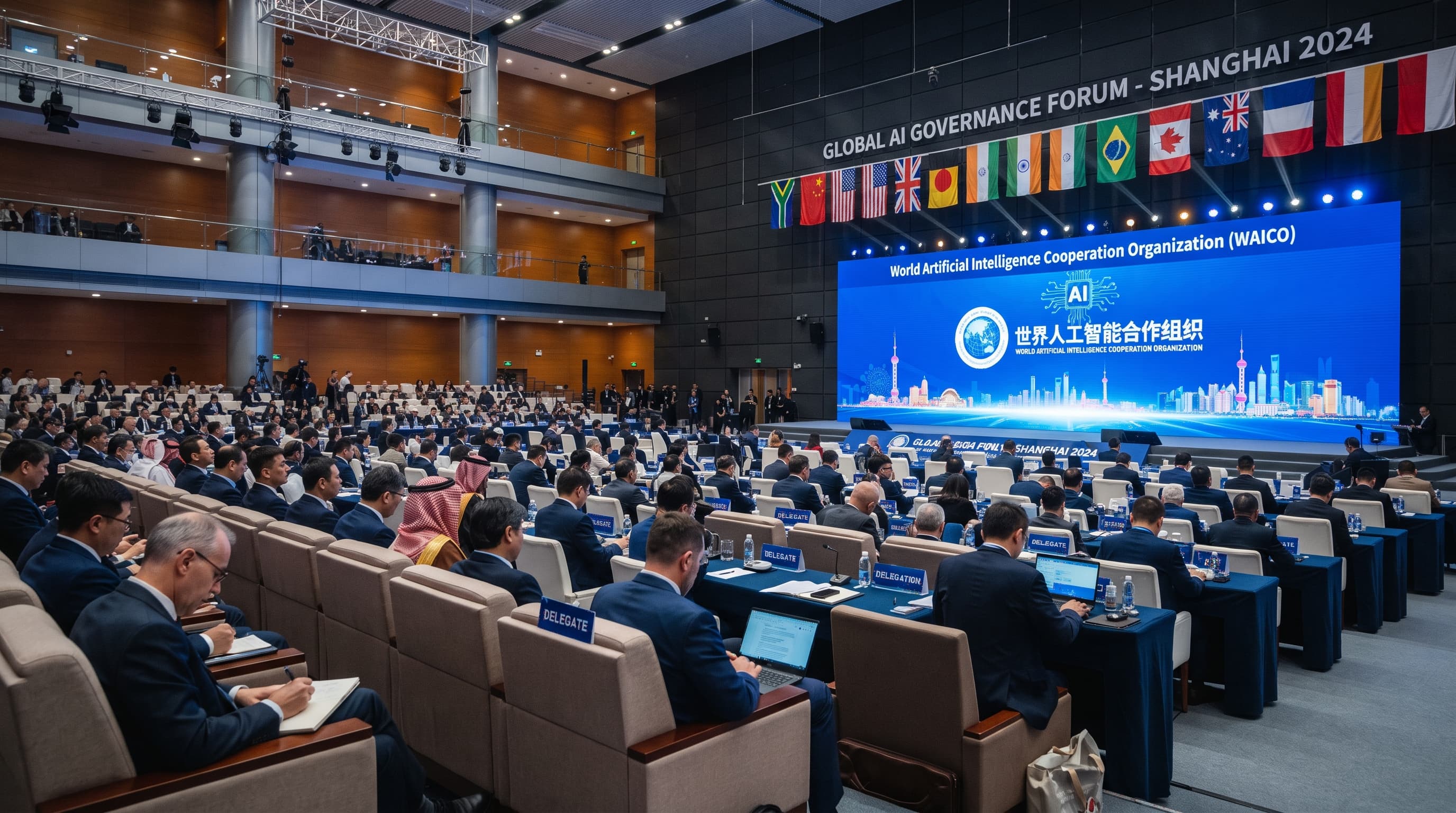
On the same day Moonshot AI released Kimi K3 — the largest open-source model ever — Xi Jinping opened the World AI Conference in Shanghai with a message that was equal parts invitation and challenge. "China will not let America be the monopoly of AI technology," he told the assembled delegates. Twenty-four hours later, 29 countries had formally signed on to prove him right.
The World Artificial Intelligence Cooperation Organization — WIKO, headquartered in Shanghai — is China's clearest bid yet to build a parallel AI governance structure outside Western influence. First proposed in 2025, it went from concept to signed treaty in roughly fourteen months. Russia, Brazil, South Africa, Pakistan, and Indonesia are among the founding members confirmed publicly; the full list of 29 signatories draws from ASEAN, the African Union, the Arab League, and Central Asia. No European Union member state, the United States, the United Kingdom, Canada, Japan, South Korea, Australia, or New Zealand signed on.
This is not a symbolic gesture. It represents the most concrete institutional split in AI governance since the technology became a geopolitical priority.
What WIKO actually is
WIKO is structured as a membership-based international organization with its headquarters in Shanghai. The Decoer, which first reported the final details of the agreement on July 18, describes it as "Xi's clearest play yet for a parallel AI order." The organization was first proposed at the 2025 World AI Conference, and the 2026 conference served as the formal signing ceremony.
The structure mirrors other China-led multilateral initiatives in digital infrastructure and technology — the Digital Silk Road, the Belt and Road Initiative's tech components, and the Global AI Governance Initiative Beijing proposed in 2023. What makes WIKO different is its singular focus: AI governance, model certification, training standards, and — implicitly — a framework for AI development that competes directly with the approaches emerging from Brussels, London, and Washington.
The numbers Xi put on the table
Xi's keynote on July 17 included specific commitments:
- 5,000 AI training slots for Global South countries over the next five years
- Access to a Chinese AI weather prediction tool for 30 countries
- Expanded AI cooperation partnerships with ASEAN, the Arab League, and the African Union
- A stated valuation of China's "Smart Economy" — spanning AI, digital infrastructure, and related technologies — at over 1 trillion renminbi ($140 billion)
The training slots are particularly strategic. By training government officials, researchers, and regulators from developing countries, China creates a generation of AI professionals familiar with Chinese tools, platforms, and governance norms — a classic standards-play that mirrors how Huawei and ZTE built telecommunications influence in the Global South over the past two decades.
Why no Western countries joined
This was by design. The Decoder reports that Xi specifically pushed back against "overly broad national security justifications" in AI policy during his speech — a clear reference to US export controls on AI chips and technology that have restricted China's access to advanced semiconductors from NVIDIA, AMD, and TSMC. He also called for AI to remain under human control, a framing that contrasts with Western concerns about AI safety (existential risk, alignment) with a more state-centered approach (national control, sovereignty).
No Western country was invited to sign, and no Western country would have accepted under current geopolitical conditions. The EU is in the middle of implementing its AI Act. The US has its own AI Executive Order framework. The UK hosted the Bletchley Park Summit in 2023 and the Seoul Summit followed in 2024. WIKO is explicitly an alternative governance track for nations that feel excluded from those conversations.
The AI conference that tied everything together
The 2026 World AI Conference wasn't just about WIKO. The same week saw Moonshot AI release Kimi K3, a 2.8-trillion-parameter open-source model that scores third on the GDPval-AA v2 benchmark behind only Claude Fable 5 and GPT-5.6 Sol. Anthropic simultaneously accused Chinese labs of running a massive model distillation campaign. The three stories together form a coherent picture: China now has competitive open-source models, the hardware restrictions meant to slow them down, and a governance organization to legitimize both.

What a split AI governance regime means
For companies and developers operating globally, a split governance regime creates genuine operational complexity. If WIKO develops its own model certification standards, safety reporting requirements, and data localization rules, a company shipping an AI product to both a WIKO member and an EU member state may need to comply with two different regulatory frameworks. Export controls — already multilayered between US CHIPS Act restrictions, EU dual-use regulations, and allied coordination — could face a parallel system under WIKO that recognizes Chinese-certified compliance instead.
The practical timeline matters here. WIKO has a founding document and signatories, but it does not yet have operational regulation, enforcement mechanisms, or technical standards. Those will take months to years to develop. The next twelve months — as WIKO builds its institutional capacity and Western regulators watch — will determine whether this becomes a genuine regulatory split or remains a diplomatic statement.
A grounded take on where this leads
There is a temptation to frame WIKO as either a brilliant strategic move or an empty diplomatic gesture. It is neither — at least not yet. What it is is the first institutional infrastructure for a world in which the US and China operate fundamentally different AI governance systems, and developing nations are being asked to choose which framework to align with. That choice will be heavily influenced by which side offers more tangible benefits: computing access, training, model availability, or market access.
The countries that signed WIKO are the same countries that have been most vocal about feeling left out of Western-led AI governance. The Bletchley Park Summit had 28 countries, but only a handful from the Global South. The EU AI Act was written by and for EU member states. WIKO offers those nations a seat at a table — even if the table is in Shanghai and the rules are written in Beijing. Whether that seat comes with real influence or just a flag on a podium will define whether WIKO matters in five years.
Sources
- China's new World Artificial Intelligence Cooperation Organization — THE DECODER
- Kimi K3: China's Moonshot AI Just Released the World's Largest Open-Source Model — AIgentic.media
- EU Compels Google to Share Android and Search Data With Rival AI Assistants — Unite.AI
- Xi Jinping opens World AI Conference 2026 — South China Morning Post
- Digital Silk Road — Belt and Road Initiative tech components overview