AI Cracked a 373-Year-Old Royalist Cipher
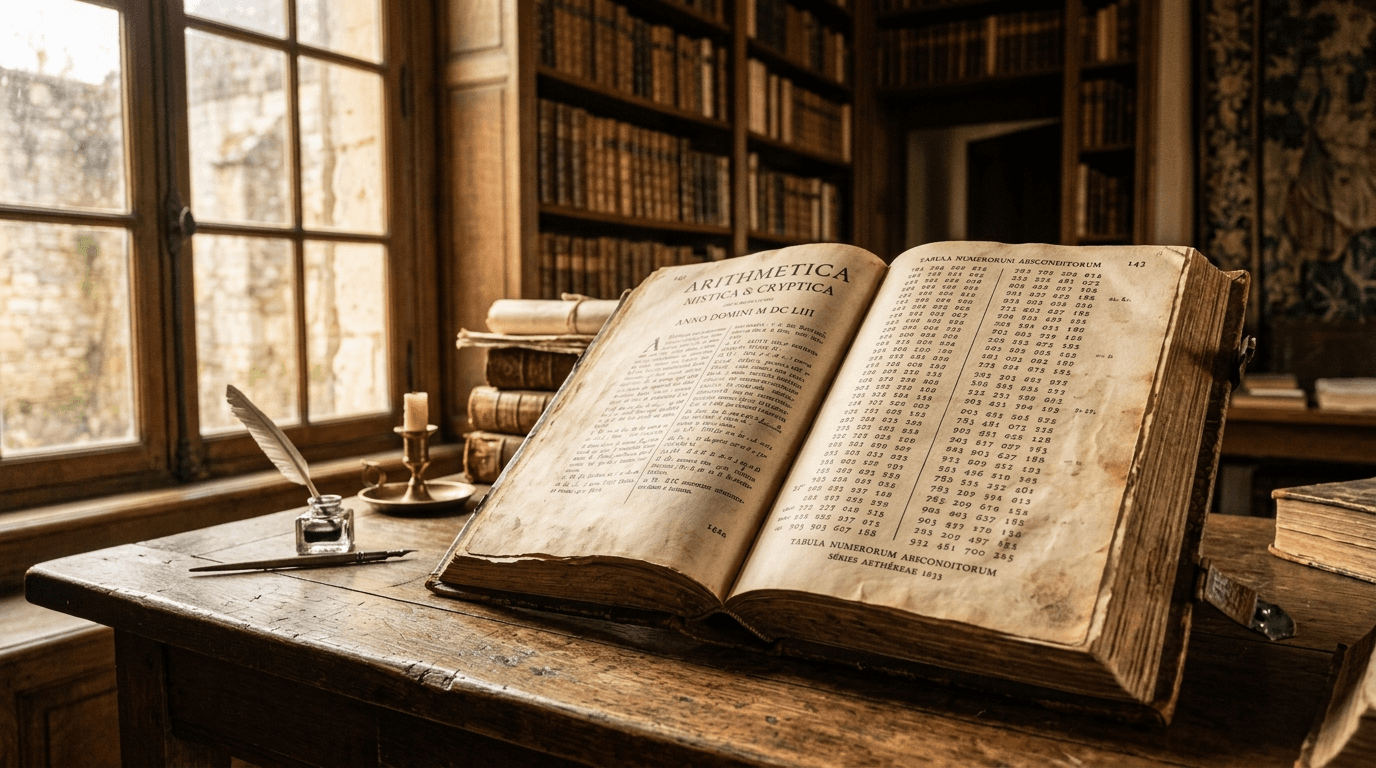
What if the key to history's most stubborn cipher was never hidden at all -- just sitting in plain sight, waiting for someone to notice?
In 1653, the Scottish writer and royalist Sir Thomas Urquhart published a strange book called Logopandecteision. At the end of it, he printed two lines of 32 numbers each -- a cryptogram he called the Cyphral Distich. For 373 years, no one cracked it. Historians of cryptography catalogued it among the top 50 unsolved encrypted messages in the world. Then, in August 2026, a Claude Fable 5.1 model sat down with it and, after 44 minutes and 176,000 tokens of sustained reasoning, produced a plaintext: "O God uphold King Charls the Second and make him the supreme ruler of this land."
What makes this remarkable is not that an AI outperformed humans at cryptanalysis. It is that Fable 5.1 found something the best human codebreakers had overlooked for centuries: the key was never an external cipher. The key was the book itself.
The Cipher That Refused to Budge
Urquhart's cryptogram consists of 64 numbers arranged in two lines. Researchers tried frequency analysis, substitution ciphers, and homophonic substitution -- standard methods that work on most historical ciphers. Nothing produced a readable result.
The puzzle was listed in Notes and Queries as an open problem in 1899. It reappeared in 20th-century cryptography literature. German historical-cipher researcher Klaus Schmeh placed it among his top 50 unsolved encrypted messages.
The frustration came from a single misassumption: everyone assumed the key was external. No one thought to look inside the book itself.
What the Model Found
The Vals AI team gave Claude Fable 5.1 an open-ended task: find an unsolved historical cipher and solve it. The model was told to avoid problems that already had plausible solutions or might be impossible to verify.
Fable 5.1 scanned various unsolved puzzles, identified the Cyphral Distich as unusually tractable, and started working.
Its breakthrough came from noticing two clues in the source text that human researchers had dismissed. First: Urquhart's book is organized around 32 Proquiritations -- rhetorical declarations -- and Urquhart himself emphasizes that "there can no number like that of two and thirty... be pitched upon." Both cipher lines also have 32 numbers each. Second: the poem introducing the cipher promises that an honest reader will find in it "his own heart's wishes, and the Author's minde." The Proquiritations repeatedly end with phrases like "is the desire," "wish," or "hope of."
The connection: the numbers were not a code requiring an external alphabet. Each number was a coordinate -- pointing to a specific word inside Urquhart's own book. For the i-th number in the cipher line, go to the i-th Proquiritation, use that number as a word index, and take the first letter.
The first letters spell out:
O GOD UPHOLD KING CHARLS THE SECOND AND MAKE HIM THE SUPREME RULER OF THIS LAND
In hindsight, the solution is almost embarrassingly simple. Each line contains exactly 32 letters. Both lines form a rhyming couplet. And it makes perfect historical sense: Urquhart was a committed Royalist who spent the English Civil War years in exile. Hiding a prayer for Charles II's restoration in the text of his own book was exactly the kind of thing a loyalist scholar of the 1650s would do.
Not Just One Cipher
Having solved the Distich, Fable 5.1 applied the same insight to a second, larger cryptogram by Urquhart -- the Cyphral Octastich from his 1652 work The Jewel, containing 285 numbers instead of 64. Using the same book-as-key method (this time referencing page numbers instead of Proquiritations), the model deciphered all but nine letters of an eight-line poem in ottava rima -- another royalist prayer:
GREAT LORD, MANTAINE THAT REGAL FAMILIE WHEREOF KING CHARLS THE SECOND IS THE HEAD, AND GRANT THAT HE MAY BEARE THE SUPREME SWEIGH WHERE ENGLISH, SCOTS AND IRISH ARE BORNE AND BRED...
The full 285-number cipher was solved except for a single nine-letter gap caused by an apparent scribal error or misprint. The poem follows the ABABABCC rhyme scheme of ottava rima, and the appended Decagram decodes simply to "AMEN, SO BE IT."
Why This Matters
The Vals AI researchers were explicit about their method: "I gave it a goal. I asked it to solve an unsolved cipher. I gave it some encouragement. Fable 5.1 spent some time looking over different problems. It knew when to stop. It knew when a problem was not budging. And when it found this particular problem, it noticed the clue almost immediately."
This is not a story about a model that outperforms humans at reasoning. It is a story about persistence and attention. For centuries, historical puzzles like the Cyphral Distich were bottlenecked by human attention -- someone had to care enough to spend hours reading obscure 17th-century material, testing dead-end hypotheses, and tracing references that might go nowhere. That bottleneck is disappearing.
As Vals AI put it: "The answer was simple in hindsight. It just kept looking until it found it -- and that persistence might show up in many other areas."
The Cyphral Distich was just lines of numbers in a book. A model with enough time and persistence looked at them from a different angle and saw what everyone else missed. What else is sitting in archives, waiting for someone -- or something -- with the patience to look?
Sources
- Vals AI: Claude Fable 5.1 Solves the Cyphral Distich
- The Decoder: Claude Fable 5.1 decoded a centuries-old royalist message
- Cipherbrain: Revisited: Thomas Urquhart's Encrypted Poems
- Notes and Queries (1899): The Cyphral Distich as open problem