China Opens a New Front in the AI Chip War
The Moat Nobody Talked About
For years, the AI hardware conversation has been about one thing: raw compute. Who has the most teraflops, the widest memory bandwidth, the fastest interconnects. Nvidia won that race by a wide margin, and the narrative settled into a comfortable groove. To compete with Nvidia, you need a better chip.
What that narrative misses is that Nvidia's real advantage was never just the chip. It was CUDA.
CUDA is Nvidia's proprietary software ecosystem: the programming model, the libraries, the compiler toolchain, the decades of developer tutorials and forum answers and production deployments that make it the default environment for AI development. A faster chip is useless if nobody can program it, and CUDA makes programming Nvidia hardware the path of least resistance. Every AI company, every research lab, every cloud provider optimized for CUDA because CUDA was the only game in town.
DeepSeek and Huawei just called that assumption into question.
TileLang: CUDA's First Credible Alternative
On September 30, DeepSeek announced through Chinese social media platform WeChat that it had partnered with Huawei to build a complete open-source programming toolchain for Huawei's Ascend AI chips. The centerpiece is TileLang.
TileLang is a high-level programming language designed specifically for AI accelerator development. DeepSeek describes it as a simpler programming model that abstracts away the low-level complexity of chip-specific instructions. "TileLang was created precisely to meet this need," DeepSeek said, explaining that the need is a programming model that works across different AI accelerator architectures without requiring developers to learn chip-specific assembly.
The release includes more than just TileLang. DeepSeek also published Ascend-optimized versions of five core software components used in its own V4-series model training: DeepGEMM for matrix multiplication, DeepEP for inter-device communication, TileKernels for vector compute, FlashMLA for sparse attention mechanisms, and DeepSelect for data filtering. Every TileLang operator used in DeepSeek's V4 training now has a high-performance Ascend implementation.
Critically, the same Python interfaces support both Nvidia GPUs and Huawei NPUs. The backend is selected automatically based on the hardware. A developer writing code in TileLang can run it on an Nvidia H100 cluster today and an Ascend NPU cluster tomorrow without rewriting a single line. That kind of cross-platform compatibility is what CUDA never offered. And what developers who want flexibility have been asking for.
The 128-Chip Supernode
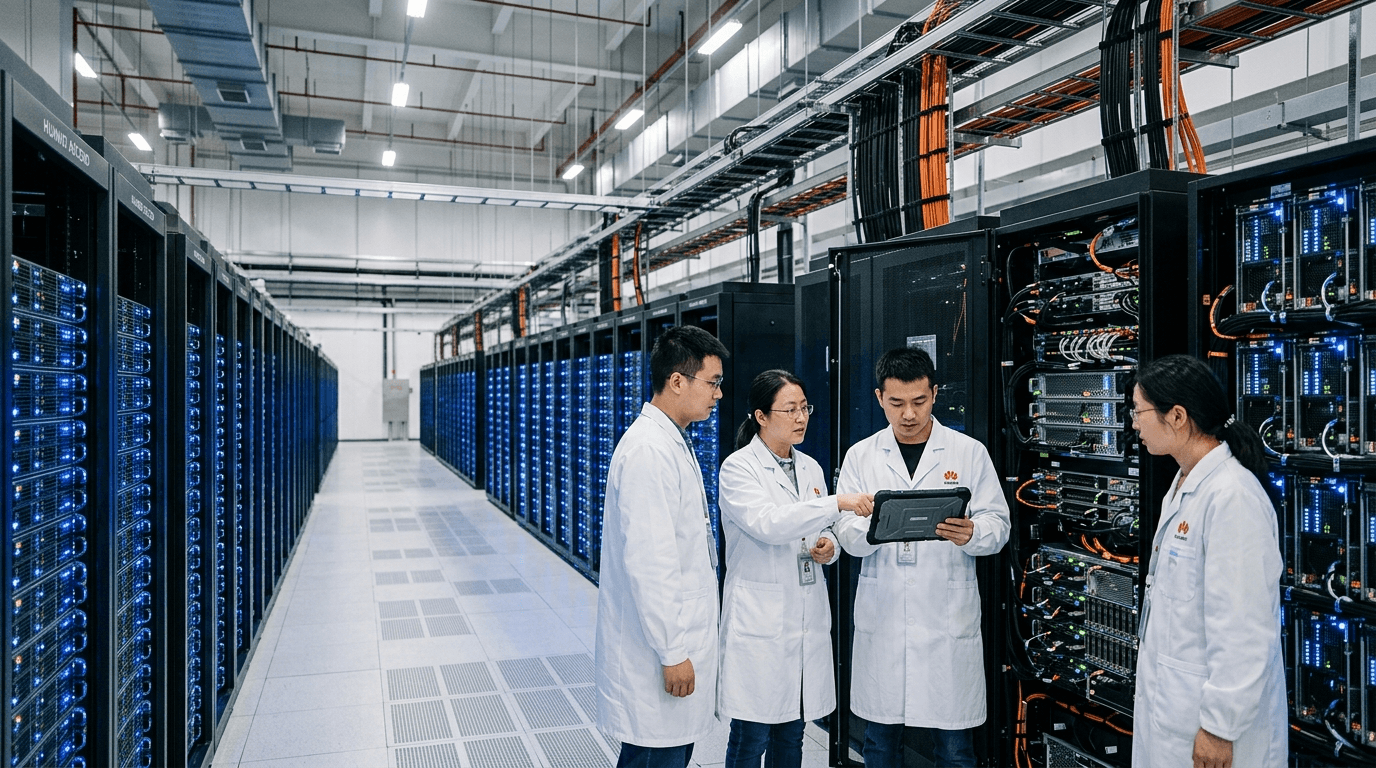
The hardware target for this toolchain is the Ascend 950 supernode, a system that connects 128 Huawei Ascend processors into a single computing cluster optimized for large-scale AI workloads. DeepSeek and Huawei jointly optimized the computing and communication layers for this specific configuration.
The 128-chip number is strategically important. Nvidia's advantage has never been just individual GPU speed. It is the NVLink interconnect that lets GPUs talk to each other at speeds competitors cannot match. When training a large model across hundreds or thousands of processors, the communication bottleneck between chips often matters more than the raw speed of any single chip. By building their own interconnect fabric around the Ascend 950 and optimizing DeepSeek's software stack specifically for it, DeepSeek and Huawei are attacking Nvidia at its strongest point: the ability to scale across chips efficiently.
What This Means for Nvidia
Nvidia's response will matter. The company has known for years that China needed domestic chip alternatives. US export controls saw to that. But the threat has always been framed as a hardware problem: can Chinese chipmakers build processors that match Nvidia's specs?
TileLang shifts the question. Even if Huawei's Ascend chips never match Nvidia's raw performance per chip, a software ecosystem that lets developers target both Nvidia and non-Nvidia hardware with the same code weakens CUDA's lock-in effect. A Chinese AI lab evaluating whether to build on Ascend or Nvidia clusters no longer faces a binary choice. The software layer now supports both.
The timing is also telling. Huawei recently introduced its next-generation AI processors and expects wider deployment for model training in 2027. TileLang gives those chips a ready-made software foundation, accelerating adoption at exactly the moment Chinese AI demand is exploding.
The Skeptical Take
TileLang is not a CUDA killer. Not yet.
Nvidia's ecosystem advantage is decades deep: documentation, debugging tools, optimized libraries for every conceivable workload, and a developer population measured in millions. TileLang's documentation launched on WeChat. Its developer community is zero. And while cross-platform compatibility is technically valuable, most AI teams optimize for a single hardware target anyway. They want the fastest possible implementation, not the most portable one.
What TileLang does do is create optionality. For Chinese AI labs facing supply uncertainty around Nvidia hardware, TileLang reduces the switching cost to domestic chips. For Huawei, it provides a developer on-ramp that didn't exist before. And for the broader industry, it demonstrates that the software layer around AI hardware is no longer a permanent monopoly. It can be challenged, one open-source repository at a time.
The CUDA moat is not gone. But it has a crack now, and both sides know it.
Sources
- DeepSeek, Huawei Build 128-Chip AI System to Challenge Nvidia: Analytics Insight
- DeepSeek and Huawei Target a Key Source of Nvidia's A.I. Dominance: The New York Times (via Google News)
- DeepSeek partners with Huawei to develop chip programming tools, reducing reliance on Nvidia: Reuters (via Google News)
- DeepSeek opens tools to help Huawei chips supplant Nvidia in AI: South China Morning Post (via Google News)
- DeepSeek's new Huawei partnership could reshape China's AI chip race with Nvidia: WIONews (via Google News)
- DeepSeek unveils Huawei AI chip software to challenge Nvidia: Seeking Alpha (via Google News)