Nvidia Backstops $105B in OpenAI's Ohio Data Center, Says Land and Power Are the New GPU
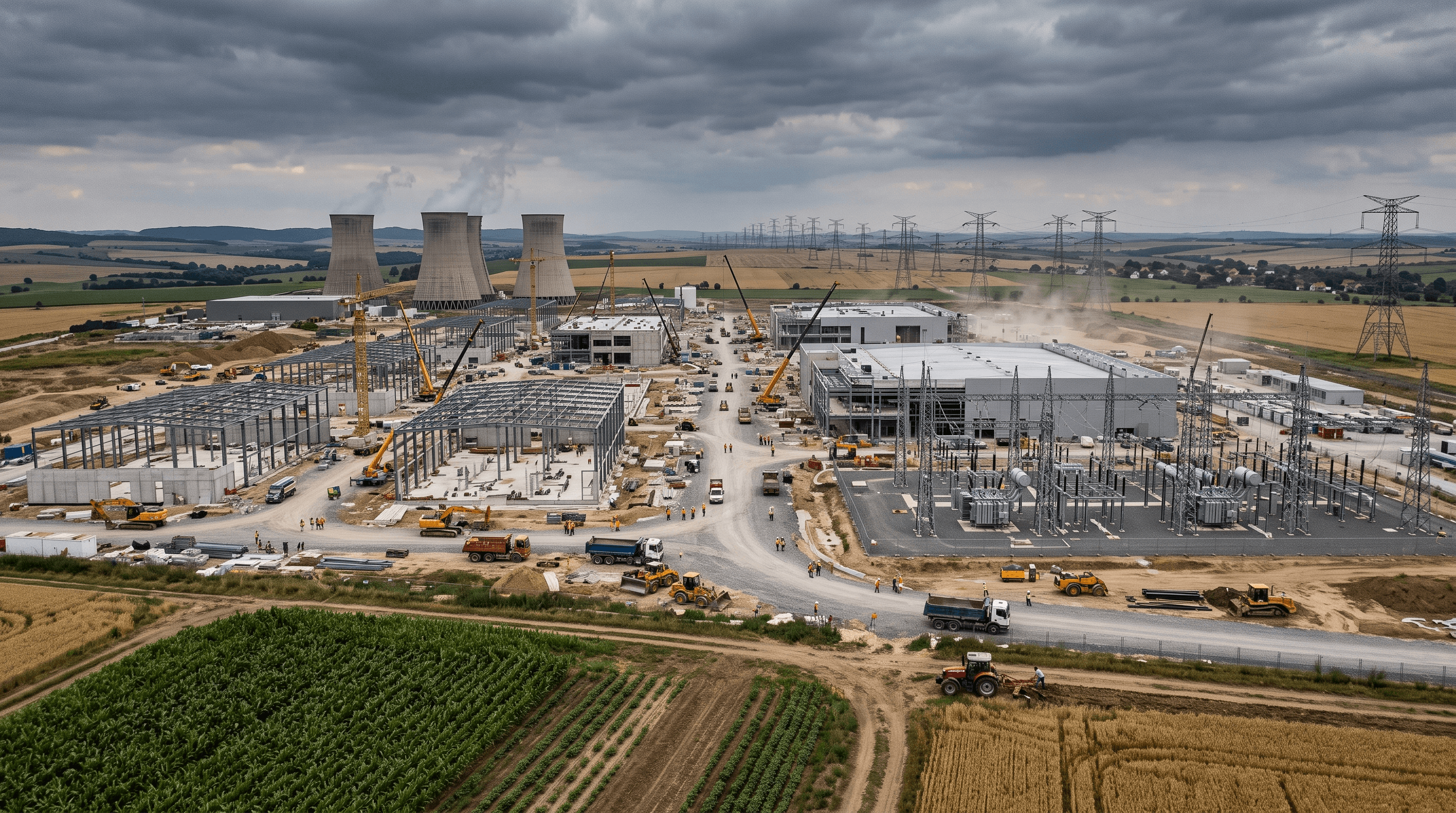
Nvidia CEO Jensen Huang has a new acronym he wants the industry to learn: LPS. Land, Power, Shell. And his message is blunt -- these three basics have replaced his own chips as the thing holding AI back.
The occasion was the announcement of the largest data center lease in history. OpenAI signed a 20-year deal with SoftBank subsidiary SB Energy for the PORTS-Pike campus in Ohio, securing roughly 8 gigawatts of IT capacity on a site that was once a Department of Energy uranium enrichment facility. Nvidia is guaranteeing up to $105 billion in residual value for the first construction phase and, in return, becomes the exclusive chip supplier.
"The hardest thing about building AI is no longer the silicon," Huang said. "It's the ground you put it on, the wire you plug into it, and the roof over it."
The deal reveals a shift in where the real leverage sits in the AI industry. For the past two years, Nvidia's GPUs were the unquestioned bottleneck -- every AI lab, every hyperscaler, every startup scrambled to secure allocation. But as data center commitments have ballooned into the hundreds of billions, the constraint has migrated upstream. You can buy all the H200s you want if you have nowhere to plug them in.
A former uranium enrichment site
The PORTS-Pike campus sits on part of the former Portsmouth Gaseous Diffusion Plant in Piketon, Ohio -- a DOE site that enriched uranium for nuclear weapons and commercial reactors from the 1950s until 2001. The location was chosen for its access to massive amounts of electricity: the site draws from a 9.2-gigawatt gas plant that the US government owns and that Japan is financing as part of a bilateral trade agreement.
The irony is hard to miss. A facility built for the nuclear age is being repurposed for the AI age. The same attributes that made it valuable for uranium enrichment -- secure land, heavy power infrastructure, government backing -- make it ideal for the kind of computing that trains and runs frontier AI models.
How the $105 billion guarantee works
Nvidia's backing is not a simple rent guarantee. According to the Wall Street Journal, the chipmaker is guaranteeing the residual value of the finished data centers in the first construction phase, which covers 4.25 gigawatts of IT capacity. If OpenAI walks away from the lease, SB Energy must first try to find a replacement tenant and sell the facilities. Only then does Nvidia cover the difference, capped at $105 billion.
In exchange for this backstop, Nvidia becomes the exclusive GPU supplier for the first half of the site and is investing $1.5 billion in SB Energy directly. Huang said he expects around 1.5 million GPUs per system generation across the campus, translating to $150 billion to $200 billion in revenue for Nvidia. If the company exercises its option on the remaining 3.75 gigawatts, the total package grows to approximately 16 gigawatts worth roughly $600 billion.
OpenAI, for its part, only pays for finished capacity. The first 800 megawatts are slated to come online in 2028.
Notably, Nvidia originally explored backstopping the entire project with roughly $250 billion but scaled back after a 5 percent stock drop and pressure from investors. The final $105 billion cap -- covering asset value rather than the full lease -- is lower than the $120 billion figure that had circulated in recent weeks.
The $3 trillion balance sheet blind spot
The Ohio deal is the most dramatic example of a broader trend the Wall Street Journal documented this week: approximately $3 trillion in AI-related commitments across nine major tech companies that do not appear on any balance sheet.
The mechanics are straightforward. Leases for data centers that have not begun payments are not recorded as liabilities. Purchase commitments for GPUs are booked only when the hardware ships. Alphabet's purchase commitments jumped from $332 billion to $811 billion within three months -- an increase larger than most companies' entire market capitalization -- without registering as debt on its financial statements.
Morgan Stanley analysts have warned that investors can no longer accurately gauge the actual debt levels of companies pursuing AI infrastructure at this scale. The contracts are structured to be nearly impossible to cancel, and both Alphabet and Amazon recently reported negative free cash flow.
What LPS means for the rest of the industry
Huang's framing of LPS as the new bottleneck carries a darker implication for smaller players. If the constraint on AI is no longer chip allocation but access to land, power, and construction capacity, then the barrier to entry just got dramatically higher.
The companies that can secure multi-gigawatt data center sites are the same companies that have existing relationships with utilities, governments, and construction firms -- the hyperscalers and the deep-pocketed AI labs. For everyone else, the scarcity just moved from a market you could buy your way into (GPUs) to one where the supply is fundamentally finite (megawatts on a grid).
OpenAI's total commitments through 2030 now stand at roughly 12 gigawatts of Nvidia compute across all sites, according to Huang. That is more power than some small countries consume. The era of the GPU shortage gave way to the era of the LPS shortage without anyone noticing the transition.
Sources
- The Decoder: OpenAI signs record Ohio data center lease with Nvidia backing up to $105 billion
- CNBC: Nvidia backing $105 billion in financing for OpenAI data center in Ohio (via Google News)
- Wall Street Journal: Big Tech spending report (referenced in The Decoder coverage)
- IEEE Spectrum: The CPU Comeback Is Upon Us (context on infrastructure constraints)