The Man Who Ran Intel Is Betting on Light to Save AI's Future
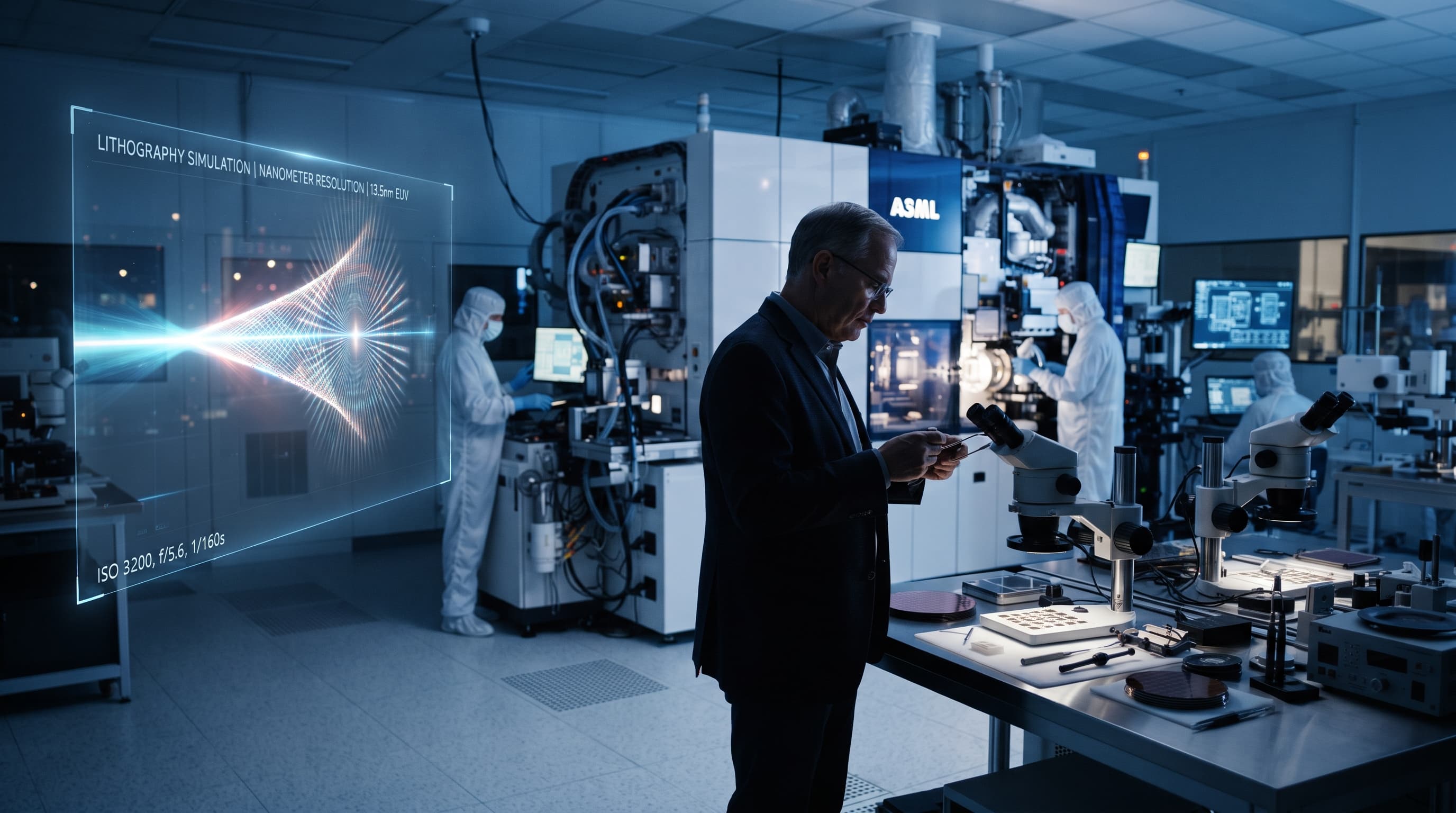
The man who spent 40 years inside Intel, the company that defined what a computer chip could be, is now betting on light.
Pat Gelsinger departed Intel as CEO in late 2024, and after a 100-day sprint of 100 meetings — exploring government roles, university presidencies, private equity, and venture capital — he landed at Playground Capital as a general partner. His mandate: find the startups that will reawaken Moore's Law, the decades-old prediction that transistors on a chip would double roughly every two years, bringing a corresponding leap in performance. That prediction has held for over 50 years, but it is now bumping against the limits of physics. Shrinking atomic-scale transistors has become prohibitively difficult and expensive.
Gelsinger's answer to that impasse is not a new chip architecture, a new material, or a new cooling system. It is light.
The Bet on xLight
Gelsinger took a board seat at xLight, a Playground portfolio company developing novel lithography techniques — the process of etching chips using nanometer-scale beams of light. The current industry standard, developed by the Dutch company ASML, uses 13.5-nanometer wavelength light. xLight is working on free-electron lasers that could push that down to 5, 4, 3, and even 2 nanometers.
"xLight is not versus ASML, it's with ASML," Gelsinger told WIRED in an interview at the RAISE Summit in Paris. "The first thing we want to do is hook our light source up and make ASML machines better."
The startup has already received investment from the US government, signaling that Washington sees advanced lithography as a strategic priority. For Gelsinger, who spent his entire career at Intel before being pushed out in a boardroom coup during the company's turnaround struggles, xLight represents the kind of deep-tech bet that matches his conviction that the semiconductor industry's future depends on solving the physics of light itself.
"Light is the most important thing," he said. "God said, 'Let there be light.' We're going to harness that as far as we can take it."
The Trillion-Dollar Semiconductor Market
The stakes could not be higher. In 2024, the semiconductor industry aimed to hit a trillion dollars in revenue by 2030. Now, Gelsinger says, that milestone will arrive next year — pulled forward by AI's insatiable demand for compute.
"The door has blown wide open," he said. "I don't need my companies to win the market to get extraordinary returns. I just need them to win a decent percentage."
AI training has been the heartland of Nvidia's GPU dominance, but Gelsinger sees a major shift toward inference — the process of running trained models — as the next battleground. And he believes the winning hardware will not look like today's GPUs.
"My job at Playground is to make AI 10,000 times better, not 10 times," he said. "That will happen on chips that don't look like today's GPUs."
He pointed to memory architecture as another area ripe for disruption. High-bandwidth memory, the current standard, is "a problematic technology," he said. By the end of the decade, stacked memory architectures from companies like d-Matrix, Fractile, and Cerebras will become dominant.
The Energy Problem Nobody Is Solving
Gelsinger's investment thesis extends beyond chips. He described energy as one of the main bottlenecks to AI progress, calling the US's low-single-digit expansion in energy capacity over the last decade "despicable."
"In a digital AI age, energy capacity is economic capacity," he said. "I don't want to be anti-climate, but we were so consumed with climate that we forgot about capacity."
New gas turbines have an eight-year supply chain. Nuclear takes a decade to build. Solar depends on Chinese supply chains. Gelsinger's portfolio includes Alva Energy, a company focused on nuclear upgrading — extracting more value from existing nuclear plants while also building new ones.
"Fundamentally, the winners and losers in the AI age will be those with the energy capacity to build their systems," he said.
The Government's Role
On the question of AI regulation, Gelsinger walked a careful line. He acknowledged that the US administration is wrestling with whether to be maximally hands-off or maximally hands-on, and that foundational models are being released every four weeks — a pace that makes traditional regulation nearly impossible.
But he did not dodge the central question: should models be reviewed by a government body before release?
"Models need to have integrity of process and visibility of the testing that was done on them," he said. "I want to know what proprietary foundational models are trained on. I want vigorous benchmarking. I want to know they're not just the first to do something, but they do it with the appropriate security requirements and values alignment."
He concluded: "One of two things needs to happen: either the industry does that review, or the government has to step in to make sure it gets done."
What It Means
The most interesting thing about Gelsinger's post-Intel career is not any single investment. It is the through-line that connects them all: a belief that the next decade of AI will be defined by breakthroughs in the physical world — in light, in energy, in materials — not just in software. The software industry has been disrupted by AI, but the infrastructure that runs that AI is still decades-old technology, pressed to its limits.
Gelsinger, more than almost anyone, understands those limits from the inside. He spent his career at the company that set the pace of the semiconductor industry. If he is now betting that the next breakthrough will come from a Dutch laser startup, a nuclear-upgrading company, and a handful of chip architects who think differently about memory, it is worth paying attention.
The man who built the chips that powered the last computing revolution thinks the next one will run on light. He has been wrong before — Intel's foundry strategy under his leadership was a costly detour — but when someone who spent 40 years inside the silicon cathedral says the roof needs to be rebuilt, the smart bet is to at least look at the blueprints.
Sources
- WIRED: This Former Intel CEO Wants to Jumpstart Moore's Law With Light (Joel Khalili, July 21, 2026)
- TechCrunch: The Anthropic-Physical Intelligence rumor roiling AI Twitter (context on AI acquisition landscape)
- WIRED: The Army Is Burning Through Its AI Tokens (context on AI adoption challenges)