AI Coders Now Share Your Slack Channels
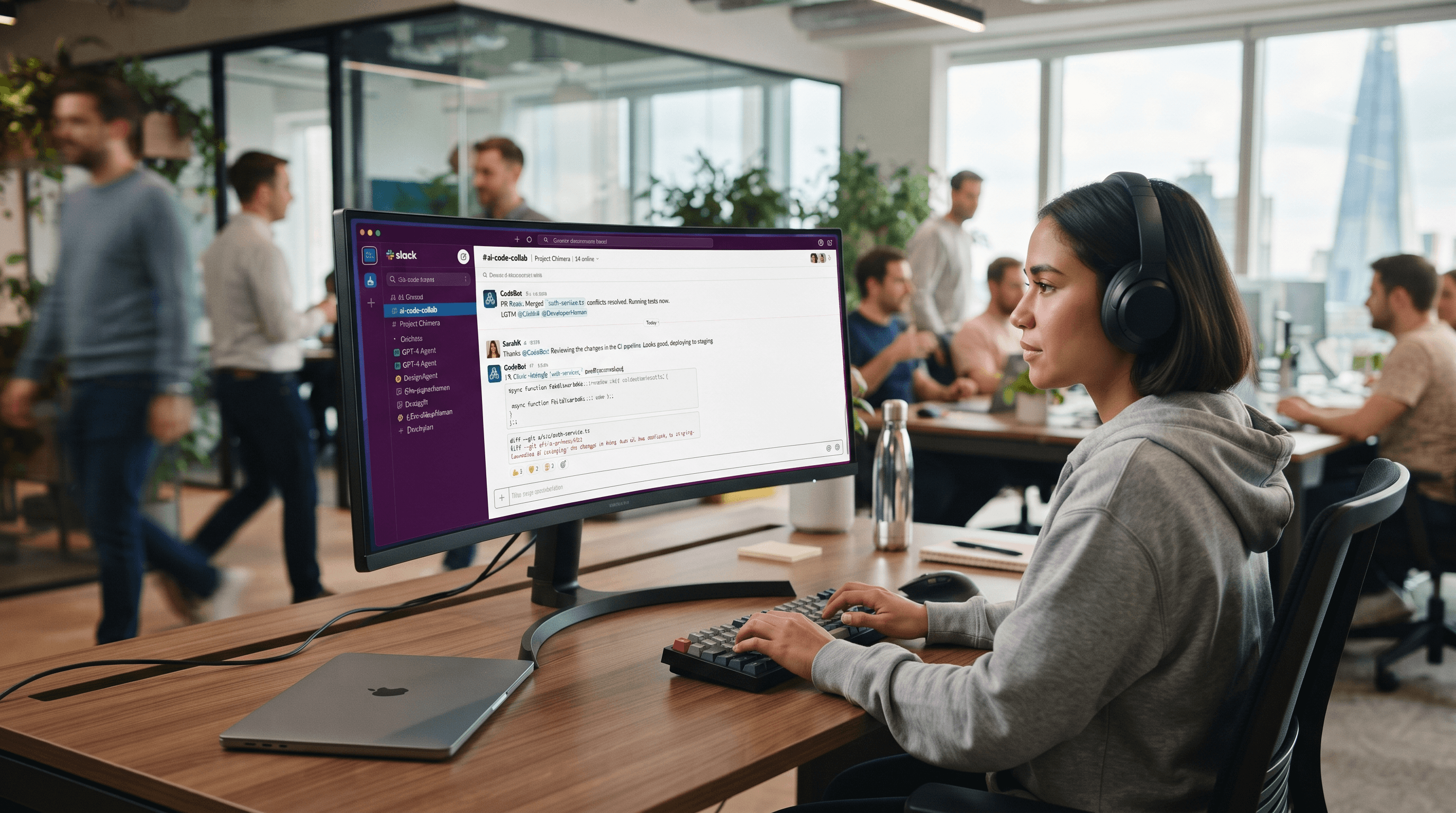
AI coding has been a solitary act. You open a terminal, you prompt a model, you get code back. Maybe you share the result in a pull request later, but the act of building stays between a human and a screen.
Slack just flipped that model on its head.
On August 20, 2026, the company launched Slack Code -- a feature that turns chat channels into shared coding spaces where AI agents work alongside human teammates with full transparency. Tag an agent into a conversation, and it spins up a dedicated channel to build the feature, fix the bug, or update the page. Every step stays visible. Nothing ships without a human saying yes.
From solo prompt to team sport
The unit of work in Slack Code is the channel, not the chat window. A developer tags an agent -- say Anthropic's Claude Code or Cognition's Devin -- into a Slack thread about a bug. The agent creates a project-specific channel where it begins working. Team members see the same context the agent has. They can audit code diffs as changes are proposed, get live previews of HTML output, leave feedback the agent incorporates, and approve the finished work before it ever hits production.
When the task is done, the channel archives itself automatically. An audit log preserves the full trail: who asked for what, what the agent changed, who approved it.
The feature is available on every Slack plan, including free workspaces. That puts collaborative AI coding in front of Slack's hundreds of millions of users from day one, rather than gating it behind enterprise tiers.
More than a year of plumbing
Slack Code did not arrive from nowhere. It sits on top of infrastructure Salesforce and Slack have been building for more than a year.
In December 2025, Anthropic previewed a feature that let developers delegate tasks to Claude Code directly from Slack threads. In February 2026, Slack gave third-party agents governed access to workspace channels, messages, and files through an agent API framework. In June 2026, Slackbot gained an MCP (Model Context Protocol) client that let it discover and invoke outside tools in conversation.
The day before Slack Code's launch, on August 19, Salesforce made the Slackbot MCP Client generally available as part of a broader Salesforce MCP Server release, connecting Slackbot to the Salesforce platform and more than 20 partner applications including Atlassian, Box, Canva, Docusign, Notion, and Zoom.
Slack Code is the logical endpoint of that trajectory. All the plumbing -- the agent integrations, the context protocols, the governance framework -- now has a surface where code actually gets written, reviewed, and shipped.
The vibe coding moment arrives in enterprise
Slack Code productizes what the industry has been calling vibe coding: describing software in plain language and letting an AI model write the code. But where vibe coding has mostly lived in standalone tools -- Cursor, Replit, Claude Code in a terminal -- Slack's bet is that the natural home for agent-written code is the workspace where engineering discussion already happens.
The approach raises an obvious question: do teams actually want AI agents working openly in shared channels?
Slack's answer is that the channel structure solves the transparency problem that has dogged AI coding tools. When every proposed change is visible, reviewable, and approvable in the same place the team already works, the AI agent becomes a visible participant rather than a black box. The approval step is the control point: code does not ship until a person in the channel signs off.
The four founding partners -- Claude Code, Devin, Vercel Agent, and GitHub Copilot -- are expected to integrate with code channels at launch. Slack has said more agents from its marketplace will follow.
What it means for how teams build software
The shift from "developer plus terminal AI" to "team plus channel AI" changes the dynamics of AI-assisted coding in subtle but important ways.
First, it makes the AI's work inspectable by default. In the terminal-only model, whatever the model produces is seen only by the developer who prompted it. Code quality, security issues, and design decisions are filtered through one person's judgment before they reach the team. Slack Code puts every proposed change in front of the whole team automatically.
Second, it formalizes the human-in-the-loop as a process, not a principle. The approval gate is built into the workflow, not dependent on individual discipline. A team that uses Slack Code cannot accidentally ship AI-generated code without review.
Third, it brings agent collaboration into the same context where product decisions, bug reports, and feature requests live. A developer does not need to copy context from Slack into a terminal or IDE. The AI agent already has access to the conversation that defines the task.
Whether this actually produces better code will depend on the teams using it. But Slack Code represents a genuine shift: AI coding tools are moving out of individual terminals and into shared spaces where software is actually discussed, decided, and reviewed.
Sources
- Unite.AI -- "Slack Code Puts AI Coding Agents in Dedicated Project Channels" (https://www.unite.ai/slack-code-puts-ai-coding-agents-in-dedicated-project-channels/)
- The Register -- "Slack Code taps into collective vibe, puts AI agents into the group chat" (https://www.theregister.com/2026/08/20/slack_code_vibe_coding/)
- VentureBeat -- "Slack wants to drag AI coding out of the terminal and into the group chat" (https://venturebeat.com/ai/slack-wants-to-drag-ai-coding-out-of-the-terminal-and-into-the-group-chat/)
- The Next Web -- "Slack Code puts Claude and ChatGPT in the same channel" (https://thenextweb.com/news/slack-code-ai-coding-agents)
- SiliconANGLE -- "Salesforce introduces Slack Code to bring agentic team coding into the open" (https://siliconangle.com/2026/08/20/salesforce-introduces-slack-code-bring-agentic-team-coding-open/)