AI Agents Burn 600x More Energy Than a Chat Prompt

The Numbers You Were Told Were Wrong
Google told you a Gemini prompt uses 0.24 watt-hours. Sam Altman pegged the average ChatGPT query at 0.34 Wh. Both numbers are reassuringly tiny -- less energy than nine seconds of television, less than a 2009-era Google search.
They are also increasingly irrelevant to how people actually use AI.
Climate scientist Zeke Hausfather, who works at Stripe and publishes the widely-read Climate Brink newsletter, decided to measure his own real-world AI usage. Over eight weeks he tracked every prompt, every model call, and every kilowatt-hour his Claude Code agent consumed. The result: each agentic prompt burned roughly 150 watt-hours of electricity. That is 600 times the industry's quoted per-chat figures.
"A prompt is ultimately not a unit of AI use any more than trips is a measurement of driving; it's how far you go that matters," Hausfather wrote in his analysis on The Climate Brink.
What Is Agentic AI Doing to the Numbers?
A standard chatbot query sends a question, gets an answer, and stops. An AI agent does not stop. It plans, writes code, runs that code, reads the output, adjusts its approach, and loops. Each loop is a fresh model call with the entire conversation history re-read from cache.
Hausfather's 1,138 manually typed prompts triggered over 14,000 model calls -- an average of 12 per prompt. Those calls processed 3.2 billion tokens. Of those, 96 percent were cache reads: the agent re-reading its own accumulated context at every step. Only 0.4 percent of all tokens were the actual output Hausfather saw on screen.
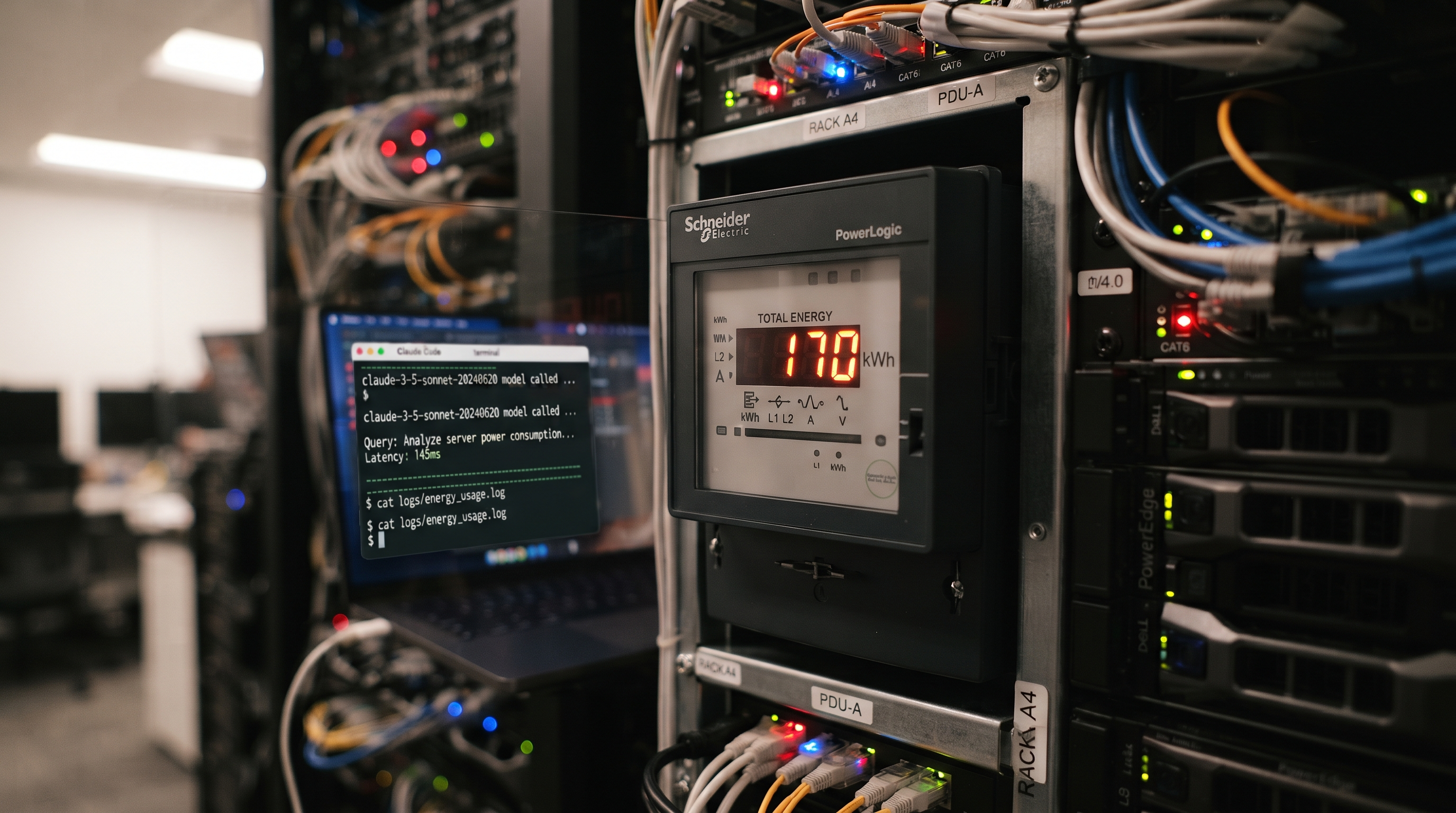
The energy math follows the token count. Hausfather estimates his total eight-week consumption at 170 kWh of data center electricity, with an uncertainty range of 70 to 330 kWh depending on the methodology used. His median single session consumed 0.6 kWh -- fifty times the energy needed to charge a smartphone.
 Published per-prompt estimates (blue) compared to Hausfather's measured values (orange). The gap spans five orders of magnitude. Source: Zeke Hausfather / The Climate Brink.
A Day of Agentic AI Is More Than Two Refrigerators
Hausfather's average day of Claude Code usage consumed 3.0 kWh, with a range of 1.2 to 5.9 kWh. That is more electricity than two refrigerators running simultaneously. On his heaviest day -- when multiple parallel agents were processing a large geospatial analysis -- he estimates 11 kWh were consumed. That is more than a third of the daily electricity draw of an average American household.
Annualized, Hausfather's Claude Code usage comes to roughly 1.1 MWh and 370 kgCO2e per year. That is comparable to running an electric clothes dryer or about half the emissions of a San Francisco-to-New York round-trip flight. It is roughly 2 percent of the average American's total annual carbon footprint.
These numbers are simultaneously significant and modest. Hausfather does not argue for guilt or abstinence. But he makes a clear point: this is a net new source of emissions at a time when the world is already falling short of its climate goals.
The Gap That Published Numbers Hide
Hausfather's analysis arrives alongside a new white paper from climate tech company Watershed (Bistline et al. 2026) that proposes a standardized framework for corporate AI emissions accounting. That paper's most striking finding is that electricity consumption per AI task spans more than five orders of magnitude -- from thousandths of a watt-hour for text classification to 50-500 Wh for a full agentic workflow.
The widely cited per-query numbers from Google and OpenAI capture only the very bottom of that range. Watershed's authors note that emissions attributed to a single "interaction" may understate actual compute consumed "by an order of magnitude or more."
Other researchers have reached similar conclusions. A 2026 study by Bai et al. found that coding agents consume roughly 1,000 times the tokens of an ordinary chatbot interaction. Anthropic's own Economic Index reports that 97 percent of its API usage now shows automation-dominant patterns associated with agents, not chat. The shift to agents is not hypothetical -- it is already the dominant usage pattern.
What It Means
Hausfather identifies the most critical lever for reducing AI's climate impact: decarbonizing the data center power supply. An AI agent running on a grid powered by renewables produces dramatically fewer emissions than one running on coal or natural gas, even though both consume the same electricity. "It is fundamentally a much easier-to-decarbonize end-use than aviation," he notes.
But the broader takeaway is that the industry's reassuring per-query benchmarks are becoming a distraction. As AI agents proliferate -- coding, researching, analyzing, and acting autonomously for hours or days at a time -- the gap between the 0.24 Wh chat number and the 150 Wh agent reality will only widen. A future where every knowledge worker runs multiple agents daily is a future where AI's energy footprint dwarfs current projections.
Hausfather's personal numbers are not a prediction for everyone. He is a power user in Silicon Valley. But that is precisely the point: the people building the future of AI are the ones already using it most intensely, and their usage patterns are the canary in the coal mine.
Or, more accurately, in the data center.
Sources
- Zeke Hausfather, "The real energy use of agentic AI," The Climate Brink, August 5 2026. https://www.theclimatebrink.com/p/the-real-energy-use-of-agentic-ai
- Matthias Bastian, "AI agents use roughly 600 times more energy than a simple chat prompt," The Decoder, August 8 2026. https://the-decoder.com/ai-agents-use-roughly-600-times-more-energy-than-a-simple-chat-prompt/
- Bistline et al. (Watershed), "A standardized framework for corporate AI emissions accounting," 2026. (Referenced in Hausfather's analysis)
- Bai et al., "Measuring coding agent energy consumption," 2026. (Referenced in Hausfather's analysis)
- Anthropic Economic Index, API usage automation-dominant patterns, 2026. (Referenced in Hausfather's analysis)