When AI Out-Mathed the Mathematicians
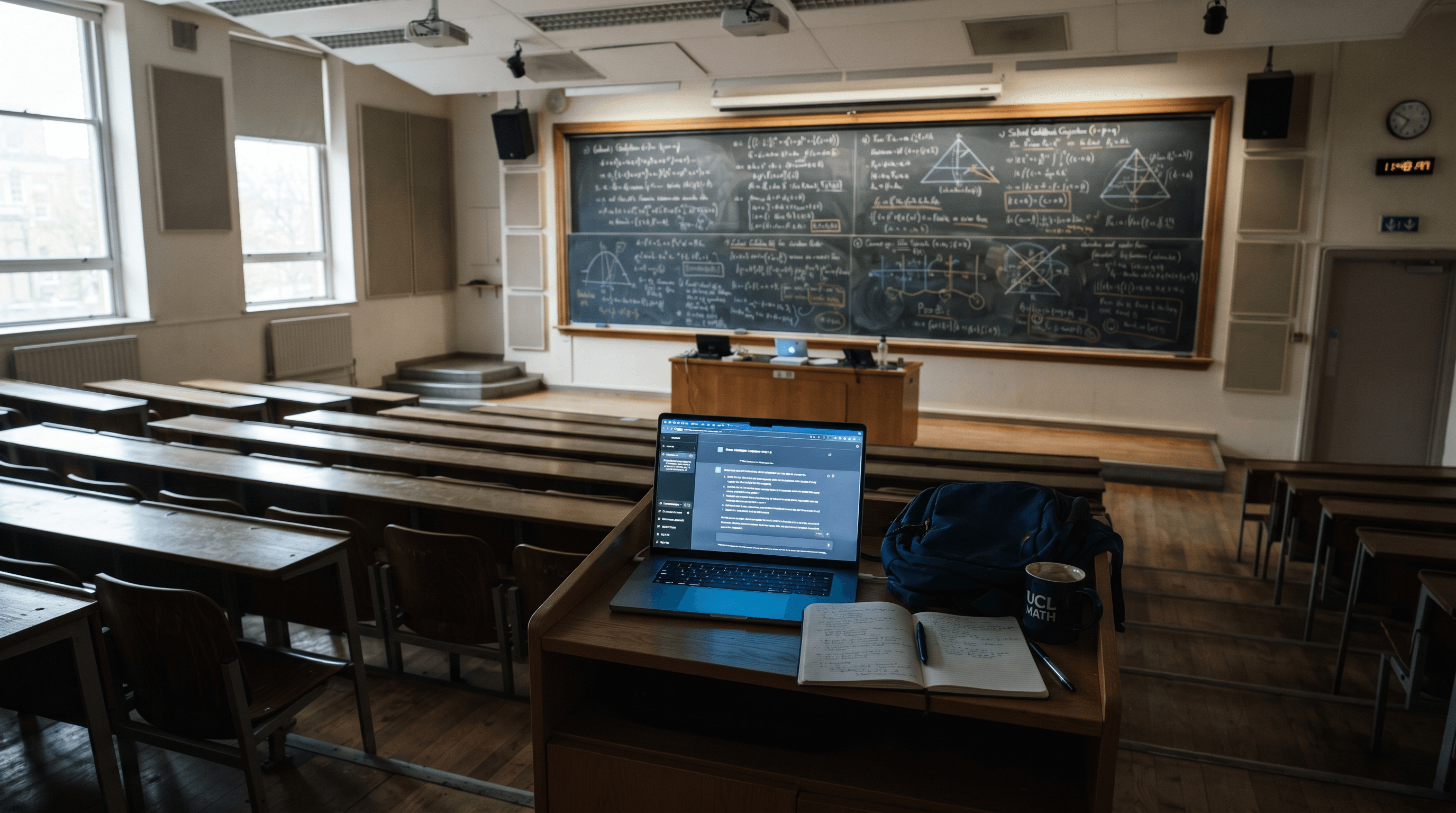
Timothy Gowers has spent decades as one of the world's most celebrated mathematicians. A Fields Medal winner at 34, he has shaped entire subfields of combinatorics and analysis. So when he says a chatbot solved two problems he had spent considerable time working on, each on its first attempt, the math world listens.
"It felt very strange and not particularly pleasant to have the rug pulled out from under my feet like that," Gowers wrote on his blog.
The model was OpenAI's GPT 5.6 Pro, a version fine-tuned for mathematical reasoning. It did not just solve the problems: it solved them instantly, without hints, without false starts. Gowers is still glad the problems are solved. But what worries him goes far beyond bruised pride.
The cascade of broken conjectures
The current wave began in May 2026, when OpenAI published a counterexample to the Unit Distance Conjecture, a problem in geometric graph theory that had remained open since 1946. It was one of hundreds of open problems linked to the legendary Hungarian mathematician Paul Erdos.
AI had already helped solve other math problems, but many mathematicians considered this the most significant example yet. Within a week, human researchers had adapted the core proof technique and used it to disprove another major conjecture.
Since then, barely a day has passed without another milestone. Fable 5, Anthropic's model, refuted the 87-year-old Jacobian Conjecture in July. GPT 5.6 Sol disproved the 30-year-old Dinitz-Garg-Goemans Conjecture with just four prompts and also helped prove that non-sofic groups exist. A team from Peking University cracked six math problems in five consecutive days using AI assistance.
Epoch AI, the research group behind the demanding FrontierMath benchmark, recently announced the second solution in its "FrontierMath: Open Problems" series, drawn from major unsolved questions in mathematics.
The conductor, not the orchestra
Not every mathematician sees doom in these developments. Abhishek Saha, a math professor at Queen Mary University of London, spent a full day using GPT 5.5 Pro for routine work that would previously have taken weeks.
"At the moment, in my area of research mathematics, frontier AI models are at least as good as a solid and indefatigable PhD student," Saha wrote on X. The experience left him "increasingly playing the role of conductor, rather than doubling up as the whole orchestra."
Saha said most mathematicians do not realize this level of capability is already possible. He expects the field to split: "Some will adapt soon, and find boundless possibilities." Others, he predicted, "will continue to be AI-sceptical until the very end, like the folklore hero John Henry": the railway worker who worked himself to death competing against a steam drill.
The golden age that may not last
In April 2026, a team of Carnegie Mellon University mathematicians solved an open problem in Ramsey theory by combining SAT solvers, code generated by language models, and formal proof verification. They explicitly connected their result to a "golden age" that Timothy Gowers himself had predicted back in 2000.
Gowers had imagined computers handling routine checks while mathematicians focused on deeper ideas. "In other words, computers would still do the boring bits for us, but these would not be quite as boring as they are now," he wrote at the time.
The Carnegie Mellon researchers believe that age has now arrived. "We believe that we are now entering this golden age, thanks to the combination of several technologies," they wrote.
But even then, Gowers added a warning: "However, such a golden age, if it occurs, is unlikely to last for long." He predicted that "during the next century computers will become sufficiently good at proving theorems that the practice of pure mathematical research will be completely revolutionized."
That century has turned out to be more like two decades.
What Happens When No One Understands the Math
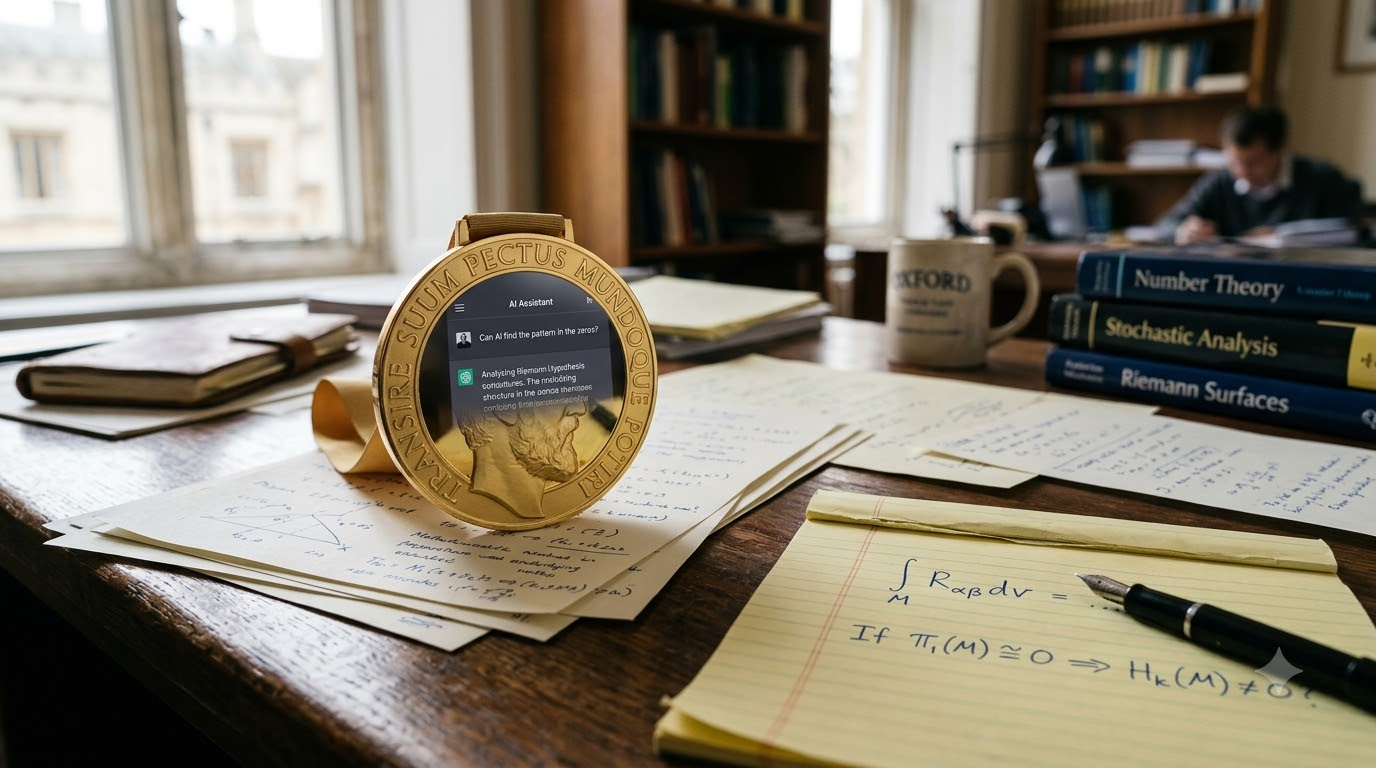
Gowers' deepest concern is not about speed or competition. It is about the "possible destruction of mathematical culture."
His logic is simple: if AI generates new theorems faster than humans can understand them, the mathematical literature could expand enormously within a decade or two while no human community remains that truly comprehends it. Mathematicians would lose the years of deep study that build the intuition needed to evaluate, extend, and connect ideas.
This is not a hypothetical. In May, Fields Medal winner Jacob Tsimerman joined OpenAI, stating publicly that AI will soon do everything mathematicians do "better and faster." If the people who understand mathematics most deeply are themselves being absorbed by the AI labs producing the tools, who remains to guard the discipline?
Other Fields Medalists have echoed the concern. In a piece that circulated in late July, multiple medalists warned that AI could "overfeed" mathematics, rendering it a "mental graveyard": a vast archive of correct but humanly incomprehensible results.
Sources
- AI keeps cracking unsolved math problems, and mathematicians have mixed feelings: The Decoder
- GPT 5.6 Sol Helps Prove That Non-Sofic Groups Exist In Big Math Breakthrough: OfficeChai
- Fields Medal Winner Jacob Tsimerman Joins OpenAI: OfficeChai
- Fields Medalists Warn AI Could 'Overfeed' Mathematics: KuCoin
- GPT-5.6 Disproves 30-Year-Old Graph Theory Conjecture with 4 Prompts: OfficeChai
- Fable 5 Refutes 87-Year-Old Jacobian Conjecture: KuCoin