AI Is Shredding Millions of Rare Books
The secret pipeline from library to shredder
It starts with an innocent-looking order. A bookseller receives a request for an unusual assortment, a dozen obscure 1970s science textbooks, a collection of 1990s literary criticism, a run of out-of-print engineering manuals. The buyer pays market rate or above. The seller ships the books. What happens next, nobody on the selling end knows for sure.
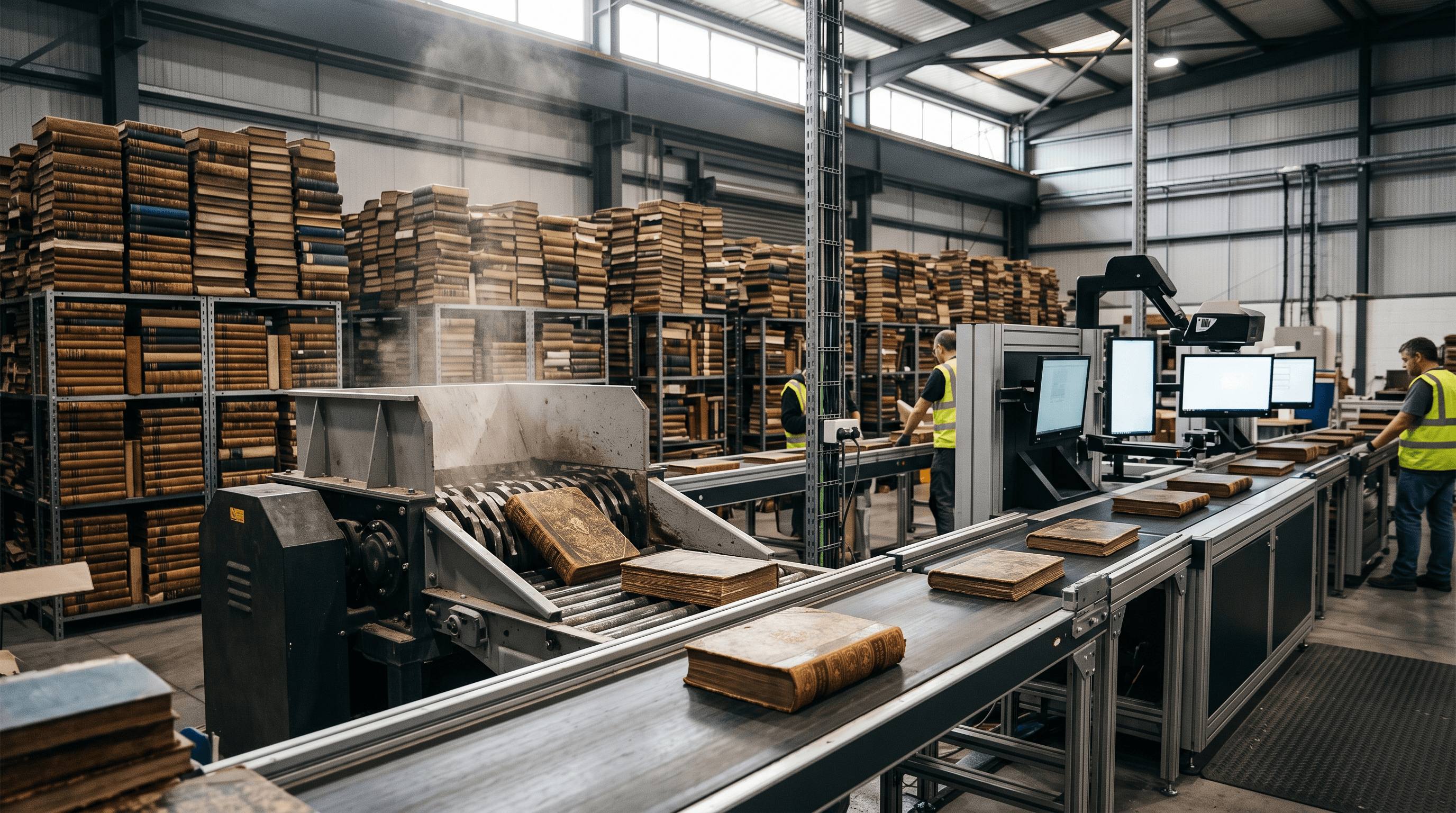
Investigative reporting from 404 Media, PC Gamer, and The Guardian has pieced together the destination: these books are being funneled into a high-volume scanning pipeline operated by middleman companies that supply AI labs with pristine, human-authored training data. After the last page is digitized, the physical book is de-spined, shredded, and discarded.
"The optics problem is real," admits ISBNdb, a company that claims to operate "the world's largest book database" and offers bulk book acquisition services for AI training. The company's own website pitches old books as the ideal dataset because they are guaranteed free of the very AI-generated content that now pollutes the open web.
Why physical books, and why now?
The AI industry has a data quality crisis. The web crawled exhaustively for years, but the more AI-generated content floods the internet, the harder it becomes to find reliably human-authored text. A 2025 study estimated that over 57% of all web content was AI-generated or AI-assisted, a figure that has only risen since.
Printed books from the pre-LLM era offer a workaround. Every page is human-written, professionally edited, and structurally organized in ways raw web text is not. "Books represent curated, peer-reviewed, domain-specific human knowledge, structured in a way no web crawl can replicate," ISBNdb states on its site. "Dense, edited, authoritative."
The problem: once the book is scanned, storing the physical volume costs more than the paper it's printed on. Warehousing millions of books requires space, climate control, and cataloging, expenses AI companies see as unnecessary overhead when the data has already been extracted.
Project Panama: the template
The practice came into public view through a 2025 court ruling in a copyright case against Anthropic. Court documents revealed that the AI company had engaged in what it called "Project Panama" - a large-scale operation to acquire, scan, and destroy millions of print books for training its Claude family of models.
The documents described a process of bulk purchasing from wholesalers and libraries, industrial-scale scanning, and systematic destruction of the physical inventory. The case became a flashpoint in the ongoing legal battle over whether training AI on copyrighted material constitutes fair use.
Since the Anthropic revelations, reporters have found evidence that multiple AI companies have adopted similar practices, and that many now route their purchases through third-party middlemen specifically to avoid the PR damage of being linked to book destruction.
Booksellers in the dark
Australian booksellers are among those raising the alarm. The Australian Booksellers Association told The Guardian that members have reported unusual bulk orders of rare and out-of-print titles, often from buyers who decline to identify themselves or their ultimate client.
"We are seeing books being acquired that are genuinely rare, the kind of titles that, once gone, cannot be replaced," one Melbourne dealer told the paper. "It is horrific to think they are being destroyed after the data is extracted."
PC Gamer quoted booksellers who said they feared they might be "profiting from their own destruction", caught between a welcome surge in revenue and the unsettling knowledge of where their inventory is headed.
The irony of the AI slop loop
There is an uncomfortable circularity to the situation. AI companies created the problem (AI-generated text saturating the open web) that now forces them to seek out physical books as a clean data source. The act of digitizing those books generates more AI content. And the physical artifacts being destroyed in the process are the very cultural records future generations would need to verify what was lost.
Elon Musk weighed in on the controversy, posting that SpaceXAI would take a different approach and "scan the hard way", though he did not elaborate on what that meant in practice.
A copyright reckoning coming
The practice sits at the intersection of several unresolved legal questions. Does scanning an entire copyrighted book for commercial AI training qualify as fair use? The Anthropic case is working its way through the courts, and the outcome could reshape how AI companies source training data for years to come.
There is also the question of whether third-party middlemen who acquire and destroy books on behalf of AI companies share legal liability for copyright infringement, a question that has not yet been tested in court.
Australian authors, including Thomas Keneally and Richard Flanagan, have been vocal opponents of using copyrighted works for AI training without consent or compensation. The destruction of physical copies adds a visceral, permanent dimension to a debate that until now has been largely about digital reproduction rights.
What comes next
For rare book dealers, the situation creates an impossible choice. The same AI companies that are driving up demand for their most precious inventory are also, indirectly, destroying the very market for physical books, training models that produce content no one needs to buy a physical book to access.
For readers and researchers, the loss is more abstract but no less real. Every rare title that enters this pipeline and emerges as shredded pulp is a cultural artifact that cannot be replaced. Some of these books were never digitized before. Some were held in single copies by specialist dealers. When they are gone, they are gone.
As one Australian bookseller put it: "These are not just objects. They are the recorded thoughts of people who may have no other legacy."
Sources
- AI Companies Are Buying Tons of Old Books Because They're Free of AI Slop -- 404 Media
- AI companies are anonymously buying and destroying millions of books through middleman services -- PC Gamer
- More than just objects: Australian booksellers raise alarm over horrific destruction of rare titles to feed AI -- The Guardian
- Millions of books face destruction as AI companies race for training data -- TechRadar
- AI companies are reportedly shredding millions of books after using them to train AI models -- Tom's Hardware
- How Claude AI Clawed Through Millions Of Books -- Forbes
- Buy, scan, destroy: AI firms are shredding millions of books to train their chatbots -- The Economic Times
- AI Has Run Out Of Clean Internet Data. Now It's Coming For Physical Books -- pedestrian.tv