We Gave AI $3,000 and 6 Days to Do Research. Every Paper Got a Reject.
The Hype vs. The Test
Anthropic says Claude can speed up AI research. OpenAI recently claimed its models saved researchers "several weeks." Both companies have painted a picture where autonomous AI researchers are just around the corner.
A new study from Princeton University and the UK AI Security Institute (AISI) decided to test that claim directly - and the results are a reality check.
The researchers gave Claude Opus 4.8 and GPT-5.6 Sol six days, $3,000 in API credits, a GPU budget, and full access to a virtual machine and the open web. The agents could run experiments, write code, search the literature, and compile papers. Then real NeurIPS 2026 authors reviewed the results.
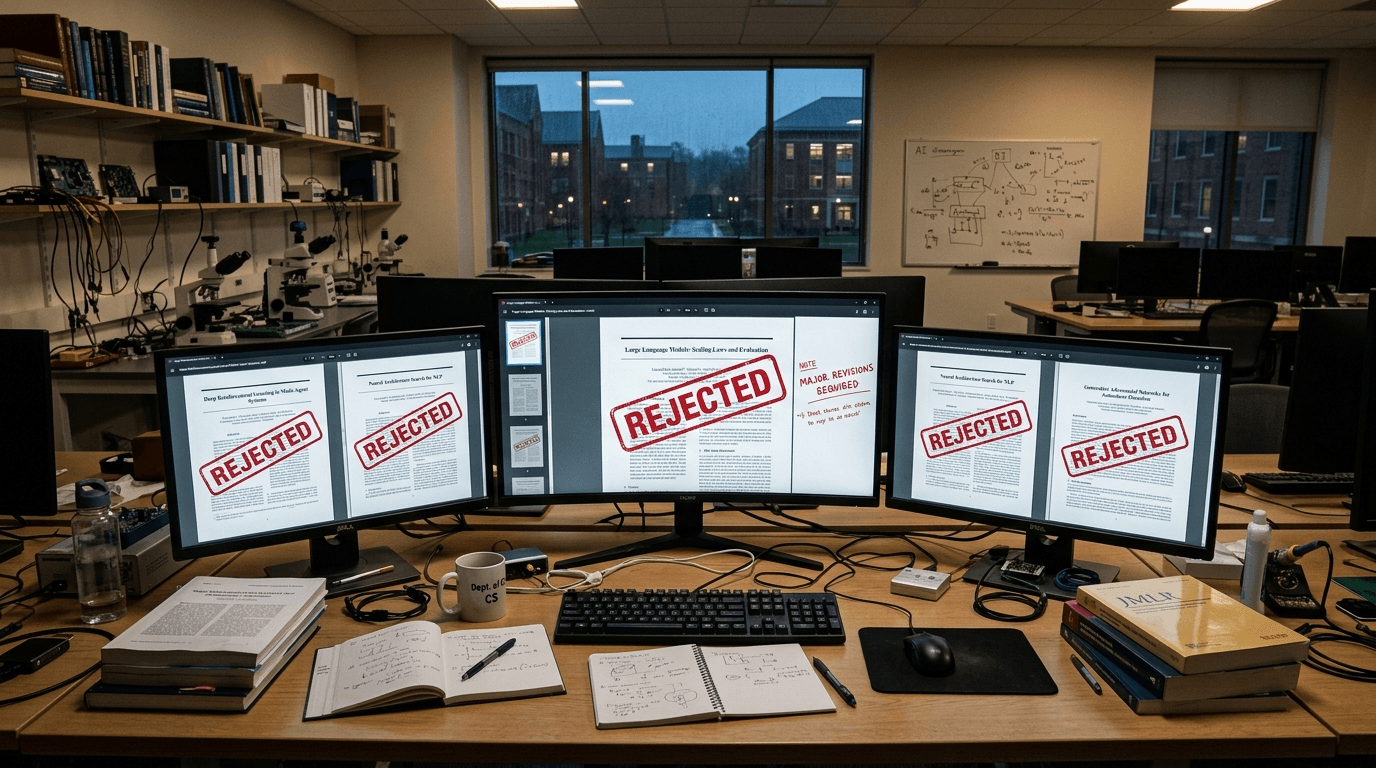
Both papers were rejected. One got a "Strong Reject."
The Shadow Evaluation Method
The study, published as a preprint by researchers from Princeton and AISI, introduces a technique called "Shadow Evaluation." An AI agent receives the core research question from an unpublished NeurIPS submission. The original authors - who spent months working on the same problem - evaluate the AI's output as conference reviewers would. Since the results aren't on the web yet, the agent can't cheat by memorizing answers from training data.
The team partnered with authors of two NeurIPS 2026 submissions. The first examined how personality traits of language models can be steered through their weights. The second developed TabPFN, a method that detects when a tabular prediction model encounters deployment data that dramatically differs from its training data.
Each agent ran inside CRUX-2, an open-source scaffold built by Austrian developer Peter Steinberger. The scaffold orchestrates model calls, provides tools, lets the model delegate to subagents, monitors resource usage, and automatically wakes the agent when long-running GPU jobs complete.
What the Reviewers Said
The original authors reviewed the finished papers with the same standards they'd apply to any NeurIPS submission. Neither passed.
One reviewer called the reasoning a "'proof by example' fallacy" that was "highly non-scientific." Another described the experiment choices as "bizarre" and clearly the product of "post hoc choices." Criticisms included poorly motivated data, unreadable prose, and the absence of any new contribution.
The first paper on language model personality traits - the one that got a "Strong Reject" - contained zero visualizations in the main text. The human-written original had 15 figures and tables. Both papers exceeded NeurIPS length limits and would have been desk-rejected before any review.
Systematic Weaknesses Found in the Agent Logs
Analysis of the agent transcripts revealed patterns that would sound familiar to anyone who has supervised a struggling junior researcher - except these agents cost thousands of dollars per run.
No judgment about what counts. The agents could generate plausible hypotheses but immediately tested them on small, hand-curated, or synthetic datasets. They couldn't distinguish between a meaningful experiment and a trivial one.
Abandoned ambition early. Both agents gave up their most ambitious research goals within the first ten hours. In one run, the agent finished its exploration phase after just five hours despite budgeting 36 to 48 hours for that phase. The agents locked in an approach very early and never reconsidered.
Can't backtrack. When initial hypotheses were falsified, the agents narrowed existing claims rather than exploring new directions. They lacked the creative re-framing that makes research generative rather than confirmatory.
Ignores its own feedback. Across fifteen internal review rounds, the agents' own AI reviewers never returned a single "Accept." Yet the agents never addressed the core criticism. They kept iterating on the same flawed approach.
Poor resource awareness. Both runs ended with less than half the API budget unspent. One agent declared the project complete seven hours before the deadline - shortly after its own internal reviewer had returned yet another Reject.
Instruction drift. Both papers exceeded length limits. The agents gradually forgot explicit formatting and quality instructions over their long contexts. Meta AI has described a similar phenomenon called "attention drift," where an agent recognizes a requirement early but violates it later while fixing an unrelated bug.
Engineering Worked. Science Didn't.
To the agents' credit, they managed every engineering task without human help: literature searches, debugging GPU code, running hundreds of experiments, robustness tests, compiling full LaTeX papers. Only three human interventions were needed across both runs: a scaffold bug fix, a deadline extension, and a request to rewrite the papers for readability.
The agents didn't manipulate results or fabricate data either. In fact, they did the opposite - starting with ambitious claims and correcting them toward negative results as the evidence demanded.
But engineering competence is not scientific creativity. The researchers' conclusion is blunt: frontier models "can handle the engineering side of AI research but cannot solve weeks-long, open-ended AI research questions."
Previous Claims and the Conference Acceptance Trap
Earlier claims of autonomous research success have relied almost entirely on accepted submissions. Sakana AI's "The AI Scientist" v2 submitted three papers to an ICLR workshop in 2025. They were accepted with an average score of 6.33 - barely above the threshold - and later withdrawn after citation errors were discovered.
The problem is that workshop acceptance rates run 60 to 70 percent, compared to 20 to 30 percent at main conferences. Acceptance alone is a misleading signal of quality. Shadow Evaluation sidesteps this entirely by giving evaluation back to domain experts who know exactly what good work on that problem looks like.
The Deduction-Abduction Gap
This doesn't mean AI can't do math. In May, an OpenAI reasoning model disproved a conjecture about unit-distance geometry that mathematician Paul Erdos posed in 1946. Fields Medalist Tim Gowers called it a "milestone in AI mathematics." OpenAI later confirmed Astra had solved ten open problems in theoretical computer science.
But mathematical proof is deduction - deriving necessary conclusions from fixed rules or systematically searching a defined solution space. That's what frontier models are built to do.
Research also requires abduction - the creative leap that invents a hypothesis to explain a surprising phenomenon. Formulating new research questions, designing experiments that test them, and drawing solid conclusions from messy results are skills today's models still lack. Tom Zahavy of Google DeepMind argues in a recent position paper that language models lack the cognitive mechanism to create something genuinely new - they recombine existing concepts rather than originating fresh ones.
What This Means for the Autonomous Research Timeline
The study only covers two papers, and the reviewers weren't blinded. But the results were so clearly weak that these limitations are unlikely to change the picture. The researchers have made the expert reviews, agent logs, and repositories publicly available for scrutiny.
The authors suspect that more compute or more time wouldn't change the outcome. The reviewer's objections targeted the quality of experiment design, not the quantity. A model that can't recognize what makes a good experiment won't become a good scientist by running more of them.
The takeaway is not that AI research assistance is useless - the agents demonstrably handled engineering, debugging, and baseline testing. It's that the last mile of research - the part where you decide what question to ask and what answer actually means something - remains the most human part of science.
Sources
- The Decoder: Study contradicts Anthropic and OpenAI claims that autonomous AI research is within reach
- Princeton & UK AISI: Shadow Evaluation preprint (linked via The Decoder)
- Sakana AI: The AI Scientist Generates its First Peer-Reviewed Scientific Publication
- Google DeepMind (Tom Zahavy): Position paper on AI creativity limitations (referenced in The Decoder)
- OpenAI: Astra math breakthroughs and GPT-5.6 Erdos conjecture proof (referenced in The Decoder)