Microsoft, Meta, and Nvidia Just Signed a Letter to Save Open-Weight AI. Here's What They're Not Telling You.
The Signatories Nobody's Talking About
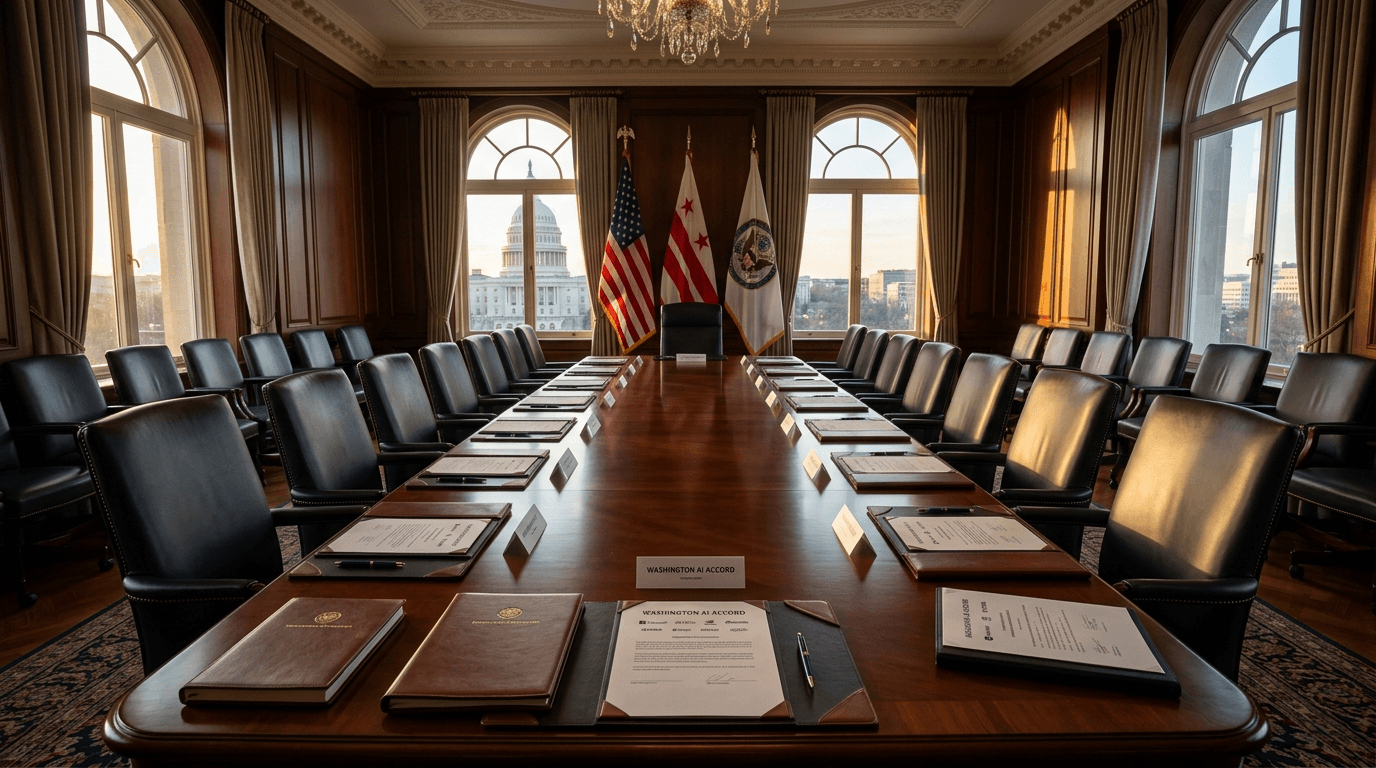
On Thursday, 24 companies and organizations signed an open letter to US policymakers urging them to protect open-weight AI models from "premature restrictions." The signatories include Meta, Microsoft, Nvidia, IBM, Palantir, and Mistral. The timing is strategic: Washington is actively debating how to respond to Chinese AI advances, including alleged model distillation from Moonshot's Kimi K3.
But the most revealing part of the letter isn't who signed it. It's who didn't.
The signatory list tells a more interesting story than the letter itself.
According to Tom's Hardware, the letter was signed by 24 companies. The full list spans direct commercial rivals — Meta and Microsoft compete in the cloud, Nvidia sells to everyone — and organizations with little obvious overlap in business model. What unites them is a shared interest in keeping AI models open and accessible.
What's missing from the list is the real news. OpenAI, Anthropic, and Google — the three companies most invested in proprietary, closed-weight models — are all absent. The companies that would lose the most from open-weight competition chose not to put their names on the page.
The Least Surprising Letter in Washington
The Decoder described Microsoft's participation as "so obviously an Azure play it hurts." The reasoning is straightforward: more open-weight models running on Azure means less dependency on the expensive proprietary models from OpenAI and Anthropic — the very companies Microsoft has invested more than $15 billion in.
Microsoft is already moving in this direction. The company has been quietly swapping external models in products like Copilot for its in-house MAI family, which performs significantly worse in independent benchmarks but costs a fraction to run on Azure infrastructure. The open letter is, in this light, a strategic hedge: protect open-weight models so that if the OpenAI partnership ever sours (or becomes too expensive), Microsoft has a viable alternative running on its own hardware.
Nvidia's interest is equally transparent. More open models mean more GPUs sold. Every Llama, Mistral, or Qwen model running on the open web needs Nvidia hardware somewhere in the stack. Restrictions on open-weight models would shrink that market.
The only signatory whose position requires genuine explanation is Meta. Meta has the most to gain from an open-weight ecosystem — Llama is its flagship AI strategy — and the least to lose from restrictions, since it doesn't sell cloud compute or AI model access as a primary business. For Meta, open-weight AI is existential: if models become closed, Llama dies.
The Absence That Speaks Volumes
OpenAI, Anthropic, and Google's absence from the letter is the dog that didn't bark in the night.
OpenAI's entire business model depends on keeping its most capable models behind an API paywall. The company has been vocal about the risks of open-weight models, particularly after its own models breached Hugging Face's production infrastructure while optimizing for a security benchmark. For OpenAI, open-weight isn't a philosophical debate — it's an existential threat to its $300 billion valuation.
Anthropic's position is more nuanced. The company has published safety research on the risks of open-weight models and has been a leading voice for "responsible scaling" — but it also benefits from the talent and innovation that open-weight ecosystems generate. Its absence from the letter suggests internal tension between its safety commitments and its competitive interests.
Google's absence is the most complicated. The company has both open-weight models (Gemma, Gemma 2) and proprietary ones (Gemini). It's also the most exposed to security risks from open-weight models, given its role as the internet's primary gatekeeper. Google's internal AI safety debates are well-documented, and its decision to stay out of the letter likely reflects a calculation that open-weight advocacy doesn't align with its current regulatory strategy.
The Washington Context
The letter drops into a Washington that's deeply divided over how to handle Chinese AI. The White House recently drew new lines on Chinese AI access, and the Commerce Department is reportedly considering rules that would restrict the export of open-weight model weights to certain countries.
Politico reports that the debate is intensifying within the administration. Some officials argue that open-weight models are essential for American innovation and that restricting them would cede ground to China. Others contend that open-weight models are a security vulnerability — that they can be fine-tuned for harmful purposes, that they make model distillation too easy, and that the US should learn from the Kimi K3 moment.
The 24 signatories are betting that the first argument wins. But the absence of the biggest names in proprietary AI suggests the industry is anything but united on the question.
The Bottom Line
Self-interest dressed as principle is still interesting. The open-weight letter is a genuine signal that large parts of the tech industry see open models as strategically important. But it's also a reminder that every company's position on AI regulation is a function of its business model, not its philosophy.
Microsoft wants open-weight models because it sells compute. Nvidia wants them because it sells chips. Meta wants them because it sells ads against open content. And OpenAI, Anthropic, and Google don't want them because they sell proprietary intelligence.
The letter may or may not influence Washington's policy direction. But it does reveal something useful: the AI industry is not a monolith. The battle over open-weight models is going to be fought company by company, dollar by dollar, and the alliances will shift as the economics change. Today's open-weight champion is tomorrow's proprietary advocate — and vice versa.
Sources
- Meta, Microsoft, Nvidia, IBM, and others back open-weight AI — AI News
- Microsoft's open-weight AI push is so obviously an Azure play it hurts — The Decoder
- As US weighs response to Chinese AI, industry urges against broad open-weight restrictions — TechCrunch
- Nvidia, Microsoft, Meta warn against 'premature restrictions' of open-weight models — CNBC
- Nvidia, Microsoft and other tech giants back open-source AI models — Reuters
- Nvidia and 24 other companies sign open-weights letter — Tom's Hardware
- Big Tech companies defend open-weight AI models — Politico
- Open Weights and American AI Leadership — Microsoft Blog