To Train Robots, This Startup Is Reading Warehouse Workers' Brain Waves
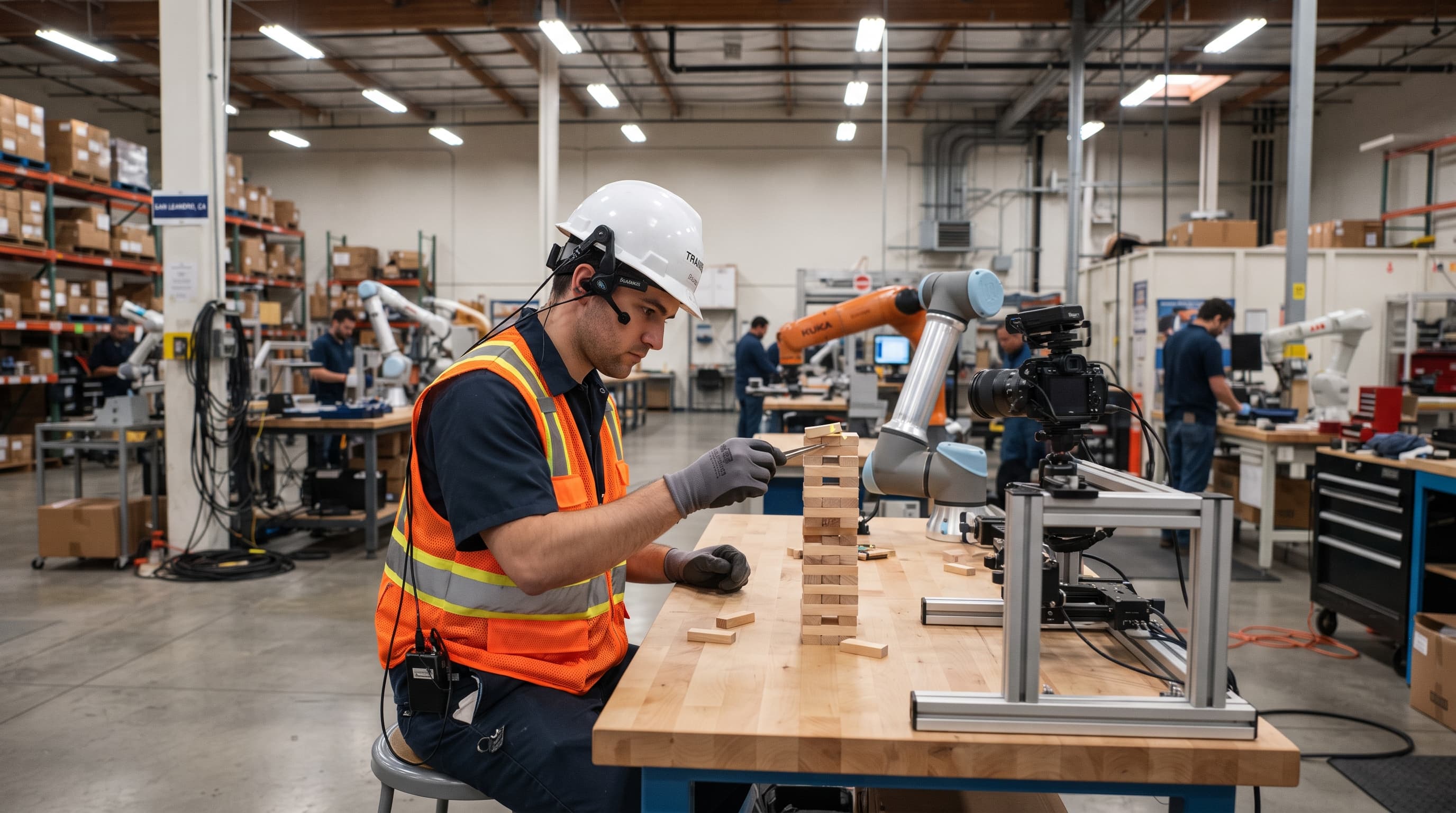
The frontier of physical AI is a Jenga game in a warehouse in San Leandro, California.
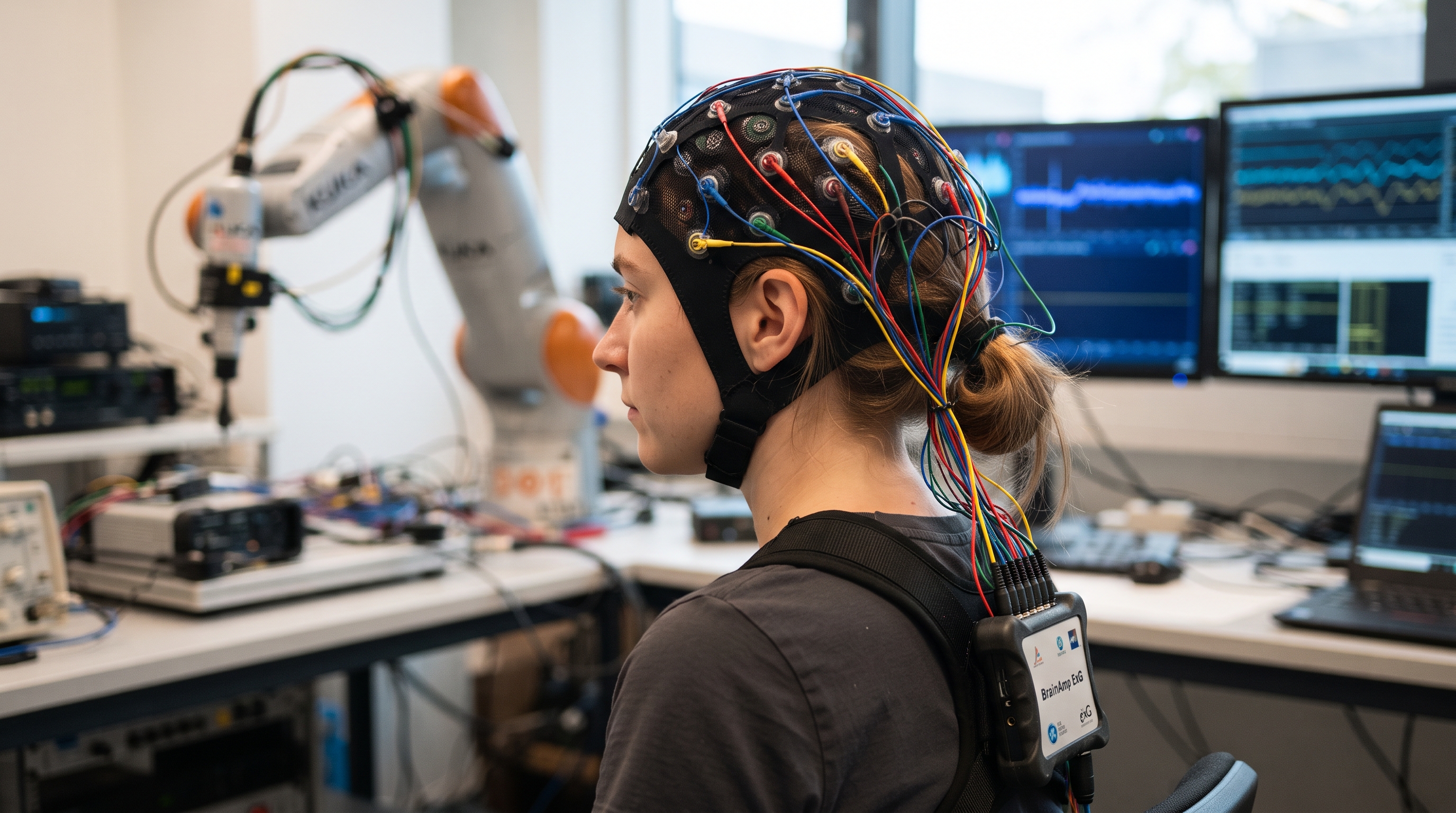
A worker named Andrew Ceja carefully pulls wooden blocks from a tottering tower. He's wearing a warehouse uniform, but also a headset covered in electrodes — the kind of EEG cap you'd expect to see in a neurology lab, not a robotics facility. Every time Ceja's brain signals a moment of error, intent, or surprise, that data point gets logged and fed into a model that will one day teach a robot hand to do the same thing.
This is the bleeding edge of solving the robotics data bottleneck. And it reveals an uncomfortable truth about the AI industry: the methods that worked for building chatbots are failing for building robots.
The physical world can't be scraped
LLMs like GPT-5 and Claude Opus 5 were trained on trillions of words scraped from the open web — Reddit threads, Wikipedia articles, GitHub repositories, PDFs. The internet is, in effect, one giant training dataset for language. But no equivalent exists for the physical world.
"You can't scrape a Jenga tower," as one Encord engineer put it.
The bet that generative AI can do for robots what it's done for chatbots keeps running into this same wall. Self-driving car companies collect physical-world data themselves, but that's hard to scale. Every robotics company is essentially starting from scratch, building its own small datasets one demonstration at a time.
Encord was founded to help companies building machine-vision applications annotate data and evaluate models. As their customers — many leading robotics firms — pushed into physical AI, Encord realized the bottleneck wasn't model architecture. It was data.
Reading the mind to train the machine
Enter Zander Labs, a German neuroscience startup that builds EEG hardware capable of reading neural signals in real time. The company's insight is straightforward: when a human performs a physical task, their brain activity contains information that's invisible to cameras and sensors.
Lucas Gehrke, a Zander neuroscientist supervising the work at Encord's warehouse, explains that the amount of brain activity used at any point during a task offers clues for model builders. When a worker's brain lights up during a particular motion — say, adjusting grip pressure on a slippery object — that's a signal that the motion is cognitively demanding and needs more training data.
The EEG headset turns this intuition into measurable data. Instead of relying on cameras to guess when a task is difficult, the system reads the worker's brain directly.
Vineeth Velmurugan, Encord's head of robot learning and a veteran of OpenAI's robotics lab and Berkshire Grey, calls this the "bleeding edge" of the effort to solve the data bottleneck. "We're not just watching what people do," he says. "We're watching how hard their brains are working to do it."
Beyond brain waves
Brain waves are just one of several unconventional data modalities Encord is exploring. In the same San Leandro facility, pilots use leader-follower rigs — paired robotic arms, with one controlled directly by a human and the other mimicking its movements — to generate data about tasks like plugging Ethernet cables into server racks. Another experiment uses a set of sensors strapped to the forearm to detect electrical signals in muscles, since video of human hands often misses the subtle grip adjustments that matter most.
The company also collects "egocentric" video from workers wearing cameras at several factories around the globe. Each frame is annotated with physical descriptions — "right hand tightens bolt" — to help LLM-based models understand what's happening.
The scale of the challenge is enormous. Velmurugan estimates that physical-world training data costs roughly 20 times more to produce than text data. That's an improvement — it used to be worse — but it means the robotics industry is spending heavily just to get the data that LLM builders got for free.
The Jenga game tells a bigger story
The fact that Encord is running brain wave experiments in a warehouse with a Jenga tower is itself a sign of the industry's state. Robotics has made spectacular progress in recent years — humanoids from Boston Dynamics, Figure, and Tesla can walk, run, and manipulate objects. But the gap between a robot that can perform a task in a lab and one that can perform it reliably in the real world remains vast.
The data bottleneck is the reason. And the solutions being tried — EEG headsets, muscle sensors, leader-follower rigs — are creative but also reveal how early the field still is.
There's a cautious optimism at Encord's facility. The pilots, like Ceja and Sofia Infante, are part of a burgeoning workforce that develops the building blocks for neural networks. They previously worked at Amazon warehouses. Now they train the robots that may one day replace them.
Sources
- Are brain waves the next unlock for physical AI? — TechCrunch
- Encord creates real world datasets to train physical AI — Межа
- Brain waves may be the next frontier for training physical AI — Bitcoin World
- Encord Tests Brain Wave Sensors to Train AI Robots — Whalesbook
- New Step for Physical AI: How Brain Waves Train Robots — Zamin.uz