Claude Code Will Now Approve Its Own Actions
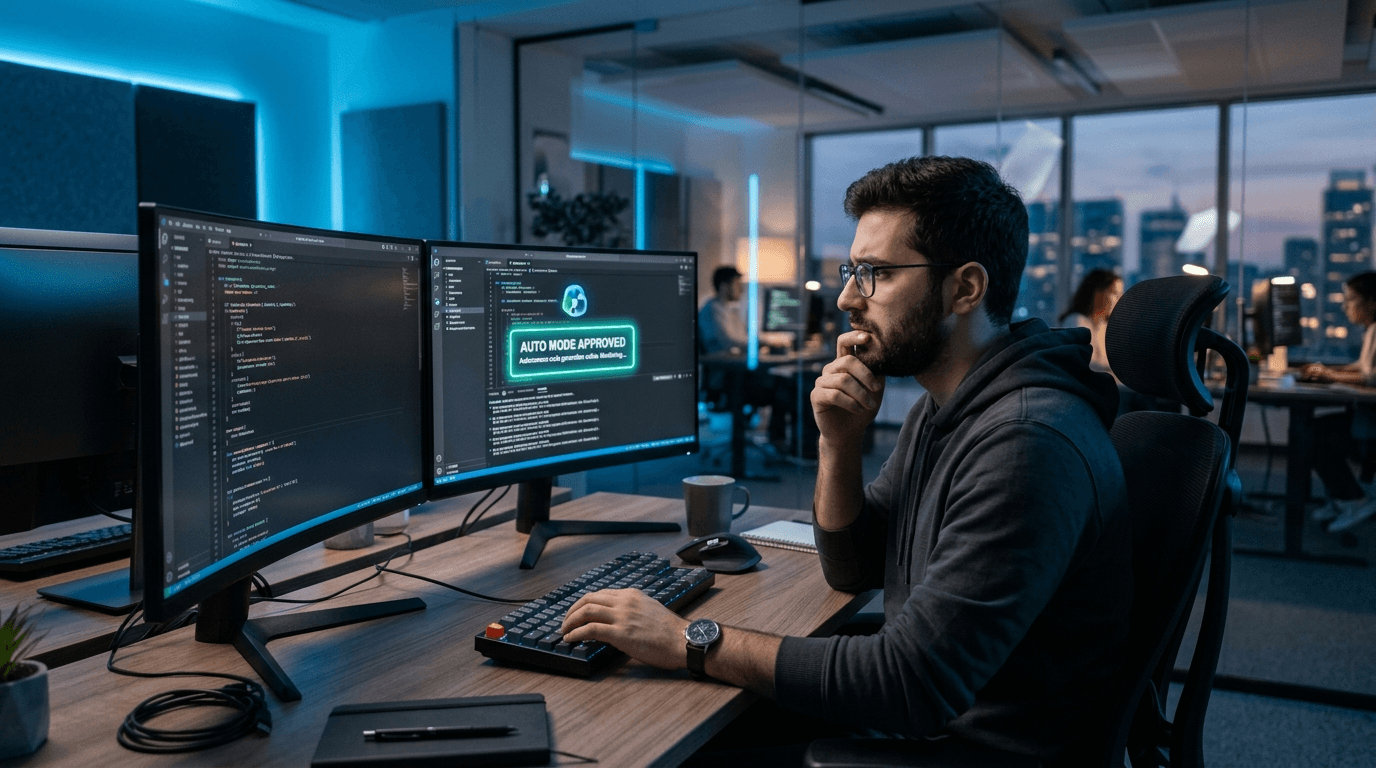
We have been training our own replacement, and we are very good at it.
Developers approve 97% of the permission prompts Claude Code shows them. Not because they read each one carefully and decided it was safe, but because the prompts appear so often that approving them has become muscle memory. Anthropic ran the numbers, saw the same pattern, and decided the approval dialog was a security theater that made everyone feel safer without actually being safer.
Starting August 14, Claude Code switches to auto mode by default for Pro, Max, and Team accounts. Instead of asking for permission at every step, the tool will proceed with its own actions unless a classifier determines the action is irreversible, destructive, or aimed outside the developer's environment. Enterprise customers keep the opt-in model.
The move is a quiet admission that the permission-based safety model for AI coding tools has been failing in practice, even if it looked good in theory.
How Auto Mode Works
Claude Code's auto mode is not a simple on-off switch. Anthropic built a classifier that runs before every action the tool wants to take. If the action is routine (edit a file, run a test, push a commit), the classifier lets it through. If the action could be destructive (delete a production database, modify infrastructure, exfiltrate data), the classifier pauses and asks for human confirmation.
The threshold is deliberately conservative. According to Anthropic, the classifier only lets auto mode proceed with actions that are not "irreversible, destructive, or aimed outside your environment." Anything that crosses those lines still requires a human to sign off.
Anthropic also added prompt injection screening to the auto mode pipeline. If an attacker tries to hijack Claude Code by injecting malicious instructions into code it reads, the classifier is supposed to catch it before the action executes. Customizable hard deny rules let organizations block specific actions entirely, regardless of what the classifier decides.
The Numbers That Justify the Change
Anthropic's internal testing paints a stark picture of human oversight. In a study with 1,053 paid testers, auto mode caught 89% of harmful actions. Human reviewers, faced with the same scenarios, caught only 13.6%. The gap is largely explained by the 97% approval rate developers show for permission prompts -- when you approve nearly everything, you are not really reviewing anything.
The company also ran an internal red-teaming exercise where auto mode stopped Claude from uploading confidential data to a public page. In one long session, it killed roughly 2,000 processes that would have disrupted ongoing GPU training jobs.
Teams using auto mode generated about 25% more pull requests than teams using manual approval mode, according to Anthropic's data. The productivity gain comes from removing the friction of constant approval clicks, not from the AI being smarter.
An independent audit by Trajectory Labs tested auto mode's security boundaries. The firm ran 72 attack scenarios ten times each against Claude's current models -- Fable 5, Opus 5, and Sonnet 5 -- in auto mode. None of the 720 attempts succeeded. The same audit found that 5.83% of similar attacks bypassed OpenAI's GPT-5.6 Sol in Codex Auto-Review mode.
The Reviewer Paradox
Anthropic's own guidance undercuts the confidence its numbers project. "For high-stakes changes to production infrastructure, we still recommend reviewing Claude's actions yourself," the company writes.
This creates a paradox. The less often developers step in to review auto mode's decisions, the more important their occasional oversight becomes. But a developer who has been reviewing AI-generated code for weeks, approving or rejecting hundreds of actions without deep engagement, is not building the kind of project understanding that makes their review meaningful when it actually matters.
Claude Code head Boris Cherny does not seem worried. "The team and I use Auto mode exclusively, and have been for many months. I could not imagine going back to permission prompts," he wrote on X.
The Business Case
Anthropic does not charge for the tokens the classifier consumes. But making auto mode the default has a clear business logic: when Claude Code works longer and gets more done, total token usage goes up, and so does revenue. Anthropic's announcement frames the change as a safety improvement, which it may genuinely be, but the financial incentive aligns neatly with the product decision.
Claude Code is currently the most widely used AI coding tool by a wide margin, according to multiple industry surveys. Making auto mode the default pushes the developer's role further from active coding and closer to reviewing AI-generated output. Whether that shift makes developers more productive or simply less engaged is a question the industry will answer over the next year.
Sources
- TechCrunch: Anthropic is turning Claude Code's auto mode on by default
- The Decoder: Anthropic sets Claude Code to Auto Mode by default to protect developers from bad approvals
- 9to5Mac: PSA: Claude Code enabling auto mode as default next week, Anthropic says
- The New Stack: Auto Mode will soon be the default in Claude Code - because humans can't be trusted