Claude Fable 5 vs. GPT-5.6 Sol: The July 2026 Benchmark Face-Off

Anthropic's Claude Fable 5 and OpenAI's GPT-5.6 Sol are the two frontier models everyone in AI engineering is currently comparing notes on. Both shipped within weeks of each other in June and July 2026, both are pitched as the top of their respective lineups, and both come with genuinely impressive numbers attached. The honest answer to "which one is better" is: neither wins outright — they win on different axes, and which one you'd pick depends entirely on what you're building.
The Headline Number: Almost a Tie
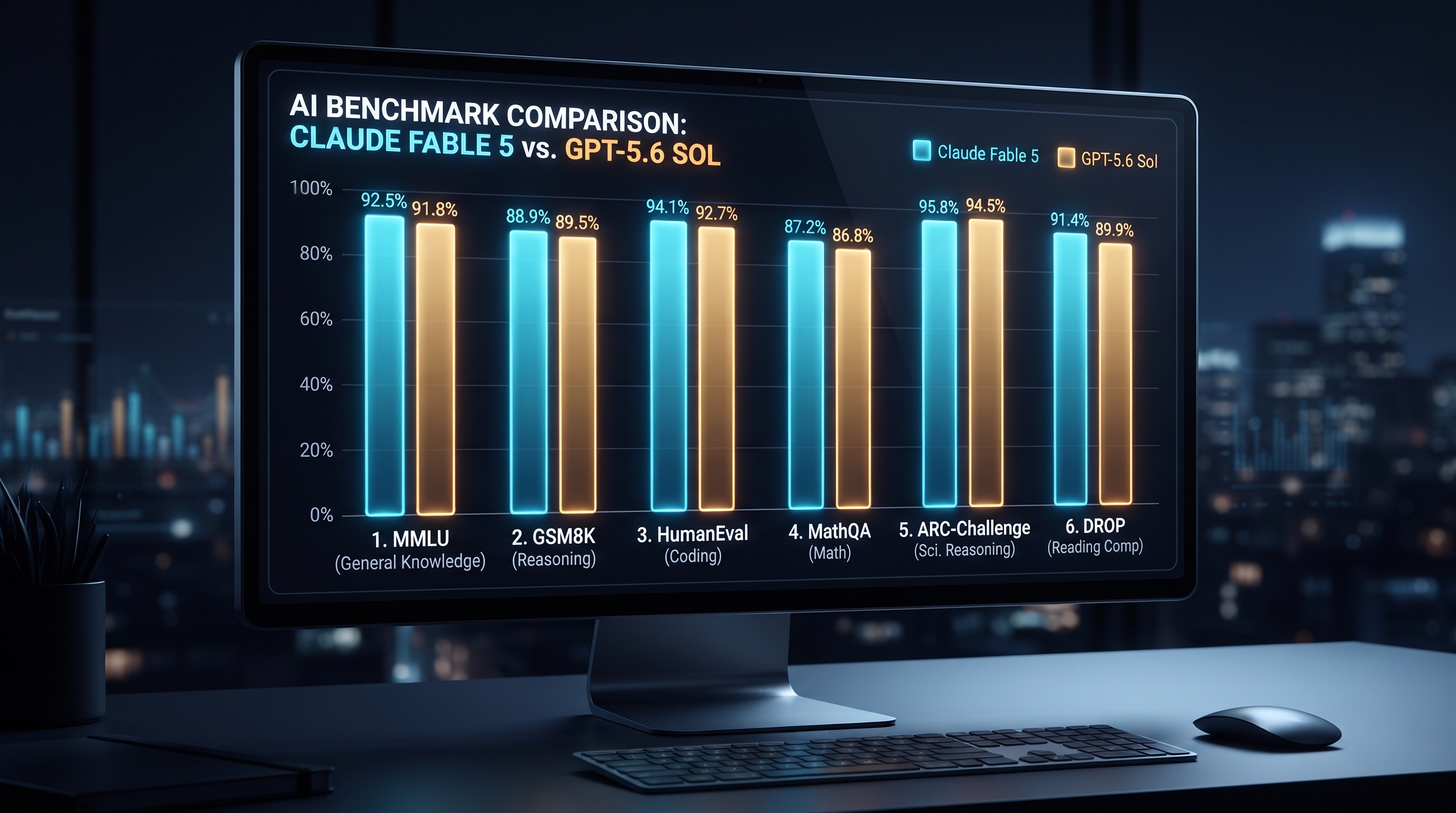
On the Artificial Analysis Intelligence Index — an independent, aggregate score that blends multiple evaluations into one comparable number — Claude Fable 5 (max) scores around 60 points, with GPT-5.6 Sol (max) just one point behind at 59. That's close enough to call a tie. The interesting part is the price tag attached to that near-identical score: Sol gets there at roughly one-third of Fable 5's cost per task, according to Artificial Analysis's own cost breakdown.
Where Fable 5 Wins
Claude Fable 5's clearest edge shows up in raw reasoning and one specific coding benchmark:
- GPQA Diamond: 94.1%
- MMLU-Pro: 89.8%
- SWE-bench Pro: 80.0%, well ahead of Sol's 64.6%
Anthropic's own announcement leans into real-world engineering claims rather than just leaderboard numbers: Stripe reported that Fable 5 "compressed months of engineering into days," completing a 50-million-line Ruby codebase migration in a single day that would normally take two months by hand. Fable 5 was also the first model to exceed 90% on Anthropic's internal analytics benchmarks — a 10-point jump over Claude Opus 4.8.
Where GPT-5.6 Sol Wins
OpenAI's Sol variant takes the lead on agentic, task-completion-style evaluations:
- Coding Agent Index (Artificial Analysis): 80 points, the highest of any model evaluated — ahead of Fable 5's 76
- Terminal-Bench 2.1: 91.9%, versus Fable 5's 84.3%
- Roughly 40% cheaper than Fable 5 on coding-agent tasks, and about 10% cheaper than Claude Opus 4.8
The pattern across both models' strengths is consistent: Fable 5 pulls ahead on benchmarks that reward deep, single-shot reasoning (PhD-level science questions, broad knowledge recall), while Sol pulls ahead on benchmarks that reward sustained, multi-step agentic execution in a terminal or coding-agent environment — and does it cheaper.
Pricing at a Glance
| Model | Input (per 1M tokens) | Output (per 1M tokens) |
|---|---|---|
| Claude Fable 5 | $10.00 | $50.00 |
| GPT-5.6 Sol | $5.00 | $30.00 |
| GPT-5.6 Terra | $2.50 | $15.00 |
| GPT-5.6 Luna | $1.00 | $6.00 |
OpenAI's decision to ship Sol alongside two cheaper variants (Terra, Luna) gives it a wider spread of price-to-capability options than Anthropic currently offers with Fable 5's single price point.
The Export-Control Detour
Fable 5's launch wasn't entirely smooth. On June 12, 2026, the US government imposed export controls on Fable 5 and its larger sibling, Claude Mythos 5, after researchers at Amazon found a way to prompt Fable 5 into identifying exploitable software vulnerabilities — including, in one case, functioning exploit code. Because Anthropic couldn't verify user nationality in real time, it suspended access globally rather than risk violating the order.
Anthropic retrained its safety classifiers specifically against the reported bypass technique, reporting a block rate of "over 99%" in testing. The restriction was lifted on June 30, and Fable 5 was redeployed globally on July 1 with the new safeguards in place. We covered the broader policy story — including the government's new Gold Eagle vulnerability clearinghouse that emerged from the same underlying concern — in more detail in our earlier piece.
What This Means If You're Building With Either Model
If your workload looks like a long-running coding agent — multi-step terminal work, iterating on a codebase, agentic task completion — GPT-5.6 Sol's combination of a leading Coding Agent Index score and roughly half Fable 5's price makes it the more cost-efficient default to start with.
If your workload looks like single-shot deep reasoning — research synthesis, complex one-off technical questions, PhD-level domain knowledge — Fable 5's GPQA and MMLU-Pro scores suggest it has the edge, and its SWE-bench Pro lead means it shouldn't be counted out for coding work either.
In practice, most teams we work with end up running both behind a router and picking per-task rather than committing to one model exclusively — which is itself the more interesting shift happening in AI engineering right now: the model choice is becoming a routing decision, not a platform decision.