Congress Is Letting AI Write the Laws
The most important law in the American defense budget was being drafted last month when someone in a Florida congresswoman's office accidentally filed a receipt for how the work actually gets done now. The text that landed in the public record of the National Defense Authorization Act read: "increasing example specific factors. Identical to H.R. 100 (118th Congress).11:25 AM????Claude responded:"
A staffer had copied the output of an Anthropic Claude prompt into the official record without checking what they were pasting. The garbled line, timestamp and all, came from a chatbot session, not from a human drafting a defense bill.
The people writing the rules on AI are drafting the laws with AI.
A Capitol Hill confession
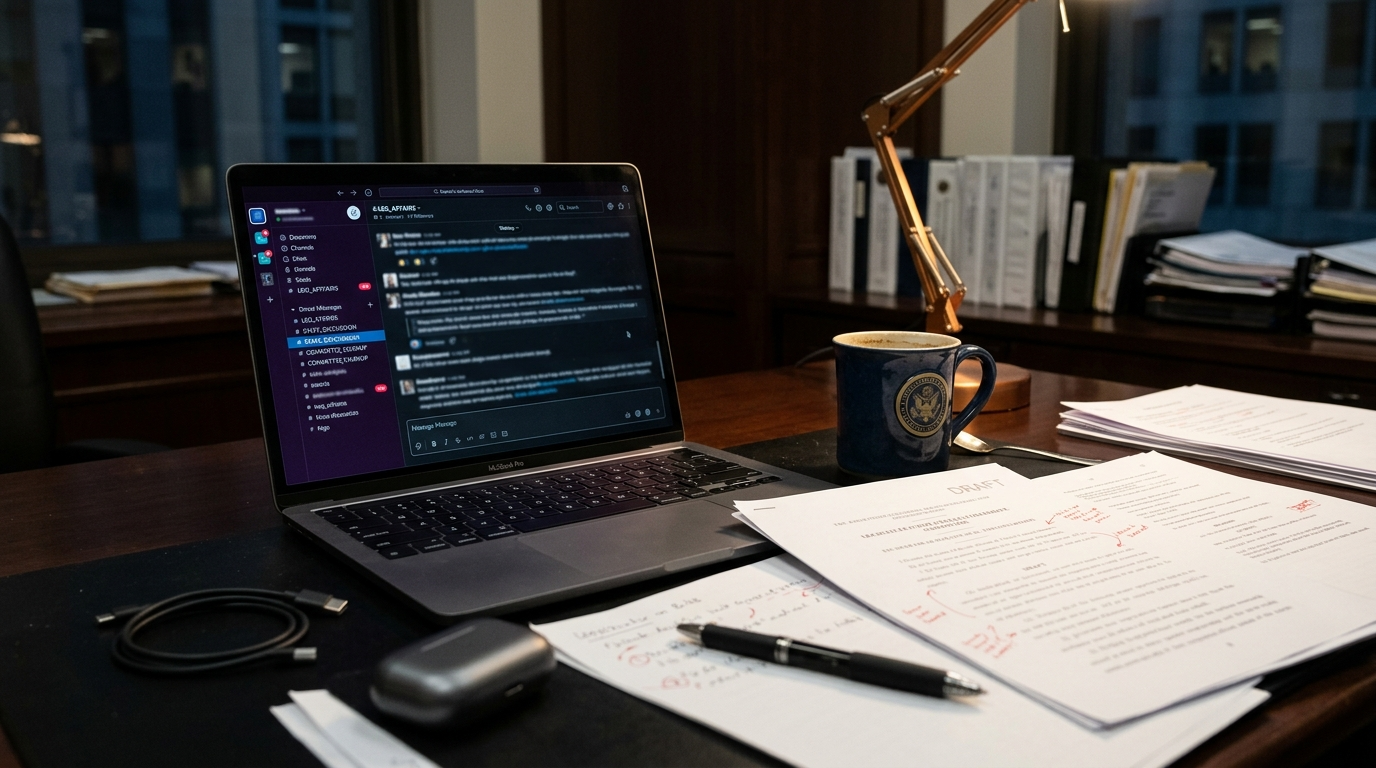
The Washington Post reported this month that AI chatbots have become routine in both chambers of Congress. Staffers use ChatGPT, Claude, and Grok to draft legislation, write speeches, summarize documents, and research policy positions. Representative Anna Paulina Luna (R-FL), whose office produced the NDAA paste, was unapologetic about it.
"A lot of staff will use ChatGPT, Claude, Grok," Luna told the Post. "I personally like Grok better, but my staffer prefers Claude. I'm not gonna knock him for that. There's nothing illegal about him doing a summary."
She is right that there is no law against it. That is precisely the problem. There is no law, no rule, and no oversight governing how AI is used in the legislative process. No staffer has ever been formally disciplined for AI use on Capitol Hill.
The unsupervised aide problem
The risk is not the representative who asks a chatbot for a summary. The risk is the junior aide working late, under deadline, who uses AI to draft language and never verifies it. The Washington Post found that unsupervised use by aides is widespread and that there is no institutional framework to catch the mistakes.
Some staffers have quietly built their own guardrails. Sydney Broome, an aide to Representative Cleo Fields (D-LA), told the Post she decided never to use AI tools to write documents from scratch. She borrowed the rule from a college course. Congress itself has adopted no such rule.
The consequences are already visible. Lawyers have been caught citing hallucinated court cases. Consulting firms have shipped nonsensical AI reports. Teachers now revise essays that students generated with the same tools. Congress is not exempt from any of this. It is simply the latest institution to discover that AI output looks authoritative and is not.
A patchwork of no policy
Capitol Hill has no central AI policy. Each office decides for itself. Some representatives have admitted to consulting chatbots for research. Others, like Luna, actively encourage their teams to use the tools. A few, like Fields' office, have self-imposed restrictions. The result is a patchwork where the people writing federal law operate under standards that vary from office to office.
The lack of rules is deliberate in a way. The Trump administration has pushed every corner of the federal government to adopt AI aggressively. Congress, which regulates the agencies that use AI, is now a heavy user itself, without the guardrails it expects from the departments it oversees.
What could go wrong
The NDAA paste was harmless, an embarrassing typo in a public record. The failure mode that matters is quieter. A hallucinated statistic in a bill's findings section. A fabricated legal citation in an amendment. A policy recommendation based on a model's confident guess rather than on the actual record. None of these would be caught, because nobody is looking.
There is also the accountability problem. If an AI draft becomes law and the law is flawed, who is responsible? The staffer who prompted the model? The model vendor? The representative who submitted it? The current answer is nobody, which is a dangerous answer for the institution that writes the rules everyone else has to follow.
The institution that regulates AI uses AI unregulated
The irony is structural. Congress is currently debating how to regulate artificial intelligence, from watermarking requirements to liability frameworks. The regulators are already dependent on the regulated technology, with no oversight mechanism of their own. A staffer's Claude prompt in the NDAA record is the visible symptom of an invisible institutional change: the legislative branch has outsourced part of its thinking to models it does not understand and does not govern.
The NDAA artifact will be forgotten. The pattern it revealed will not. The people writing America's AI rules are prompting AI to help write them, and the only difference between this and every other AI-in-the-workplace story is that here, the output becomes law.
Sources
- Congressional Staffers Are So Lazy That They're Using AI to Write New Laws, Futurism
- Chatbots are doing the work of Congress with little oversight, The Washington Post (via Google News)
- Anna Paulina Luna Defends Claude AI Mistake In Bill Summary, Forbes (via Google News)
- MAGA Congresswoman Caught Using AI to Write National Security Bill, Yahoo News (via Google News)