Teens Shrug at AI: 'Bruh' and 'Meh'
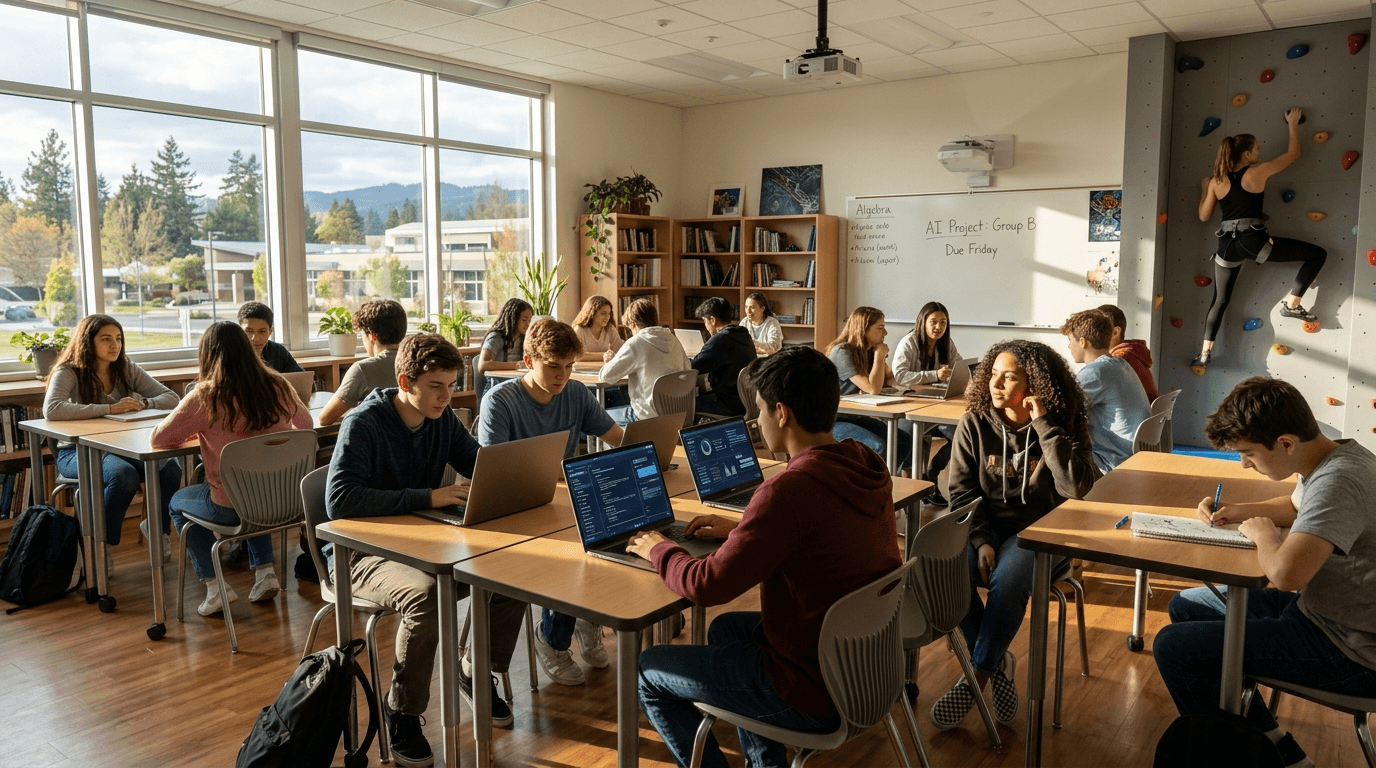
The generation that will inherit AI has something to tell you
Adults debate whether AI will save humanity or destroy it. The generation that will actually inherit the technology has a different reaction: "bruh" and "meh."
When MIT Technology Review set out to interview kids aged 10 to 18 about artificial intelligence, they expected the usual generational story. Some teens would be using it to cheat. Others would be excited about the possibilities. A few would worry about deepfakes and job loss.
Instead, what they got was a shrug. Many of the same kids who can go on and on about music, rock climbing, or soccer met questions about AI with indifference. One teen said his peers use it for things they know they should not, like writing papers. Another told MIT she will not touch AI because of the environmental impact. A few said they find the whole field disheartening.
"I'm afraid it's going to be the end of creativity and critical thinking," said Winter, 17.
The Pew Research Center's February 2026 survey of US teens backs up the complexity. 57% of teens had used AI chatbots to search for information. 54% tapped them for schoolwork. 47% used them for fun or entertainment. Only 12% turned to them for emotional support or advice. Teens are more than four times as likely to be using AI in innocuous ways than in potentially harmful ones.
But the statistic that stands out is the shrug. AI is not yet a thing that kids are begging for, the way they beg for iPhones or Snapchat accounts. It is just there, embedded in the devices and apps they already rely on.
The water in the room: data centers as the new oil rig
The most surprising theme that emerged from the MIT interviews was not about job loss, screen time, or cheating. It was about water.
A teen who described herself as a rock climber and aspiring ecologist explained why she refuses to engage with AI at all. "The part that bothers me most about AI is the data centers that companies are building to enable it," she said. "They house these huge blocks of servers that use enormous amounts of water. They take it from local towns and do not leave enough behind for the people who actually live there. And when they get big enough, they put off so much heat they can raise the local temperature a degree or two."
She makes small choices. When AI pops up somewhere, she does not engage. "It can feel isolating when everyone around me is using it, but I do not want AI to be the thing that kills the places I love."
This is not a fringe view. As AI data centers multiply across the US, local communities are pushing back against the water consumption of server farms. A generation that grew up with climate anxiety is noticing.
The builders: teens who are not waiting for permission
Not every teen is indifferent. Some are building.
A 17-year-old who had always liked building things -- Lego builds, Minecraft worlds, then video games in Scratch -- found himself spending so much time studying that he had no time to build. Khan Academy's AI tutor was stuck behind a waitlist. So he built his own.
He created Aceflow, an AI tutoring platform: feed it any lecture, blog post, or textbook, and it spins up practice questions with a tutor that explains things the way a teacher would. He built it for himself, showed it to his friends, and then put it on TikTok. It went viral.
"Was I worried people would call it cheating?" he said. "Not really. A tool like this is not so different from well-off families hiring expensive private tutors, except everyone gets one."
That project led to part-time roles at BenchSci, a Canadian AI company, and Simple Ventures, a venture firm. More recently, he joined an AI lab at MIT, co-instructed an AI agents course with an MIT professor, and launched Learnly, an SAT prep platform that uses AI to adapt to each student.
Another teen, diagnosed with type 1 diabetes in January, now uses AI in a more intimate way. His glucose monitor and insulin pump talk to each other using their own AI to predict dosing. "If it predicts that my blood sugar will be high in 30 minutes, it gives me a correction dose, and if it predicts I am about to go low, it stops the insulin before that happens," he said. "When I was first diagnosed I was still doing shots, and I went low almost every night. Now I just get to sleep more because of it."
The accidental generation: AI is background noise
For most teens, AI is not a thing they choose or reject. It is just there.
A 10-year-old who likes to draw and write songs described AI as "a little like a calculator. A calculator does the math for you, and AI does other things for you." She was surprised to learn that songs she liked on Spotify were actually made by AI. She still likes the songs, but the discovery unsettled her.
Teens are acutely aware of AI's limits. One boy who uses Character.AI to build characters and play games noted that the free version's memory runs out. "Get far enough into a chat and it slows down and forgets what happened. It is like everything else with AI. If you trust it to run on its own, it falls apart. You have to keep steering it."
A 17-year-old who uses AI for programming outside of school put it this way: "I think AI right now is sort of like the first car or the first airplane. It is interesting but crude. It is obviously an amazing invention but not actually good yet."
The fear that is not about jobs
Adults tend to frame AI anxiety around employment. Teens are more worried about something else.
Several teens told MIT they were concerned about misinformation, eroding critical thinking, and the spread of AI-generated content. One 17-year-old, studying engineering and building a civic AI agent that scrapes government documents and turns them into plain-language newsletters, said: "I am most worried about our ability to think critically and the potential for misinformation, disinformation, and biases to be spread through too much trust in AI."
His project is an AI agent system that reads city council websites, proposed bills, and meeting transcripts, then delivers a weekly newsletter with cited, plain-language bullet points. "We made it because right now, it feels as if most teens are not very engaged. I was in English class when the war in Ukraine came up and someone said, 'There is a war going on?'"
The project's goal: reduce the barriers to democratic participation. "We do not want AI to think for people," he said. "We want to use it to disperse knowledge. We want to deal people the cards and let them play them however they want."
Princeton voted to let faculty proctor exams for the first time in over a century, their honor code from 1893 now broken by AI. The signal is clear: the adults are scrambling to catch up with a technology the kids are already bored of.
A grounded take
The MIT article is unusually rich in direct, unprocessed voices, and it is worth reading the whole thing. The picture it paints is not the one the AI industry would want -- a generation that is neither awed nor terrified, but mostly indifferent, with a minority of thoughtful skeptics and an even smaller minority of builders.
The environmental angle -- data centers consuming water and raising local temperatures -- is a sleeping issue for the AI industry. If the generation that will inherit the technology is already turning away from it on environmental grounds, that is a reputational timeline that no amount of benchmark improvements will fix.
And the kids who are building are not doing it because they believe in AI hype. They are doing it because they identified a gap and wanted to fill it. That is the same impulse that built the personal computer revolution, and it is worth paying attention to.
Sources
- MIT Technology Review: How kids feel about AI, in their own words
- Pew Research Center: How Teens Use and View AI
- CBS News: Teens are using AI frequently in their daily lives, and many parents are not aware
- The Hill: Parents are underestimating their teens' use of AI chatbots: Survey
- The New York Times: More Than Half of Teens Use Chatbots for Schoolwork, Survey Finds
- USA Today: Our teens are using AI chatbots daily. It is our fault.