AI Agents Finally Coming for COBOL
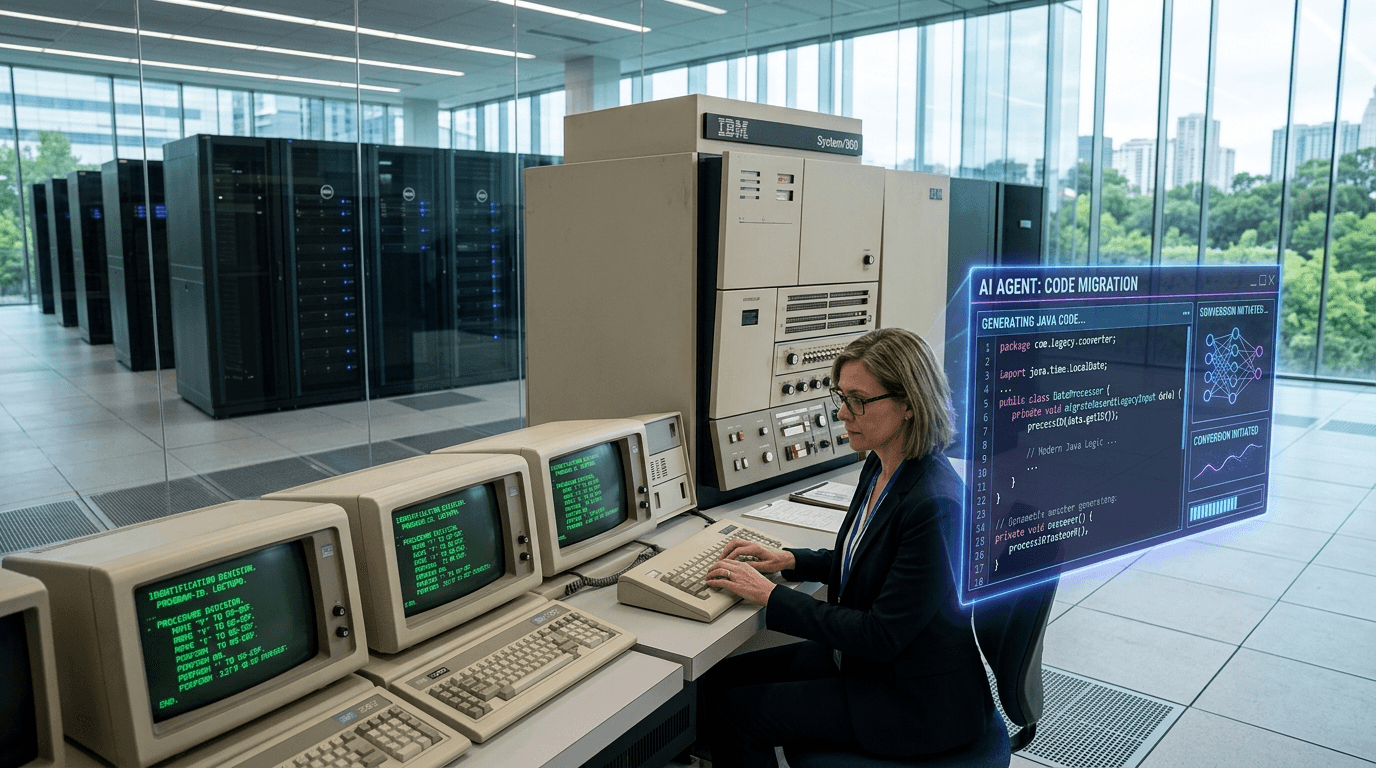

The most critical software in the world was written before humans walked on the moon. COBOL, a programming language that debuted in 1959, still handles 95% of all ATM transactions and runs the ledger systems of most major banks, insurance companies, and government agencies. And the people who know how to maintain it are retiring faster than replacements can be trained.
A startup called Hypercubic thinks AI agents can finally solve this problem. The company, founded by former Apple engineers Sai Gurrapu and Aayush Narik, announced a $5.3 million seed round led by CIV with participation from Y Combinator, Afore Capital, and others. Their pitch: autonomous AI agents that can read decades-old COBOL codebases, recover the business logic buried inside them, and rewrite everything in a modern language like Java.
"The problem is not simply translating COBOL syntax," Gurrapu told SiliconAngle. "The real challenge is recovering decades of hidden business logic, understanding how systems behave in production, and proving that a modern replacement preserves what matters."
The 200-billion-line time bomb
COBOL's longevity is its own worst enemy. An estimated 200 billion lines of the language are still in active use, powering everything from credit card authorizations to Social Security benefit calculations. But the programmer population that understands it has been shrinking for decades.
The original COBOL developers retired long ago. The second generation, who learned COBOL in the 1980s and 1990s, is now aging out. One estimate suggests 90% of current COBOL engineers will retire within the next five to ten years. For institutions running critical systems on COBOL, the math is simple: modernize or face a staffing crisis with no solution.
Manual modernization has been tried. It takes years, costs millions, and carries enormous risk. A single undocumented change in a monolithic COBOL program can crash a bank's ledger or freeze a government's payment system. COBOL has often been compared to asbestos: toxic, deeply embedded, and extraordinarily expensive to remove.
How AI agents crack the problem
Hypercubic's approach differs from earlier attempts by treating the COBOL codebase as something to be understood, not just translated. When the system encounters a legacy application, its AI agents first map the entire codebase, recovering the business logic that has accumulated over decades of patches and modifications. That logic has almost never been formally documented. The agents generate that documentation automatically.
With the recovered business logic in hand, the agents produce a functionally identical replica of the original application in a modern programming language, complete with historical data. Gurrapu says this process takes a couple of months per application, compared to the years required for manual rewrites.
The startup is already working with one of the largest banks in Latin America and a Caribbean retailer serving more than 50 million customers annually.
A wider COBOL AI race
Hypercubic is not the only player betting on AI to solve the COBOL crisis. Anthropic has been positioning Claude Code as a tool for COBOL modernization, arguing that AI assistance can streamline what has historically been a cost-prohibitive process. IBM, which has its own COBOL modernization tools and a vested interest in mainframe computing, has pushed back, warning that AI-generated code introduces regulatory and reliability risks that financial institutions cannot afford.
The debate mirrors a broader tension in enterprise AI adoption. When the system in question handles money, benefits, or personal data, "move fast and break things" is not an option. Hypercubic's approach -- exhaustive mapping and documentation before any rewriting happens -- is a direct response to that constraint.
The human cost of a silent crisis
Behind the technical challenge is a human one. COBOL programmers are a vanishing profession. Many of them learned the language decades ago and have spent entire careers maintaining systems that most younger developers have never seen. When they retire, decades of undocumented institutional knowledge leaves with them.
AI agents cannot replace that experience entirely. But they can capture it before it is lost. Hypercubic's founders describe their system as a preservation mechanism as much as a modernization tool: read everything, document everything, then translate. By the time the current generation of COBOL engineers retires, the knowledge encoded in their systems will have been transferred to something the next generation can actually work with.
The alternative is a world where the financial system runs on code nobody can read anymore. That world is only five to ten years away. Hypercubic, Anthropic, and their competitors are racing to make sure it never arrives.
Sources
- Hypercubic raises $5.3M to rewrite legacy COBOL apps with AI agents -- SiliconAngle
- Modernizing legacy IT with AI without triggering regulatory risk -- CIO.com
- Anthropic says Claude Code can help streamline COBOL modernization -- Techzine Global
- IBM vs. Anthropic: A Tale of the COBOL Modernization Tape -- The Futurum Group