Mistral + Mozilla: Open AI Comes to Your Browser
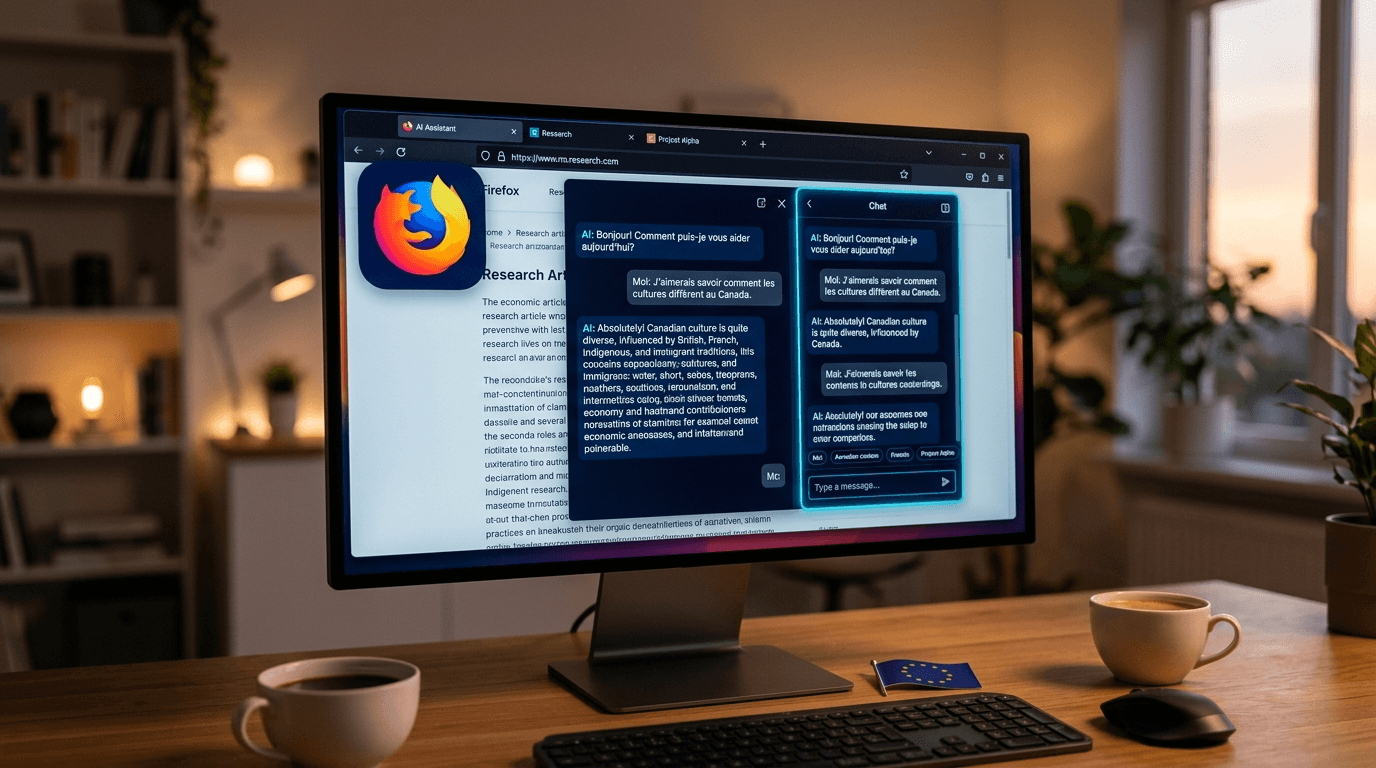
Two open-source giants bet on open distribution
For years, the AI industry has operated under an unwritten assumption: the companies that win are the ones that own the user. OpenAI has ChatGPT. Google has Gemini built into Android and Chrome. Microsoft has Copilot embedded in Windows and Office. The closed models live where the users already are.
Today, two organizations that have never had that luxury joined forces to prove there is another path. Mistral, the French AI lab behind some of the most capable open-weight models in the world, announced a partnership with Mozilla to power Firefox's Smart Window (beta) -- an AI browsing assistant that brings private, multilingual intelligence directly into the browser.
The move is not just a product integration. It is a bet that open-source AI can reach 200 million users through an open-source browser, without asking them to sign up for a Big Tech ecosystem.
What Smart Window does
Firefox Smart Window, currently in beta, is Mozilla's answer to the AI-assisted browsing trend that has swept Chrome, Edge, and Safari. It helps users make sense of complex searches across multiple tabs, remembers important information the user might have clicked away from, and surfaces relevant content based on open browser tabs.
What makes this version different is what powers it. Instead of a proprietary model from Google, Microsoft, or OpenAI -- the default choices for most browser AI integrations -- Smart Window runs on Mistral's open-weight models. The integration launches in France and North America, with the United Kingdom and Germany expected to follow later this year.

Four pillars of the partnership
Mistral's announcement laid out four reasons this partnership matters for the global AI ecosystem, each addressing a different weakness in the current closed-model paradigm.
Open technology needs open distribution. Mozilla has spent 24 years fighting for an open web. Mistral has released open-weight frontier models since its first launch. The partnership is designed to demonstrate that open-source AI can serve real users at scale, not just sit on GitHub as a research artifact.
Multilingual AI requires local roots. Mistral fine-tunes its models on regional languages and dialects -- not just English with a translation layer. The Smart Window experience adapts to how people actually speak in France, North America, and eventually the UK and Germany. A user in Lyon gets responses that understand local nuance, not generic American English.
User control over AI interactions. Firefox has privacy in its DNA. The Smart Window implementation reflects this: conversations are not saved on Mozilla's servers by default, and Mistral has agreed to zero data retention. Users get AI assistance without the standard trade-off of handing over their browsing history to a model provider.
Sovereign AI in everyone's hands. European regulators have spent years worrying about data sovereignty and dependence on US cloud providers. A French AI lab powering a European browser's AI features -- with zero data retention -- is the concrete alternative policymakers have been asking for.
The open distribution question
Mistral is not the first company to realize that having a great model is only half the battle. OpenAI's ChatGPT benefits from being the default experience for millions who never installed a separate app. Google's Gemini is pre-installed on every Android device. Even Anthropic, which resisted the consumer play for years, launched its Claude apps aggressively in 2025.
Mistral's distribution problem has been its Achilles' heel. Despite producing models that regularly benchmark within striking distance of GPT and Claude -- and often beating them on cost-efficiency -- the French lab has struggled to convert technical respect into mainstream adoption. Its enterprise business is real (customers include ASML, CMA CGM, and HSBC), but consumer awareness has been near zero outside developer circles.
Firefox's 200 million monthly active users change that equation. Even a fraction of those users interacting with Mistral-powered Smart Window represents more real-world AI usage than Mistral has ever had.
The catch, of course, is that Firefox itself is fighting for relevance. Its market share has declined steadily over the past decade, from a peak of 32% in 2012 to single digits in most markets today. But Firefox's user base is also unusually loyal and privacy-conscious -- exactly the demographic most likely to care about open-weight AI and zero data retention.
What this means for the AI landscape
The Mistral-Mozilla deal is the strongest signal yet that open-weight AI is shifting from a technical curiosity to a distribution reality. Three dynamics make this worth watching.
First, it creates a template. If Mistral can reach Firefox's users through an open-source browser integration, other open-weight providers -- Meta, Alibaba's Qwen team, the growing ecosystem of fine-tuned community models -- have a proven distribution channel to target.
Second, it pressures the browser AI market. Google already embeds Gemini into Chrome. Microsoft pushes Copilot through Edge. Apple Intelligence works across Safari and macOS. A privacy-first, open-model alternative changes the competitive calculus -- especially in Europe, where regulators are actively looking for non-American AI alternatives.
Third, it tests whether "open" matters to end users. For two years, the open vs. closed model debate has been a developer argument. Most consumers have never had the choice. Firefox Smart Window with Mistral models puts that choice directly in the browser address bar. If users choose it, the argument is settled.