Netflix Just Paid $587 Million for Ben Affleck's AI Startup — Here's What It Means for Hollywood
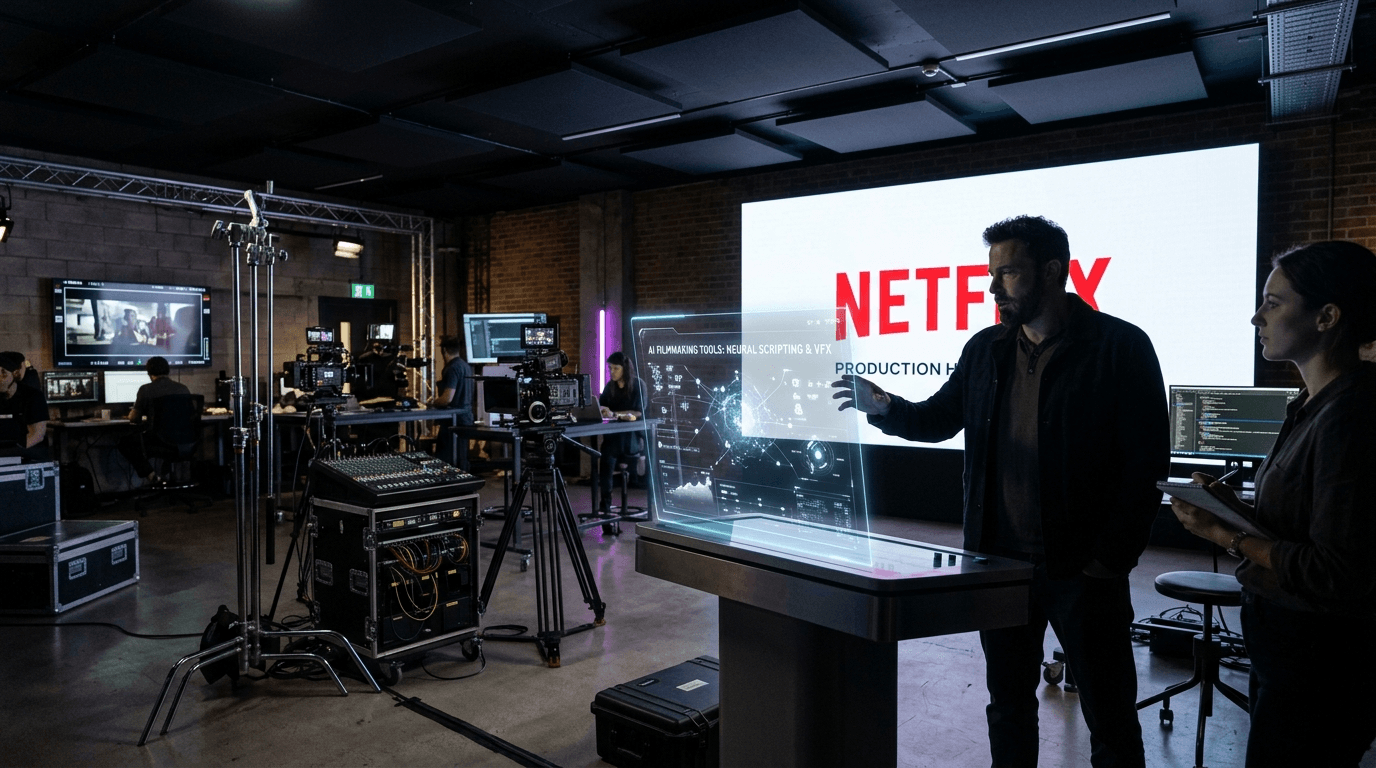
When Hollywood Met Silicon Valley — With a $587 Million Price Tag
The entertainment industry has long treated artificial intelligence as either a distant threat or a niche experiment. That changed last week when Netflix disclosed in an SEC filing that it had paid approximately $587 million to acquire InterPositive, an AI company co-founded by actor and director Ben Affleck. The figure — confirmed by The Hollywood Reporter and covered extensively by The Verge — makes this one of the most significant AI acquisitions in entertainment history, and it signals something far bigger than a single startup deal.
Disclosed as part of a routine quarterly filing, the $587 million payment was made in March 2026, the same month Netflix announced the InterPositive acquisition. While neither Netflix nor Affleck have commented publicly on the deal's specifics, the sheer scale of the investment speaks volumes: Netflix believes AI-powered content production is not a future possibility but a present necessity.
Who Is InterPositive and Why Is It Worth Half a Billion Dollars?
InterPositive was founded by Ben Affleck and a team of AI researchers with the stated goal of building tools that augment human creativity rather than replacing it. The company has operated largely in stealth mode, but sources familiar with its work describe a suite of AI-powered production tools spanning pre-visualization, real-time visual effects, automated editing workflows, and AI-assisted storyboarding.
What makes InterPositive strategically valuable to Netflix is not any single product but the integration potential. Netflix produces hundreds of original films and series annually across dozens of countries. A proprietary AI layer that accelerates every stage of production — from script breakdown to post-production — can translate into hundreds of millions in annual savings and, more importantly, faster release cycles that keep subscribers engaged.
The $587 million price tag puts InterPositive in rare company. It is larger than many entertainment-tech acquisitions and signals that Netflix views AI production tools as a core infrastructure investment, not an experimental side bet.
The Bigger Picture: Hollywood's AI Arms Race Has Begun
Netflix is not alone in this bet. Across the entertainment industry, every major studio is quietly building or buying AI capabilities:
Disney has invested heavily in AI for visual effects and has an internal AI research division. Warner Bros. Discovery and Paramount have both announced AI partnerships. And Sony Pictures recently demonstrated AI tools for automated dubbing and localization.
But Netflix's $587 million acquisition is the largest single bet any studio has made. It raises the stakes for competitors who must now decide whether to build their own AI stacks or acquire them at similarly eye-watering valuations. The streaming wars, which have lately been defined by password-sharing crackdowns and ad-tier launches, may pivot toward a new battleground: who has the best AI production pipeline.
This is not a niche concern. AI in entertainment is projected to be a $35 billion market by 2030, according to industry analysts. Studios that lag in AI adoption risk producing content slower and more expensively than rivals who have automated their workflows.
What This Means for Actors, Writers, and the Creative Workforce
The acquisition comes barely two years after the historic 2023 strikes by the Writers Guild of America (WGA) and SAG-AFTRA, where AI protections were a central negotiating issue. The strikes resulted in contractual guardrails around AI use, including requirements that writers be informed when AI is used in the writing process and that actors consent to digital replicas.
Netflix has publicly stated that InterPositive's tools are designed to "augment human creativity, not replace it." But the $587 million price tag suggests a level of integration that goes beyond experimental tooling. Industry observers note that AI-assisted pre-visualization and automated editing don't necessarily eliminate jobs — but they do shift the skills required, potentially marginalizing workers who cannot adapt.
The Hollywood Reporter's coverage noted that the deal has already drawn scrutiny from entertainment unions, who are monitoring how Netflix deploys InterPositive's technology across its production slate. The outcome could set precedents for how AI is used in content creation across the entire industry.
The Technology: What AI-Powered Filmmaking Actually Looks Like
InterPositive's technology stack reportedly includes several components that, taken together, represent a significant leap in AI-assisted filmmaking:
AI pre-visualization allows directors to generate rough versions of scenes from script text, experimenting with camera angles, lighting, and blocking before a single frame is shot. Real-time VFX enables on-set visual effects rendering that lets actors and directors see finished effects during filming rather than waiting for post-production. Automated editing uses machine learning to assemble rough cuts from raw footage, flagging the best takes based on performance quality and director preferences.
None of these replace human judgment — but they compress the time and cost of production dramatically. A pre-visualization that once took a team of artists a week can now be generated overnight. An edit that required multiple assistant editors can be roughed in hours. The savings compound across Netflix's enormous production slate.
Critically, these tools are designed to work within existing production pipelines, not replace them. A director still makes the creative decisions; the AI simply handles the grunt work faster. Whether that distinction holds as the technology improves is the open question that has the industry watching closely.
A Grounded Take: Don't Expect AI Movies Any Time Soon
For all the hand-wringing and excitement, it's worth remembering that AI-generated content still has serious limitations. The AI slop movies that have appeared on streaming platforms — covered recently by The Verge as "the new direct-to-video cash grabs" — are a far cry from the polished productions Netflix needs to retain its 300 million subscribers. The jump from AI-assisted tooling to AI-generated narratives that audiences actually want to watch is vast, and no one has bridged it yet.
What Netflix is buying with InterPositive is not a shortcut to AI-generated blockbusters. It's a productivity multiplier for the human creators who make the content people actually pay for. The question is whether that productivity gain will be shared with the creative workforce, captured entirely by the studio's bottom line, or — most likely — some messy combination of both.
The $587 million figure is a statement of intent. How Netflix deploys InterPositive's technology over the next 12-24 months will tell us whether that intent is collaborative or extractive. Either way, the AI era of Hollywood has officially begun.
Sources
- Netflix — "Innovation for Filmmaking, By Filmmakers: Why InterPositive Is Joining Netflix" (official announcement)
- The Hollywood Reporter — "Netflix Paid $587 Million for Ben Affleck's AI Company"
- The Verge — "AI slop movies are the new direct-to-video cash grabs" (Jul 15, 2026)
- TechCrunch — "Netflix paid $587M for Ben Affleck's AI filmmaking startup"