Your AI Consultant's AI Hallucinated

The cure became the disease
PricewaterhouseCoopers, one of the world's four largest professional services firms, has spent years building a practice that advises clients on AI governance, risk management, and responsible deployment. Its website is dense with whitepapers on trustworthy AI, ethical frameworks, and the importance of human oversight.
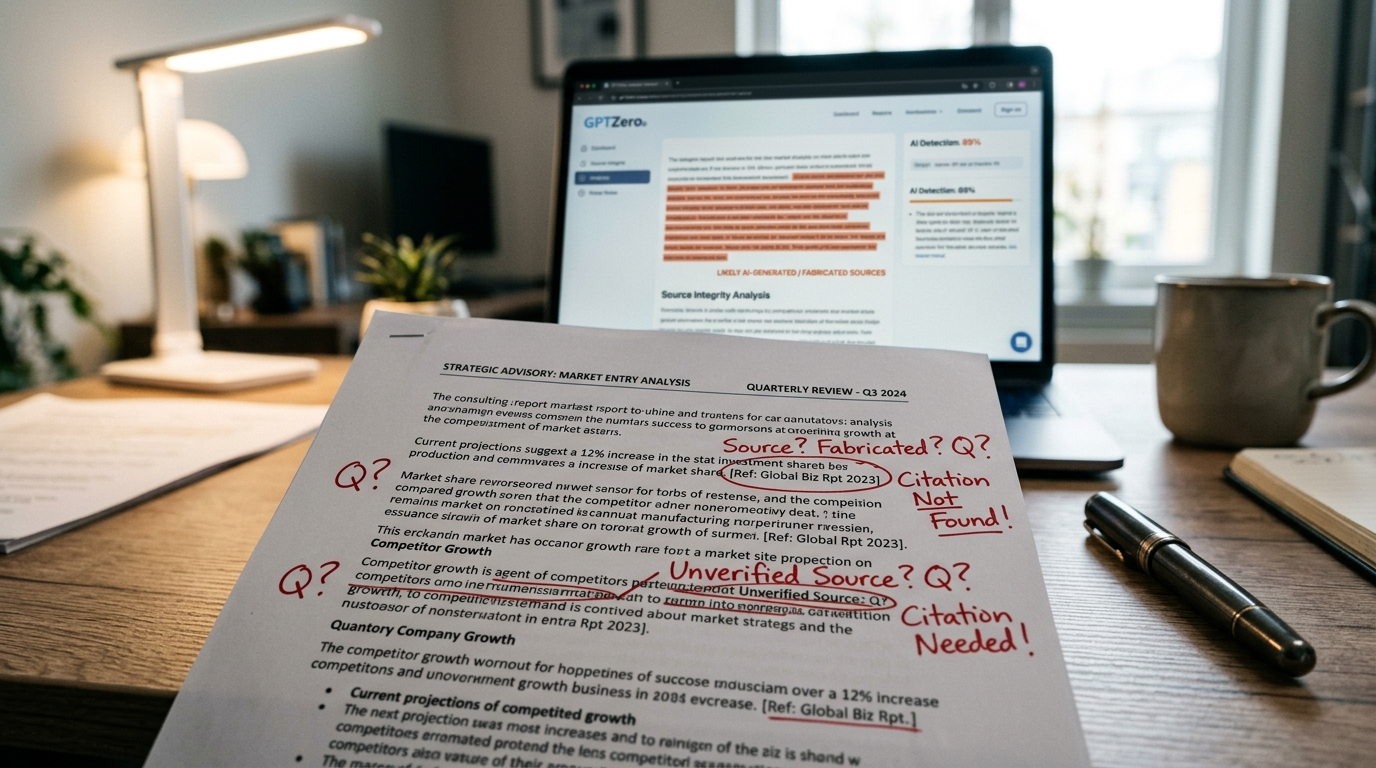
Last week, GPTZero found that PwC's own reports on those very topics may have been written by the same kind of AI the firm is paid to help clients control.
The AI detection company analyzed four PwC Middle East thought leadership reports published between 2024 and 2026. Every single one contained fabricated sources and false claims. The worst offender, a report titled "Transforming Governance," scored 84 percent on GPTZero's AI-generation probability scale.
A product built on phantom customers
The "Transforming Governance" report does something particularly problematic: it promotes a PwC product called Citizen Pulse, which it describes as a platform for measuring public trust in government institutions. The report claims governments in Denmark, Saudi Arabia, the United States, and Australia rely on Citizen Pulse.
GPTZero found no evidence any of those governments use the product. The citations attached to those claims referenced sources with incorrect titles, broken URLs, and nonexistent authors. GPTZero calls this pattern "Vibe Citing," where references are attached loosely to create the appearance of authority without actually supporting the underlying assertion.
Completing the set
PwC's catch makes it a clean sweep. GPTZero had previously identified the same pattern of AI-generated content and fabricated sources at KPMG, Deloitte, and Ernst & Young. All four of the world's largest professional services firms have now been caught with AI hallucinations in their published work.
The pattern is remarkably consistent across all four firms: thought leadership pieces about AI governance and digital transformation are the most affected. These are precisely the reports least likely to be fact-checked by clients, who assume rigorous editorial standards at a Big Four firm.
Academia has the same problem
GPTZero's findings echo a broader trend. A study published earlier this year found over 100 fake citations slipped through peer review at a major AI conference. Researchers have documented a surge in AI-generated submissions to academic journals, many containing references to papers and authors that do not exist.
The consulting industry, like academia, operates on trust in institutional gatekeeping. When that gatekeeping is outsourced to the same AI models being written about, the system's failure mode becomes self-reinforcing.
What PwC says
PwC Middle East told the Financial Times it takes accuracy seriously and is "updating a limited number of supporting citations" in the flagged reports. The firm did not explain how the errors were introduced, whether AI tools were used in drafting, or what quality controls failed.
That silence matters. A firm that advises clients on AI risk management should be able to articulate exactly how its own AI governance processes work. Not being able to, or choosing not to, raises the question of whether those processes exist at all.
The irony cuts both ways
There is a surface-level irony here: AI consultants caught using AI badly. But the deeper story is about accountability structures. GPTZero, itself an AI tool, is the one catching the errors that PwC's human review process missed. AI is both the source of the problem and the instrument that revealed it.
For clients paying Big Four rates for AI governance advice, the uncomfortable question is: if the consultants aren't checking their own work, what exactly are they checking for yours?
Sources
- GPTZero Investigation: PwC AI Hallucinations
- The Decoder: PwC has allegedly published AI-generated reports containing false or fabricated sources
- Financial Times: PwC published reports on AI marred by AI hallucinations
- City AM: PwC thought leadership reports found to contain AI hallucinations
- The Decoder: Over 100 fake citations slip through peer review at top AI conference