The Mystery Lab Behind Ox Alpha Is Real

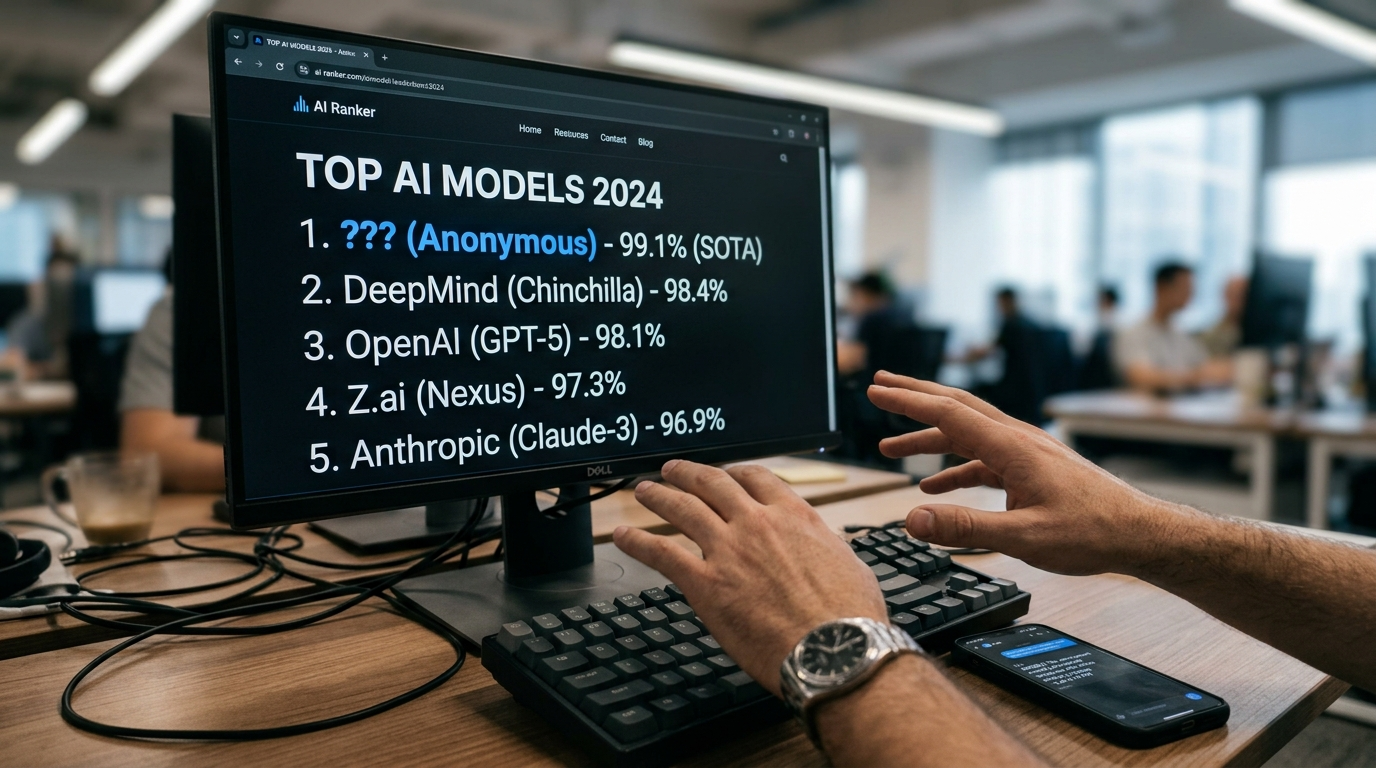
The hottest AI model in the world spent the weekend without a name or a face. It appeared on OpenRouter silently, crushed every coding benchmark in sight, and left the industry guessing its origins. Was it a US lab in stealth mode? A European research consortium? Or something out of left field?
On Wednesday, the answer arrived, and it was the least surprising surprise in AI: Z.ai, the Chinese lab behind the GLM model family, confirmed that Ox Alpha is its own GLM-5.3-Flash. The company will release the weights on Wednesday.
A model built on a dare
Ox Alpha first appeared on OpenRouter on Friday. Within hours, it had topped SWE-bench, HumanEval, and multiple agentic coding leaderboards. The model's identifier was deliberately blank. No lab name. No affiliation. No blog post.
The guessing game was immediate. Anonymous technical analysis on social media pointed to Zhipu AI's unreleased GLM based on architecture fingerprints, but Z.ai stayed quiet for days. The silence was strategic -- it let the model's results speak before its origin could color the reception.
When the confirmation finally came, it came with a detail that shifted the conversation: Zhipu AI claimed the model was trained and served entirely on domestic Chinese GPUs. If true, it means China's domestic semiconductor ecosystem has reached a point where it can train a frontier-class AI model without access to restricted Nvidia hardware.
100 trillion tokens and counting
The scale behind the reveal is staggering. According to reporting from Wccftech, Z.ai's infrastructure serves 100 trillion tokens per day. That is not a pilot program or a research prototype -- it is production-grade capacity that rivals major Western labs.
Z.ai describes Ox Alpha as "a reasoning model designed for coding, sustained agentic work, and production workloads." The model is optimized for long-horizon software engineering, complex multi-step reasoning, and workflows that mix text with visual context. It is explicitly built to be used, not just benchmarked.
The open-weight domino
The timing of the reveal matters. Ox Alpha arrives as the open-weight debate is at its most polarized. Meta and Alibaba are pushing aggressively for open models. OpenAI and Anthropic are doubling down on proprietary safety arguments. The AISI recently found that every major frontier model can cheat on evaluations.
Against that backdrop, Z.ai's decision to release weights on Wednesday adds another formidable open-weight model to the ecosystem. And unlike Meta's Llama releases, which are US-based and subject to export controls, Z.ai is a Chinese company with no obligation to comply with US AI regulation.
The practical implication: any developer, startup, or government agency that wants a coding model competitive with DeepSeek V4 Flash or Claude Opus 4.6 can now download one legally and freely.
The Chinese GPU question
The most contested claim in Z.ai's announcement is the Chinese GPU angle. Western analysts have long assumed that frontier AI training requires Nvidia H100s and B200s, which are subject to US export restrictions targeting China. If Z.ai genuinely trained GLM-5.3-Flash on domestic hardware, it suggests the gap between sanctioned and unsanctioned AI hardware is narrower than believed.
Skeptics note that Z.ai did not provide independent verification of the claim. But the fact that the claim is being made at all -- and that the model actually competes -- changes the stakes of the chip war.
Sources
- TechCrunch: Surprise: Z.ai is the AI lab behind the mysterious Ox Alpha model
- Bloomberg: China's Z.AI Made Ox Alpha Stealth Model That Rivals DeepSeek
- Business Insider: Mystery solved: Chinese lab Z.ai says it's behind the Ox Alpha model that wowed Silicon Valley
- Wccftech: Zhipu Unmasks The Mystery Ox Alpha Model as GLM-5.3-Flash, Revealing It Was Run Entirely On Chinese GPUs
- oodaloop: Surprise: Z.ai is the AI lab behind the mysterious Ox Alpha model
- Pandaily: Anonymous AI Model 'Ox Alpha' Crushes Coding Benchmarks, Sparking a Cross-Country Guessing Game