Alibaba's Qwen 3.8 Says It's Second Only to Fable 5 — and Open Weights Are Coming

Just a week after Moonshot AI released Kimi K3 — the largest open-weight model ever shipped at 2.8 trillion parameters — Alibaba's Qwen team has fired a direct response. Qwen 3.8 clocks in at 2.4 trillion parameters and makes a bold claim: it trails only Claude Fable 5.
The timing is not accidental. Moonshot hit $300 million in annual recurring revenue in June and is reportedly planning an IPO within six months. Qwen 3.8 is available right now at 10% of standard pricing through Alibaba's Token Plan, Qoder, and QoderWork — a deliberate pricing play designed to disrupt Moonshot's momentum before open weights even arrive.
The Model: 2.4 Trillion Parameters, Multimodal by Design
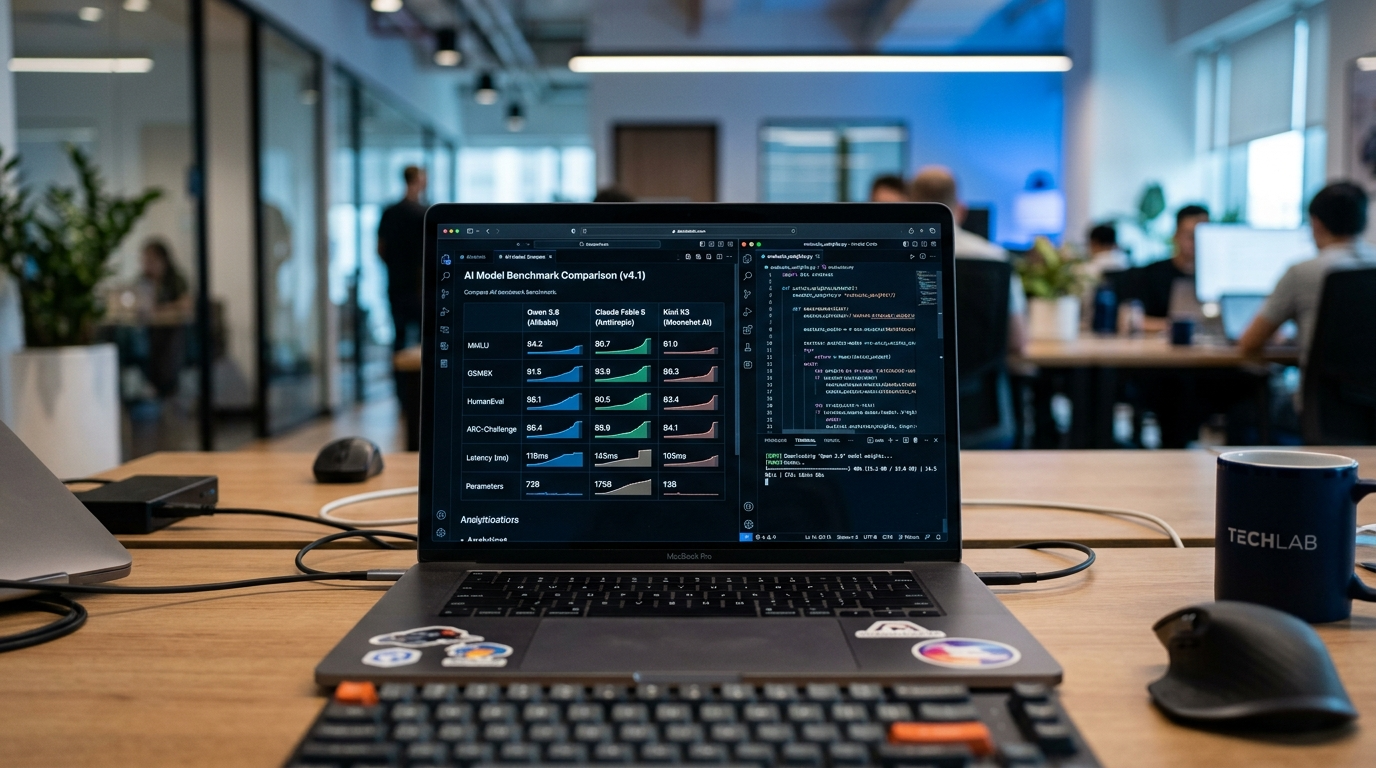
Qwen 3.8 is a Mixture-of-Experts architecture with 2.4 trillion total parameters, though the active parameters per inference are a fraction of that — standard for MoE designs. It's the Qwen team's first multimodal model above one trillion parameters, capable of processing images, videos, and documents alongside text.
The Qwen team claims on X that Qwen 3.8 "is continuously evolving" and that they believe it is "one of the most powerful models available today, compatible to leading frontier AI models, second only to Fable 5." Developer Shuai Bai specifically says it outperforms Qwen 3.7-Max in coding, full-stack development, data analysis, and office workflows.
Notably, no independent benchmark results are available yet. The Qwen team has published comparison claims but not the underlying evaluation data — a detail that matters when the claim is "second only to Fable 5" in a field where benchmark scores are the primary currency of credibility.
The Pricing War: 10% of Standard, and Open Weights Coming
The most immediately disruptive aspect of Qwen 3.8 is not its architecture — it's the price. The model is available through Alibaba's Token Plan, Qoder, and QoderWork at 10% of standard API pricing. For context, Claude Fable 5 costs roughly $10 per million input tokens and $50 per million output tokens. Kimi K3 costs $3/$15. Qwen 3.8 at 10% of standard pricing would undercut both.
The Qwen team has also promised open weights "soon" — though as The Decoder notes, that timeline mirrors Moonshot's own promise with Kimi K3, which has yet to deliver actual model weights while running access through its chat app and API. The difference is that Alibaba has the infrastructure to absorb the cost of a pricing war in a way that a startup like Moonshot cannot easily match.
Why This Matters for the Chinese AI Lab Competition
The open-weight competition between Chinese AI labs has quietly become one of the most consequential dynamics in the AI industry. DeepSeek's V4 Pro (1.6 trillion parameters) kicked things off. Then came Kimi K3 (2.8 trillion) from Moonshot, then GLM-5.2 from Zhipu AI, and now Qwen 3.8 (2.4 trillion) from Alibaba.
Each new release pushes the frontier of what's available as open weights, and each one undercuts the pricing of the last. The strategic logic is clear: by releasing open-weight models that compete with each other on performance and price, Chinese labs collectively make it harder for US frontier labs to maintain the pricing power that funds their massive compute budgets.
Bloomberg reports that Moonshot AI's plans to go public in as little as six months could be disrupted by the pricing pressure. Qwen 3.8 arriving so soon after Kimi K3 suggests Alibaba is deliberately trying to commoditize the open-weight market before Moonshot can establish a pricing moat.
A Cautious Take
The "second only to Fable 5" claim deserves scrutiny. No benchmarks have been released, and the Qwen team's announcement on X was notably light on quantitative evidence. The last time a Chinese lab made a comparably strong claim — DeepSeek V4 Pro's "frontier-competitive" positioning — independent benchmarks showed it trailing US frontier models by a measurable margin, even if the gap was smaller than expected.
What's genuinely new here is the strategic speed. Moonshot shipped Kimi K3 on July 16. Alibaba shipped Qwen 3.8 on July 19. Three days is not the gap between two research cycles — it's the gap between two companies racing to own the same market position. That kind of competitive velocity is new for the AI industry, and it suggests the open-weight race is about to get much faster than the frontier model race ever was.
Sources
- The Decoder: Alibaba's Qwen takes on Kimi K3 with open-weight Qwen 3.8
- Qwen on X: Qwen3.8 announcement
- Bloomberg: Moonshot AI's $300M ARR and IPO plans
- MarkTechPost: Alibaba Previews Qwen3.8-Max
- SiliconAngle: Alibaba previews Qwen3.8
- AIgentic.media: Kimi K3: China's Moonshot AI Just Released the World's Largest Open-Source Model