Deepseek Bets 160,000 Huawei Chips on China's Silicon Independence
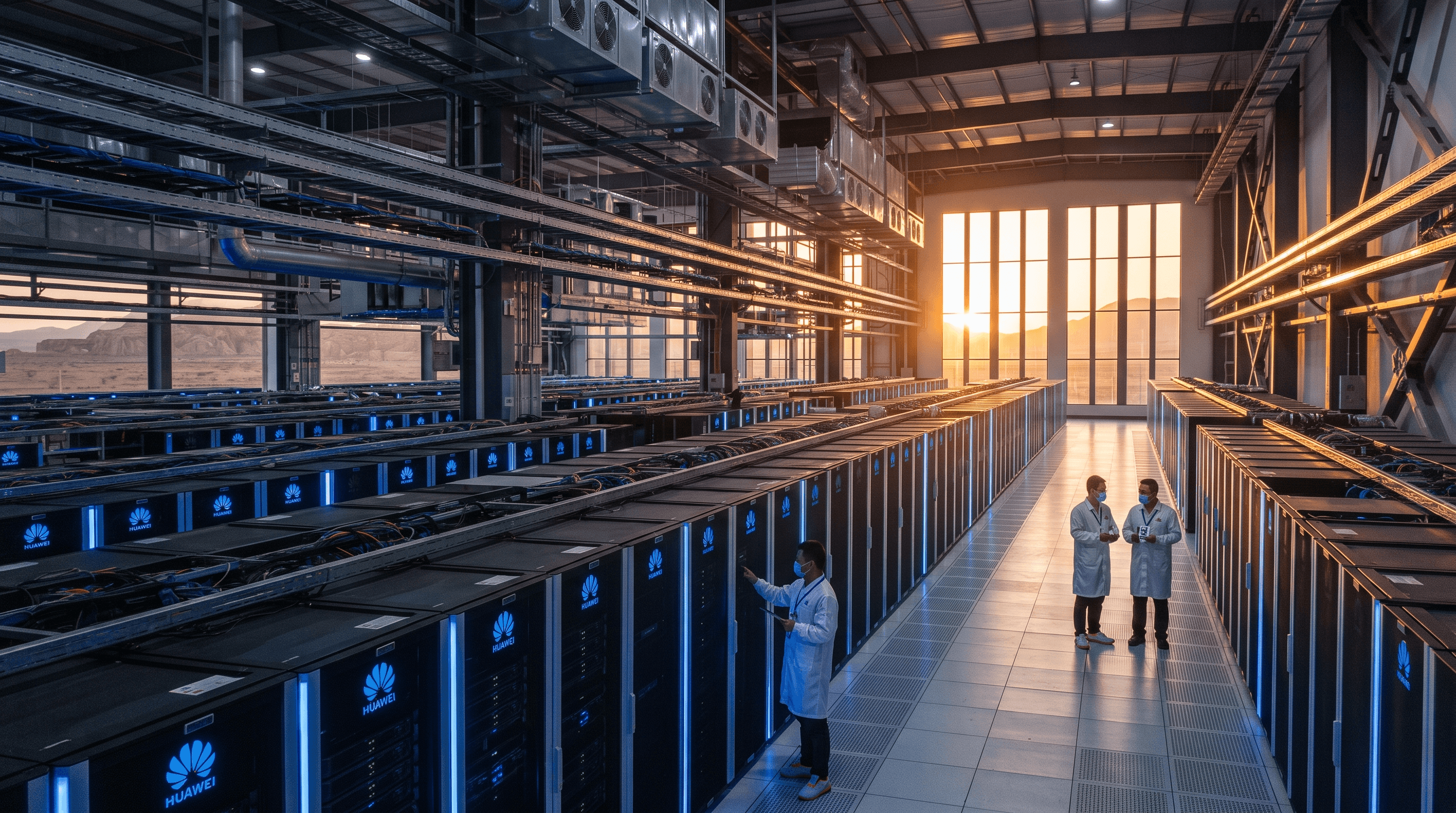
Deepseek wants to put 160,000 Huawei chips into a single data center in Inner Mongolia. The plan is audacious, the execution bottleneck is harsh, and the timeline stretches past a year.
The question this cluster answers is not "can Huawei build a competitive AI chip?" It is the harder one: "can Huawei build enough of them?"
The cluster
Deepseek plans to deploy at least 160,000 of Huawei's next-generation Ascend-950DT chips in a massive data center in Inner Mongolia, according to Bloomberg. The chips would exclusively handle inference workloads -- the cheaper, lighter part of AI compute where trained models generate responses. For the heavy lifting of model training, Deepseek still uses Nvidia hardware.
If built, this would be the largest known Huawei chip cluster and a significant step toward weaning China's AI industry off Nvidia.
But there is a gap between ambition and delivery. Huawei probably cannot fulfill the full order for over a year, hampered by production limits and a shortage of the high-bandwidth memory (HBM) chips that power AI accelerators.
The memory bottleneck
China's leading memory manufacturer, CXMT, has begun producing small batches of HBM3E for the first time. That matters because AI chips need HBM to function effectively -- it is the ultra-fast memory layer that feeds data to the compute cores during inference and training.
The problem is timing. CXMT is three to five years behind Samsung, SK Hynix, and Micron, all of which are already mass-producing HBM4, the latest generation. By the time CXMT can deliver HBM3E in volume, the rest of the world will be on HBM4 -- and potentially HBM5.
This gap is the single most pressing bottleneck in China's domestic chip strategy. You can design a competitive AI chip, as Huawei has with the Ascend-950DT, but you cannot manufacture it without the surrounding memory ecosystem.
The broader picture
Deepseek's order is not happening in a vacuum. It is part of a broader Chinese government push to build a self-sufficient semiconductor supply chain -- one that can sustain the country's AI ambitions regardless of US export controls.
The US has progressively restricted Nvidia's ability to sell high-end chips like the H100, H200, and B200 to Chinese customers. The logic was straightforward: cut China off from the world's best AI hardware and its AI progress would stall.
Deepseek is testing that assumption. By placing a bet on Huawei silicon at unprecedented scale, it is essentially asking: can domestic chips carry production AI workloads at a meaningful level?
The answer, as of late 2026, is "not yet, and not soon." But the bet itself is a signal. China's AI leaders are not waiting for export controls to lift. They are building regardless -- even if the supply chain needs over a year to catch up.
What it means
If the cluster goes live on schedule -- whenever Huawei can deliver -- it will mark a turning point. It will demonstrate that Chinese AI companies can operate at scale without Nvidia, at least for inference. That fractures the CUDA moat in the fastest-growing segment of AI compute.
If the cluster is delayed, downsized, or abandoned due to supply constraints, it will expose just how deep the dependency on advanced semiconductor manufacturing runs. No amount of ambition can substitute for a mature memory fabrication ecosystem.
Either way, Deepseek's 160,000-chip order is the most concrete evidence yet that the US chip embargo has not achieved what it set out to do. It has not stopped China from building -- it has redirected Chinese building toward domestic alternatives.
Sources
- Bloomberg: DeepSeek Plans Big Huawei AI Chip Order to Power New Data Center link
- The Decoder: Deepseek plans the largest known Huawei chip cluster
- Moneycontrol: DeepSeek plans massive Huawei chip cluster as China pushes to replace Nvidia
- Livemint: China's Nvidia alternative? DeepSeek plans massive Huawei AI chip rollout