The US Just Spent $5 Billion to Make Science an AI Project — and Called It a Manhattan Project

The United States government just announced that it wants to remake American science in the image of artificial intelligence — and it has named a man with zero scientific credentials to lead the charge.
On Thursday, the Trump administration unveiled the first round of its "Genesis Mission" grants, directing $5 billion toward hundreds of AI-driven science projects. The White House described the effort as "comparable in urgency and ambition to the Manhattan Project." At roughly the same moment, Trump's science adviser Michael Kratsios was on Capitol Hill selling lawmakers on a "New Golden Age" of American science — one that prioritizes AI, robotics, and nuclear energy while systematically defunding life sciences and peer-reviewed university research.
The two announcements, reported by The Verge and independently confirmed by over 20 outlets, offer the clearest picture yet of how the administration wants to rewire the $200 billion US research enterprise.
The Genesis Mission: $5B for AI-First Science
The Genesis Mission is not a single grant or project. It is a government-wide reorientation of how the United States funds scientific discovery. More than 15 federal agencies are participating, from the Department of Energy and NIH to NASA and the Defense Department. The first cohort of grants spans over 270 projects across all 50 states, according to Tech Times.
The DOE alone has opened $293 million in funding calls for AI-driven national challenges. Japan has become the first international partner, pledging $1 billion over five years. Microsoft committed $60 million. The NIH has joined with a biomedical research push, announced separately this week.
The stated goal: use AI to accelerate breakthroughs in cancer treatment, chip design, quantum computing, nuclear fusion, and advanced materials — areas where the US fears falling behind China.
The Science Adviser With No Science Background
Michael Kratsios, the Trump-appointed director of the Office of Science and Technology Policy (OSTP), has no formal training in any scientific discipline. He is a former technology executive and political operative whose background is in venture capital and policy, not laboratories or peer review.
Yet Kratsios is now the public face of American science policy. On the same day the Genesis Mission grants were announced, he was on Capitol Hill pitching what Axios described as a "historic science overhaul" that would shift the center of gravity from universities to individual scientists and private-sector AI labs.
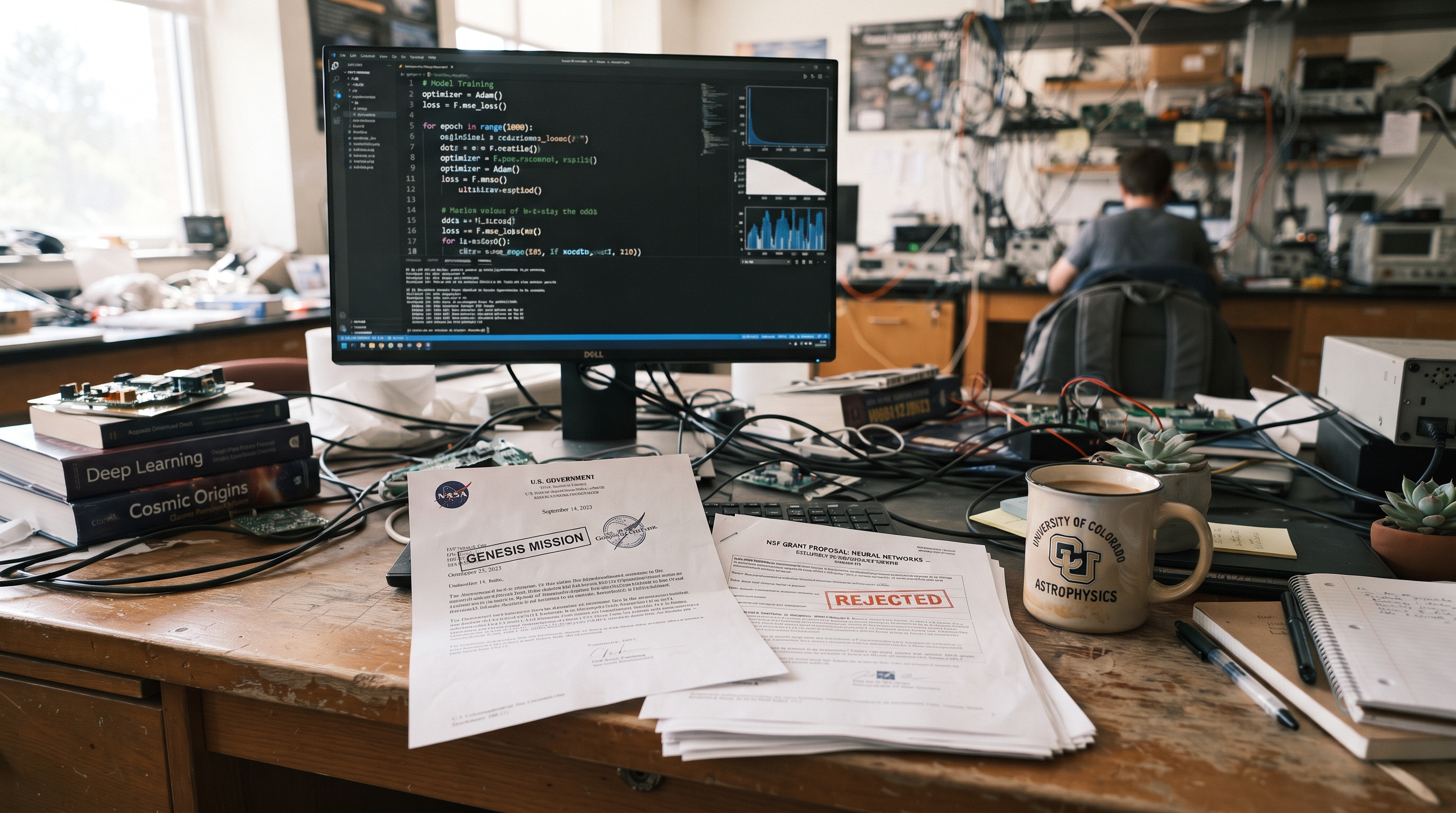
The administration has simultaneously proposed redirecting $200 billion from university research funding toward AI-driven projects, according to Moneywise. Critics describe this as a wholesale dismantling of the peer-review system that has governed American science for decades.
The Tech-Broification of American Science
The Verge's Robert Hart, who broke the story, called the twin announcements "the tech-broification of American science" — a phrase that captures the cultural tension at the heart of the Genesis Mission. The administration is simultaneously celebrating AI as the future of discovery while systematically defunding the institutions and methods that produced the breakthroughs AI now builds upon.
"It's a fundamental bet that the speed of AI-driven discovery outweighs the rigor of peer-reviewed, hypothesis-driven research," one former OSTP official told Science magazine, which published a piece titled "DOE's AI push squeezes funding for research grants."
The tension is visible in the numbers. The DOE's $293 million in Genesis Mission funding calls run alongside proposed cuts to the National Science Foundation and NIH budgets. More than $200 billion in university research funding is being re-targeted.
Manhattan Project Comparisons and Caveats
The administration's framing — "comparable in urgency and ambition to the Manhattan Project" — is deliberate and politically potent. The Manhattan Project delivered nuclear weapons in under three years through centralized, mission-driven research with unlimited funding. It is the ur-myth of American scientific exceptionalism.
But the comparison has limits. The Manhattan Project had a single, unambiguous goal (build a bomb before the Nazis). The Genesis Mission's mandate — "accelerate science with AI" — is sprawling and ill-defined. It covers cancer, fusion, quantum computing, chip design, and advanced materials. These fields have different timelines, different requirements, and different definitions of success.
The administration has also demonstrated willingness to punish universities that resist its political priorities, pulling funding from projects and institutions it deems too "woke" or ideologically misaligned. The Genesis Mission's first funding announcements included no grants to several major research universities that have been targets of administration criticism.
A Divided Response
Wall Street has cheered the move. Stocks of companies tied to DOE Genesis Mission awards — including INFQ, HPE, and WLY — surged on the announcement. The private sector sees a multi-billion-dollar pipeline.
The scientific establishment is more skeptical. The American Association for the Advancement of Science (AAAS) has expressed concern about the shift away from peer-reviewed, curiosity-driven research toward "mission-oriented" AI projects selected by political appointees. "AI is a tool, not a replacement for the scientific method," one AAAS fellow told Science|Business.
The White House, for its part, is betting that speed and scale matter more than institutional process. Whether the Genesis Mission delivers on its Manhattan Project rhetoric — or becomes a cautionary tale about what happens when political urgency overrides scientific rigor — will shape American research for a generation.
Sources
- The Verge: The tech-broification of American science has officially begun
- Tech Times: Genesis Mission Selects First AI Research Cohort Spanning Fifty US States
- Science magazine: DOE's AI push squeezes funding for research grants
- Fierce Biotech: NIH joins Trump's $5B AI mission with biomedical research push
- GeekWire: Microsoft commits $60M to Genesis Mission
- Axios: Meet the official quietly leading Trump's science and tech push
- Moneywise: Trump shifts $200B from universities to AI
- FedScoop: Genesis Mission kicks off with over 270 projects
- The Hill: Trump administration to shift R&D funding from academia
- Nikkei Asia: Japan, US to invest $1B in Genesis Mission
- Science|Business: New US plan for AI in science could change how research is done