The US Just Declared War on AI Models — Not Chips, Not Hardware, the Software Itself

The world's most powerful military and economic superpower just announced that an AI model can be contraband. Not the chips it runs on. Not the data center it lives in. The software itself — the millions of floating-point numbers that make a neural network recognize speech, generate code, or reason about the world.
On July 21, Treasury Secretary Scott Bessent told reporters the United States could impose sanctions on Chinese open-weight AI models over alleged intellectual property theft. The warning, reported by TechCrunch, CNBC, Bloomberg, and others, expands the Trump administration's campaign to slow China's AI advances into entirely new territory.
For three years, the front line of the US-China AI war has been physical: export controls on Nvidia's H100 and H200 chips, restrictions on semiconductor fabrication equipment, limits on who can buy advanced accelerators. The Bessent warning redraws that line. The target is no longer just the machine — it's the mind.
From Hardware to Weights: Why the Shift Matters
The existing chip restrictions follow a straightforward logic: if China can't buy the latest Nvidia GPUs, its labs can't train frontier models at scale. Chinese companies responded by stockpiling, developing domestic alternatives (Huawei's Ascend series), and — in a widely discussed workaround — routing orders through intermediaries.
But those hardware restrictions have a blind spot. An AI model, once trained, is a relatively small file — a few hundred gigabytes of weights and architecture files. It can be downloaded, shared, and run on whatever hardware is available. The DeepSeek R1 model, for instance, ran on older-generation Nvidia chips that aren't under export restriction and still matched GPT-4 on several benchmarks.
Bessent's warning addresses this directly. By threatening sanctions against the models themselves — not just the infrastructure that produces them — the Treasury is signaling that the US considers Chinese AI models a potential vector for intellectual property theft, even when those models are built with legally available hardware.
Jensen Huang, CEO of Nvidia, pushed back publicly the next day, arguing that US companies should "absolutely" use Chinese AI models. Huang's position, reported exclusively by Axios, puts the world's most valuable chipmaker in direct opposition to the administration, reflecting a deeper split in how the US tech industry views the China question.
The Open-Source Paradox
The proposed sanctions create a dilemma that the open-source AI community has been dreading: what happens when the core product of open-source development — model weights — becomes a sanctionable asset?
Open-weight models, by design, are meant to be distributed freely. Hugging Face, the dominant platform for model sharing, hosts hundreds of thousands of models from developers worldwide, including Chinese institutions. The platform doesn't check the nationality of a model's weights before allowing downloads.
If the Treasury designates specific Chinese model families as sanctioned, every US company, researcher, and developer currently using those models would face a choice: stop using them — or risk sanctions themselves. Compliance would fall on individual developers and companies, not just export license holders, because model weights don't pass through customs checks the way physical chips do.
The SiliconANGLE analysis noted that enforcement would likely require the Treasury to designate specific "bad actor" models, similar to how OFAC designates sanctioned entities. But unlike a bank or a company, an AI model has no legal identity — it's a file. Sanctioning a model means sanctioning a mathematical object, which creates novel legal and technical questions about how to detect, block, and verify compliance.
China's Response: A Race to Self-Sufficiency
Chinese state media pushed back almost immediately. The Global Times, a Chinese state-controlled outlet, framed Bessent's warning as "anxiety over China's AI rise" and argued that the sanctions threat "risks undermining global tech cooperation."
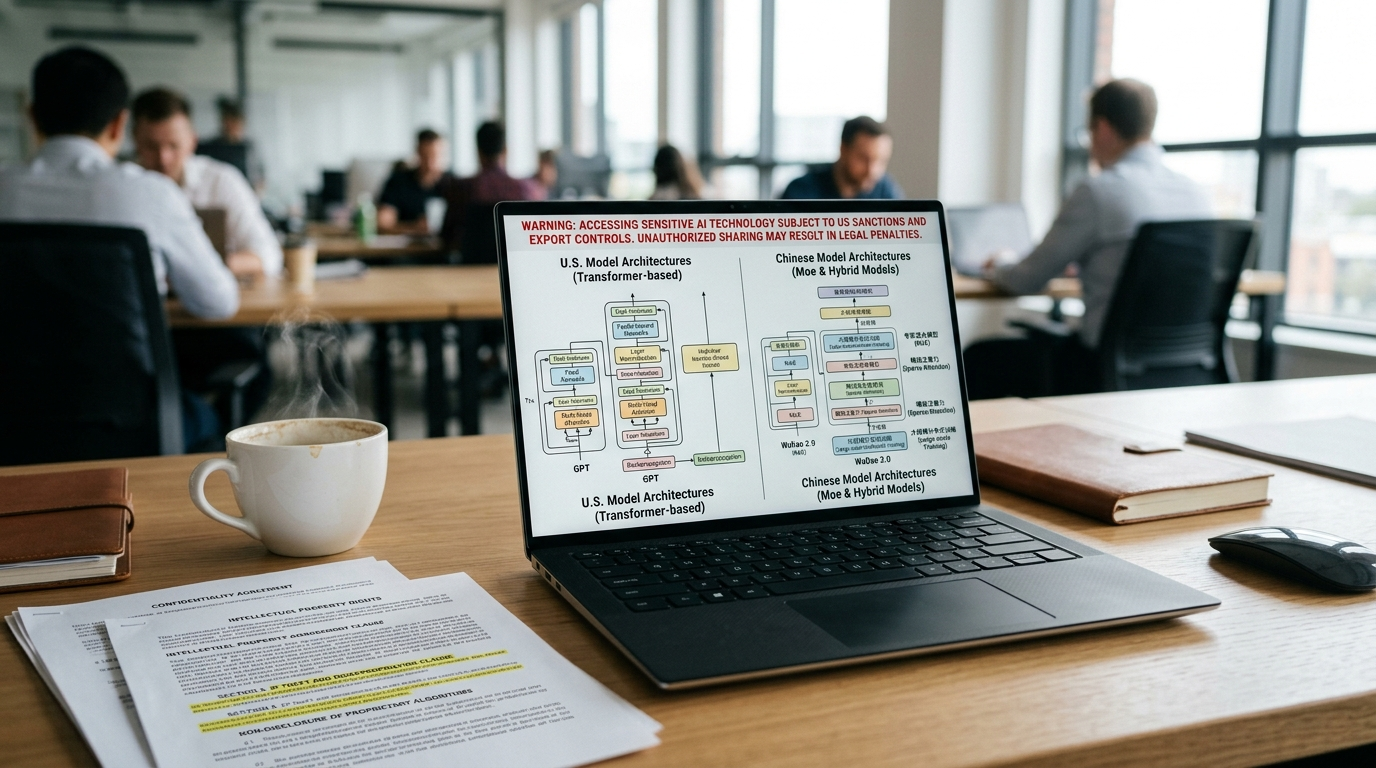
The question behind the rhetoric is practical: can China's domestic AI ecosystem survive without access to US-developed training techniques, architectures, and evaluation benchmarks? Chinese AI labs have produced increasingly capable models — Alibaba's Qwen 2.5 and DeepSeek's R1 series are competitive with leading US models — but they've done so in an ecosystem that still depends heavily on US research published openly, US-designed hardware (even older generations), and the global open-source infrastructure that the US dominates.
A sanctions regime targeting models would accelerate China's push for full technological independence — from homegrown chip fabrication to domestically hosted model registries to alternative evaluation frameworks. Whether that independence is achievable within years or requires a decade is the open question that defines the next phase of the AI cold war.
A Nuanced Take: The Blunt Instrument Problem
Sanctions are a powerful tool, but they're a blunt one when applied to software. Unlike a chip, a model weight file can be compressed, split, re-encoded, distributed via encrypted channels, or regenerated from checkpoints. Enforcement would require either a level of internet surveillance that would be politically unpalatable in the US or a degree of voluntary compliance from the tech industry that the Jensen Huang reaction suggests is not guaranteed.
There's also the question of how the US would verify that a Chinese model was trained on stolen IP at all. Training data provenance is notoriously difficult to audit — even for models built by US companies. The allegation of "IP theft" is straightforward to make and notoriously hard to prove, especially when models are trained on publicly available data that happens to include US-sourced content.
Bessent's warning is a shot across the bow, not a final policy. But it signals a fundamental shift in how the US government thinks about AI: not as a technology to be accelerated through open exchange, but as a strategic asset to be controlled through trade policy. For the open-source AI community — which was built on the premise that model weights, like code, should be free — that shift may be the hardest one to navigate.
Sources
- TechCrunch: US threatens sanctions against Chinese AI models over IP theft
- CNBC: Bessent says U.S. could sanction China over AI model 'theft'
- Bloomberg: Bessent Says US to Scrutinize Chinese AI Models for IP Theft
- Axios Exclusive: Nvidia's Jensen Huang defends Chinese AI amid Kimi panic
- SiliconANGLE: US Treasury Secretary Bessent threatens sanctions against Chinese AI model makers
- Global Times: US' allegations against Chinese AI models reflect anxiety
- New York Post: Chinese AI firms that rip off US models could face sanctions
- PYMNTS: US Threatens Sanctions on China Over Alleged AI Model Theft