The AI Voice Taking Your Drive-Thru Order
The Too-Nice Voice
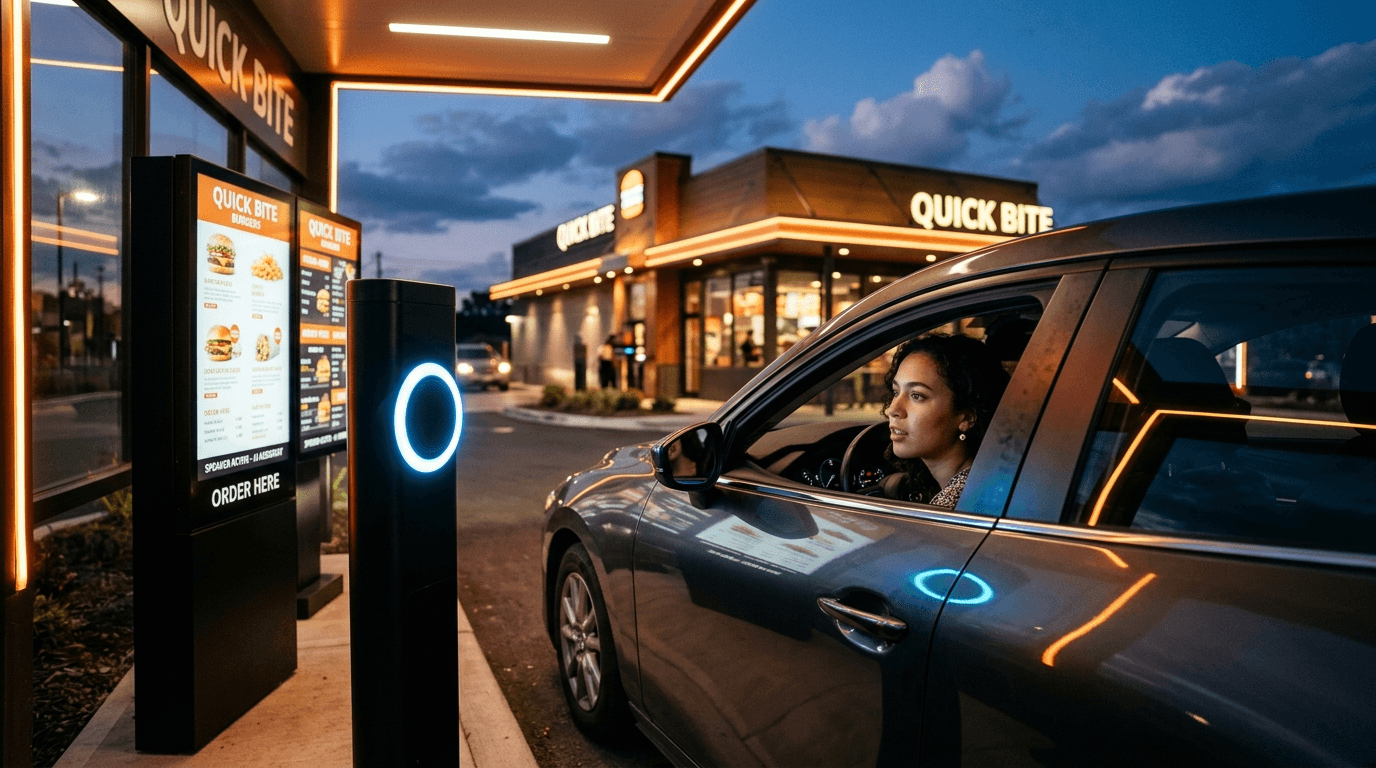
Kristen Charpentier's first hint that she was talking to a robot when she pulled into a Dairy Queen drive-thru was that the voice coming through the speaker was, simply put, too nice.
"There was no communication delay or weirdness to it. It felt completely natural," Charpentier told WIRED. "But just a little too pleasant to be human."
The voice punctuated every sentence with pleases and thank-yous. It was soft and friendly. Its attempts to upsell her on extra Snickers for her Blizzard were perfectly polite. But Charpentier had worked the Dairy Queen drive-thru herself as a teenager. She knew something was off. When she drove up to the window in Cary, North Carolina, she asked the worker there: Had AI taken her order?
The employee confirmed it. Charpentier was one of thousands of customers across the US who had just experienced an AI-voice-equipped drive-thru for the first time. Most of them don't notice until something feels too perfect.
The Quiet Rollout
In 2024, roughly 4% of fast-food locations in the US used voice AI technology in the drive-thru lane, according to Intouch Insight's annual Drive Thru Survey. Last year, that figure grew to 5%. Early research suggests it has now climbed to 6%.
Taco Bell announced in July 2026 that it has rolled out AI at 890 drive-thru lanes, more than 10% of its US locations. Dairy Queen is implementing the tech in 25 states, with eventual plans to roll it out to all restaurants. Twelve percent of White Castles now use an AI named Julia in their drive-thrus; all new locations open with Julia taking orders.
"The brands who have invested and who have been testing this heavily over the last three years -- the technology has gotten to a point where they are ready to go," Sarah Beckett, vice president of sales and marketing at Intouch Insight, told WIRED. "They're going to start scaling this massively."
Somehow, without most of the fast-food public even noticing, the age of the headset entered its final gasps.
The Viral Failure Era
If you searched AI drive-thru on social media in 2023, you would have found a very different story. There was the TikTok showing McDonald's AI adding 260 Chicken McNuggets to a single order as customers screamed "Stop! Stop! Stop!" Next came the video of AI adding bacon to a McDonald's ice cream order. Then the guy who recorded himself ordering 18,000 cups of water at Taco Bell just to break the system.
The social media mockery was accompanied by less dramatic but more consequential failures. Intouch Insight found that early AI drive-thrus tended to be less friendly than humans, with lower order accuracy. The systems struggled with accents and dialects. For human workers, the cascading flowchart of a fast-food order feels natural; for early AI agents, it was a bafflingly complex formula.
"The restaurants ended up spending more time smoothing over the problem they created," Michael Schatzberg, cofounder of Branded Hospitality, which invests in food-service technology companies, told WIRED. "Everyone was like, 'This is the worst. Stop. Get the people back with the headsets.'"
Branded Hospitality sold off its early AI drive-thru investments. In 2024, Del Taco rolled back its AI test. McDonald's sold McD Tech Labs to IBM and later pulled the plug entirely.
The Quiet Comeback
Not every chain discarded their AI drive-thru efforts. Many -- including Dairy Queen, White Castle, and Taco Bell -- continued to quietly expand their tests. AI represented more than new technology. It was the dream at the core of fast food: making the process of obtaining sustenance faster and faster, while cutting costs further and further.
Four years into White Castle's partnership with SoundHound AI, chief marketing officer Jamie Richardson says AI drive-thrus make employee shifts run smoother and speed up service. On average, AI drive-thrus beat the industry by 21 seconds per order.
Richardson also says viral AI drive-thru disasters tend to be overblown. White Castle's strategy focuses on incremental improvement. "It wasn't bad at the start," he told WIRED. "It's gotten so much better as time has gone on."
The pendulum seems to be swinging back. McDonald's announced this summer that it was once again testing AI-powered ordering, this time partnering with Google at five US locations, with a system that takes orders in English and Spanish. Branded Hospitality recently partnered with Arc, a voice AI drive-thru company that works with chains including Jack's and Pollo Campero.
"Companies have evolved, technology has evolved, and they're like -- we can fix a lot of those problems," Schatzberg said.
The Human Connection Problem
When an automated voice began speaking to Scheree Reed at a Wendy's in Virginia, his dominant emotion was bewilderment. Reed kept expecting a human to take over. When the voice maintained its distinctly robotic tone, he found himself wondering if he would be served his burger on a conveyor belt.
"I worry a lot about the ways that relying more and more on AI actually removes us from our human connections, like our ability to make community," Reed told WIRED.
Some chains seem to share those concerns. Chick-fil-A, which consistently tops industry ratings for friendliness at the drive-thru, has never hinted at replacing a human worker with a robot. Coffee chains Dutch Bros and 7Brew, two of the fastest-growing chains in the US, have similarly eschewed AI.
"Every brand has to make choices that fit its business," Nick Chavez, chief marketing officer at 7Brew, told WIRED in an email. "For us, hospitality starts with genuine human connection, and that's something our guests consistently tell us they value."
Who Actually Wins
Executives claim that AI isn't stealing anyone's job, and data so far supports that. White Castle's employment numbers have remained steady throughout the AI rollout. Taco Bell recently said that locations using voice AI have higher employee retention rates.
What chains are doing is using robots to convince people to pay more for fast food. Intouch Insight's survey found that AI drive-thru agents use suggestive selling -- upselling -- 71% of the time, compared to an industry average of 58%. Convincing people to order a Diet Coke or add extra Snickers to a Blizzard boosts margins. And AI is shameless about it.
In the near future, AI-equipped drive-thrus may be able to take orders in dozens of languages. They could recognize a customer the moment their car pulls up. They might offer suggestions based on an encyclopedic knowledge of each customer's habits. Imagine pulling up to McDonald's and having a chipper automated voice offer you a buy-one-get-one-free milkshake deal -- because it calculated you are 78% more likely to order dessert on the second Tuesday of every month.
"We never want to seem creepy," Richardson said.
For customers like Reed, the uneasiness is already difficult to ignore. Charpentier, meanwhile, sees the AI drive-thru lane as a net positive. She is in the majority: Intouch Insight reports a 97% satisfaction rate for the technology. She says that when she worked the Dairy Queen drive-thru as a teenager, she would have wanted an AI coworker.
"I think it's a great thing," Charpentier said. "There's room for human error, and I'm sure there's going to be room for AI error. But I think, as we've all seen with the advent of AI, there is more consistency with AI than there is in humans."
The AI voice at the drive-thru speaker is not coming. It is already here. And it is very, very polite.
Sources
- WIRED: AI Conquered Coding. Fast Food Is Next
- Intouch Insight: Annual Drive Thru Survey
- Food On Demand: Taco Bell Expands Voice AI to Nearly 900 Restaurants
- CBC: Do you want AI with that? Chatbots could take your next order at the drive-thru
- Restaurant Dive: Taco Bell revs up drive-thru AI deployment
- MassLive: McDonald's testing AI drive-thru with Google