The US Army Blew Through a Year of AI Tokens in One Month
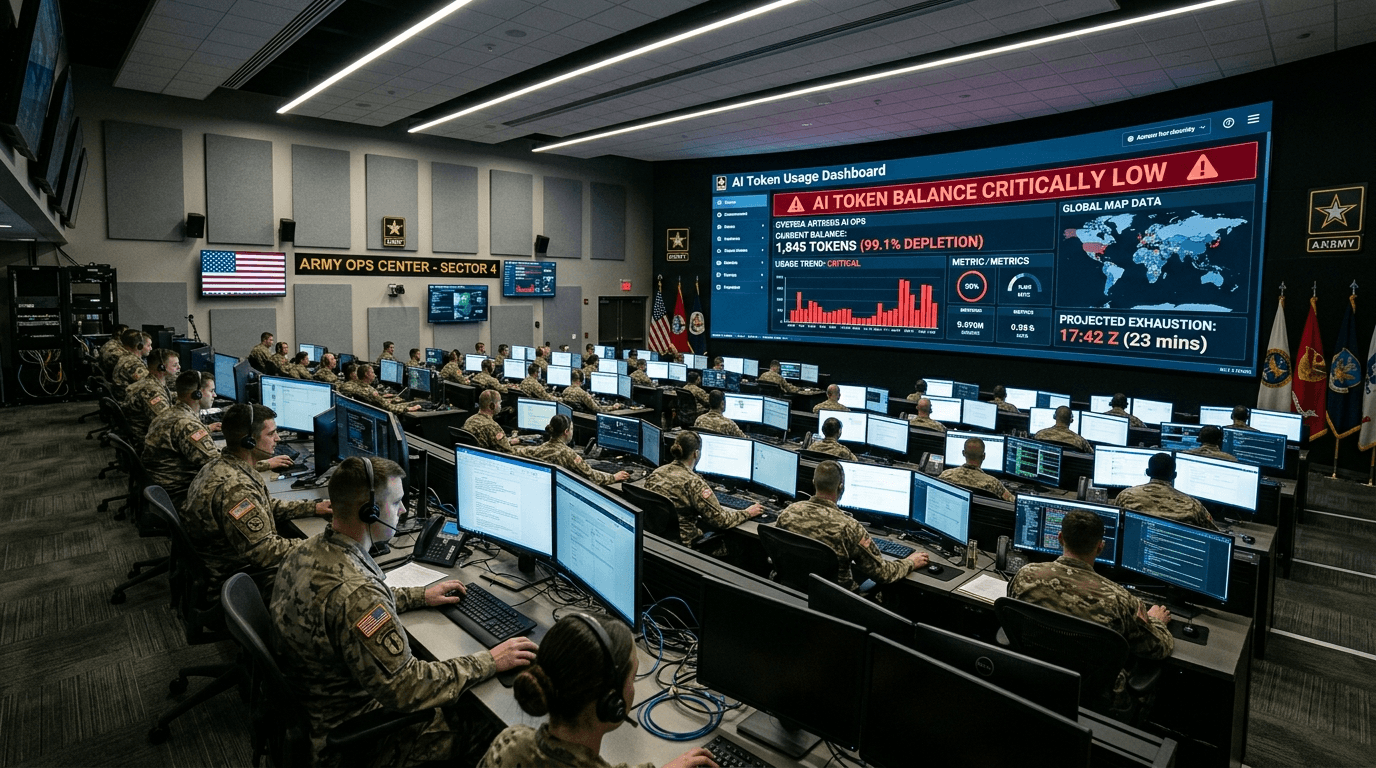
A little over a month after the Department of Defense bragged that nearly half of its 3.5 million employees were using AI at work, members of the Army's Combat Capabilities Development Command (DEVCOM) received an email informing them that they were burning through tokens and needed to limit use.
The most powerful military in the world ran out of AI credits. Not because of a budget cut, not because of a congressional hold — because the soldiers and civilians who work for it simply used them all up.
"Although the Army CIO announced in May 2026 that they were offering unlimited tokens, by mid-June the Army CIO pool was exhausted of tokens and had to re-establish limits," the email reads, as reported by WIRED. It goes on to note that renewal after October 1 is uncertain.
This is not a story about technology failing. It is a story about technology succeeding too well, and the dull, bureaucratic logistics that nobody planned for.
The Army's AI Stack
The Army uses Ask Sage, a multimodal generative AI platform that serves as a gateway to multiple large language models — Google's Gemini, Meta's Llama, and OpenAI's ChatGPT are all accessible through a single interface. Ask Sage is "accredited for Controlled Unclassified Information" and used by the Department of Defense's Chief Digital and AI Office (CDAO) for acquisitions.
The Army's own website describes Ask Sage being used for tasks like "reclassifying personnel descriptions, which involves defining and aligning job duties, experience and backgrounds" — the kind of rote, document-heavy work that generative AI is genuinely good at.
Employees were given an allotment of at least 200,000 tokens per month, with automatic top-ups if they burned through their initial allocation. The Army had access to 100 million tokens as part of an annual enterprise subscription. For context, a single token in Ask Sage equates to about 3.7 characters.
The math writes itself: 100 million tokens is not very much when half of 3.5 million people are encouraged to use them.
The Pentagon's Two-Speed AI Strategy
The token exhaustion is happening against a backdrop of the Pentagon aggressively pushing AI adoption on one hand while quietly cutting the human oversight that makes it safe on the other.
The Defense Department burned through approximately 20 billion tokens per day during the 38-day Operation Epic Fury in Iran, according to Breaking Defense — a figure that makes the Army's 100 million token annual subscription look like pocket change. That operation-level usage was likely for Project Maven, the Pentagon's AI targeting system, rather than the administrative use cases that DEVCOM is pursuing.
Meanwhile, the Intercept reported that the Pentagon has cut staff at the Civilian Protection Center of Excellence, whose job was preventing civilian casualties in conflict zones. The Department of Defense is developing an AI tool to replace the assessments those staffers used to make.
The contrast is stark: the military is running out of tokens for writing personnel descriptions while simultaneously replacing human judgment about civilian harm with AI.
Tokenmaxx: The Army Is Not Alone
The Army is not the first organization to discover that unlimited AI access creates problems nobody predicted. The pattern is repeating across the corporate world:
Meta encouraged employees to "tokenmaxx" — compete to use as many AI tokens as possible — and displayed a leaderboard. Then it quietly took down the leaderboard and is now trying to curb usage. Instagram head Adam Mosseri recently floated the idea of capping token use per engineer.
Uber saw its engineers burn through an entire year's worth of generative AI tokens in just four months, according to reporting from Fortune.
The Army's version of this story is notable because the stakes are higher. When a private company runs out of tokens, productivity dips. When the military runs out, the question becomes who decides which missions get AI support and which don't — and that's a command decision the Pentagon did not anticipate having to make.
What the Soldiers Think
An Army employee who spoke to WIRED anonymously said they have not found the generative AI tools to be particularly useful. When they did use the tools, they found them unreliable. One model asserted that it had completed a task that it hadn't.
"I think there are definitely several aspects of the bureaucracy of the US federal government that these tools might be helpful with," the employee said. "But an unthinking application and use is not going to result in an effective, efficient, and trustworthy rollout."
The Army and DOD did not respond to requests for comment.
The Real Story
The Army's AI token crisis is a microcosm of a larger problem that every large organization adopting AI is about to face. The technology works well enough that people want to use it. It works well enough that leadership wants to push it. But nobody has figured out the boring logistics of sustainable AI deployment — the token budgets, the cost allocation, the governance frameworks that separate useful use from wasteful use.
The Army will probably get more tokens. The real question is whether it will also get the governance structure that makes those tokens useful for something other than proving that 100 million is not as big a number as it sounds.
Sources
- WIRED — The Army Is Burning Through Its AI Tokens
- Breaking Defense — Insatiable Appetite for AI: Maven Usage Surged for Strikes on Iran
- The Intercept — Pentagon Cuts Civilian Harm Staff, Turns to AI
- Fortune — Uber Engineers Burned Through a Year of AI Tokens in Four Months
- The New York Times — Meta's 'Tokenmaxx' Culture and the AI Token Problem
- TechCrunch — Adam Mosseri on AI Token Budgets for Engineers
- US Army — Army Enterprise LLM Workspace
- Business Insider — Nearly Half of DOD Workers Use AI Daily