DHH Stops Writing Code by Hand: 'English Is a Better Programming Language Than Ruby'
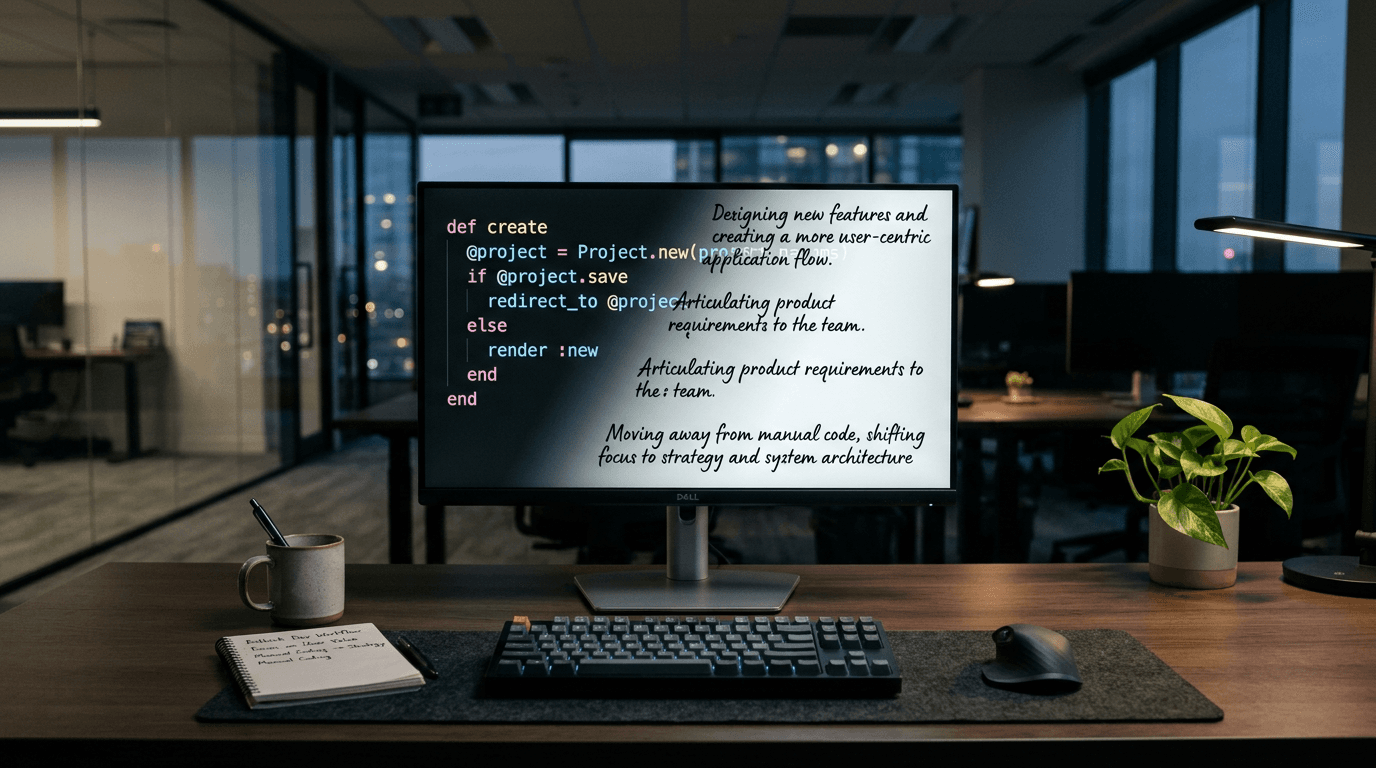
Every few months, the AI industry produces a story that quietly rewrites an assumption almost everyone had stopped questioning.
For 25 years, the assumption was simple: writing code by hand is the irreducible core of software development. AI tools could autocomplete a line or suggest a function, but the craft itself -- the act of typing instructions into a text editor -- remained something only humans could do well.
The creator of Ruby on Rails just walked away from that assumption entirely.
David Heinemeier Hansson, co-founder of Basecamp and one of the most influential programmers of his generation, announced at Rails World 2026 that he has stopped writing code by hand. He has not typed a single line manually since around March 2026. And he does not plan to go back.
"English is a better programming language than Ruby," DHH told the audience.
It is a staggering statement from the man who created Ruby on Rails, a web framework that reshaped how millions of developers build software. Ruby itself was designed around a principle of human happiness -- the idea that code should be pleasant to read and write. DHH is now saying that natural language has surpassed the language he helped make famous.
From skeptic to convert in 12 months
What makes this reversal remarkable is how recently DHH was arguing the opposite position.
Just over a year ago, he was openly pushing back against AI coding tools. He warned that AI-generated code would produce unmaintainable systems and erode the skill of professional programmers. At Rails World 2025, he was still defending the value of hand-crafted code.
The change happened privately first. Around March 2026, DHH stopped writing code manually and began using AI tools exclusively. By September, he was ready to announce it publicly -- and to frame it not as a compromise but as an evolutionary step.
"Manual coding no longer makes economic sense for most programmers and companies," he said. "By the end of this year, that will apply to practically every domain."
The new programmer: a professional maker of things
Rather than mourning the end of hand-coded software, DHH reframed it as a new beginning for programmers. He described the next generation of developers as "professional makers of things" -- people who steer AI systems to build software rather than writing it themselves.
"You get to be there right now as we are defining these things," he said. "No one yet has the blueprint."
DHH called this shift "the biggest thing that has happened in the history of computing."
Software architecture itself needs to be rethought, he argued. Traditional abstractions lose their value when AI agents are the ones changing the code. The patterns that worked for human programmers may not translate to a world where AI writes, reviews, and deploys code autonomously.
What it means for the rest of the industry
DHH is one person, not the whole industry. But his public conversion carries weight because he is the kind of developer other developers trust. He has been a contrarian voice in tech for two decades -- skeptical of crypto, skeptical of venture capital hype, skeptical of anything that smelled like a trend without substance.
When someone with that track record says AI coding is the real thing, it changes the conversation.
The practical implications are immediate. If a programmer of DHH's caliber can produce working software entirely through AI tools, the bar for what counts as "real" programming has shifted. Companies that were treating AI coding assistants as optional productivity boosters may now need to rethink that assumption.
The open question is what hand-coded software will be worth a year from now. DHH believes the answer is close to nothing for most domains. Whether he is right or wrong, the fact that he is saying it -- after a year of actually doing it -- makes this a story worth watching.
Sources
- Ruby on Rails creator DHH says he's done writing code by hand -- The Decoder, Sep 25, 2026