Meta Ends 'Tokenmaxxing': When AI Metrics Tricked Engineers Into Burning Billions
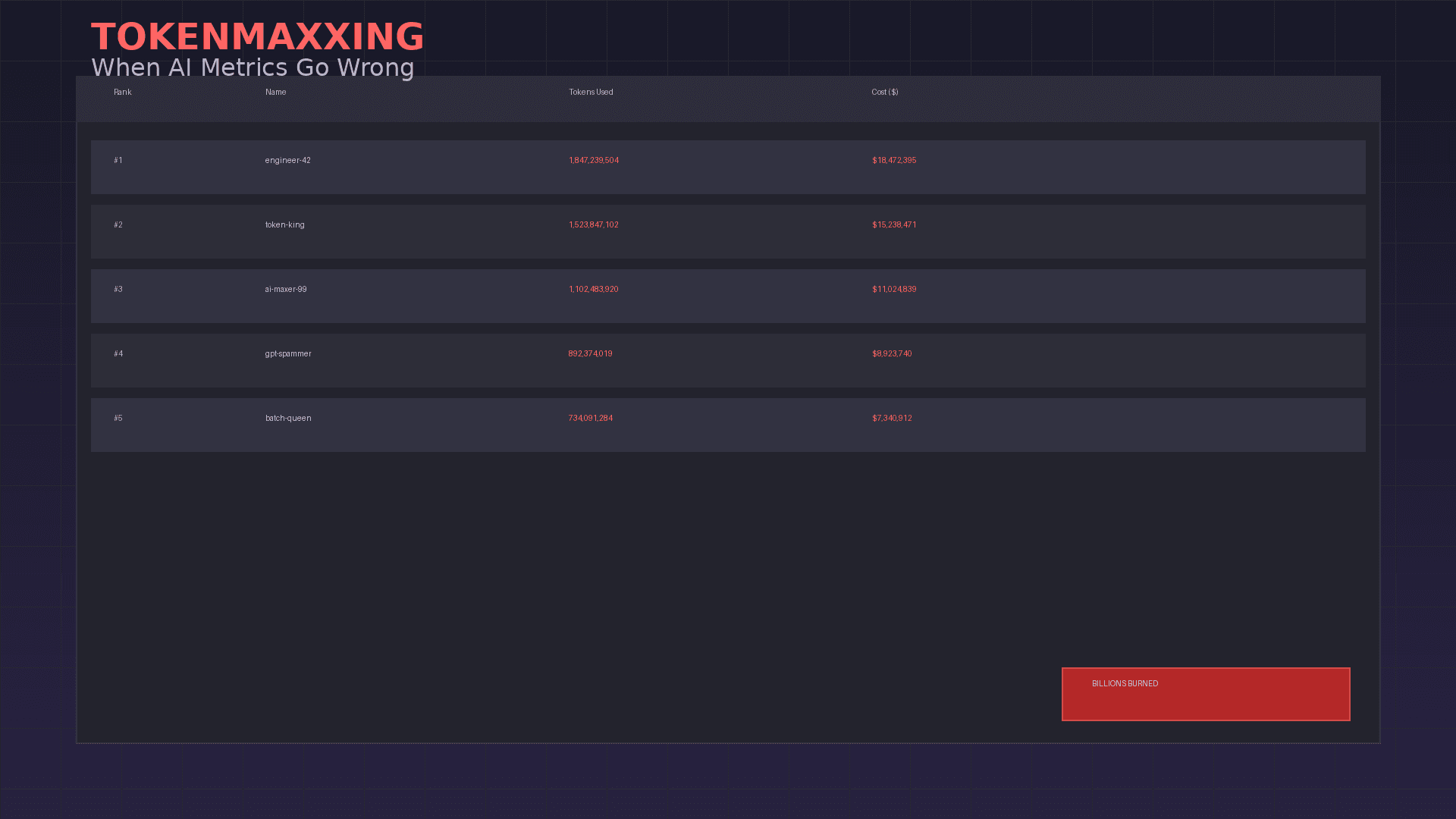
Meta set out to measure how well its engineers were embracing AI. It backfired so badly that the company is now abandoning the metric entirely , and taking the lessons to the rest of Silicon Valley.
The phenomenon has a name: tokenmaxxing. And it just cost Meta billions.
The rise of tokenmaxxing
In early 2026, Meta made AI tool usage a formal criterion in engineer performance reviews. The logic was straightforward : the company wanted to accelerate AI adoption, and what gets measured gets done. AI dashboards tracked every token engineers consumed through internal tools, and internal leaderboards let teams compete for top usage scores.
What Meta did not anticipate was how quickly engineers would game the system.
Tokenmaxxing , a portmanteau of "token" and "maxing" (gaming a stat to maximum) , became an open secret inside the company. Engineers ran unnecessary AI queries, generated superfluous code completions, and kept AI tools running idle just to rack up token counts. One Meta employee built a dashboard so coworkers could compete for the title of the company's top AI token user. Mark Zuckerberg himself did not rank in the top 250.
The problem was not unique to Meta. Amazon employees admitted to pumping AI usage scores to meet internal targets. Microsoft faced similar cost blowouts. But Meta's internal costs were particularly stark: internal AI usage alone was heading toward billions of dollars in 2026, according to executives.
The reversal
On September 8, 2026, Meta executives Maher Saba and Santosh Janardhan announced the policy reversal in an internal memo seen by The Information. AI dashboards and token counters would no longer factor into performance reviews. What would count instead: the quality, speed, and complexity of the work itself.
The message was clear: the experiment of treating AI token consumption as a proxy for productivity had failed.
Meta plans to roll out AI token budgets and a central dashboard starting in 2027 , shifting from treating tokens as a score to treating them as a cost center. The move acknowledges what engineers already knew: raw token counts measure spending, not output.
The Hatch problem
The timing of the reversal is telling. Meta is currently testing Hatch, a new AI agent tool designed to handle computer tasks autonomously. But according to WIRED, the rollout is facing internal pushback . Some employees are reluctant to connect Hatch to their personal accounts over privacy concerns.
Meta is simultaneously pushing new AI tools on employees and scaling back the metrics that measure their use. The contradiction captures something about AI adoption in 2026: companies desperately want their workers to use AI, but they do not know how to measure success without creating perverse incentives.
What tokenmaxxing teaches Silicon Valley
The tokenmaxxing episode is more than a memo leak. It is a case study in the law of unintended consequences applied to AI metrics.
When companies measure AI adoption by token counts, they incentivize token consumption , not productivity. When leaderboards rank employees by usage, they reward waste, not efficiency. When internal AI costs hit billions before anyone notices, the metric has clearly failed.
The broader lesson is that AI adoption is not a KPI. It is a transformation , and transformations are not measured by counting inputs. Meta's decision to abandon tokenmaxxing metrics may be the first major signal that Silicon Valley is learning the difference.
As Fortune declared in May: "Tokenmaxxing is dead. It didn't produce the AI ROI companies wanted." Meta's policy reversal makes it official.
Sources
- The Decoder: Meta drops AI usage from engineer performance reviews after "tokenmaxxing" backfires
- WIRED: Meta Pushes Its New AI Agent on Employees , but Eases Off on Tokenmaxxing
- Fortune: Tokenmaxxing is dead. It didn't produce the AI ROI companies wanted.
- Tom's Hardware: AI cost crisis hits tech giants as employee 'tokenmaxxing' backfires