Midjourney Bought an Astrology App. That's Weirder — and Smarter — Than It Sounds

The Punchline
Midjourney, the AI lab that turned Discord prompts into a billion-dollar business, just bought an astrology app. The headline reads like a Silicon Valley parody — "AI image company acquires horoscope startup" — and the internet reacted accordingly. But the punchline isn't that Midjourney bought Co-Star. The punchline is that it makes perfect sense.
The Deal
On July 24, 2026, Midjourney acquired Co-Star, a social astrology app with roughly 4.3 million monthly active users. Terms were not disclosed. Co-Star's team of about two dozen employees has joined Midjourney, and Co-Star CEO Banu Guler will become Midjourney's Chief Design Officer.
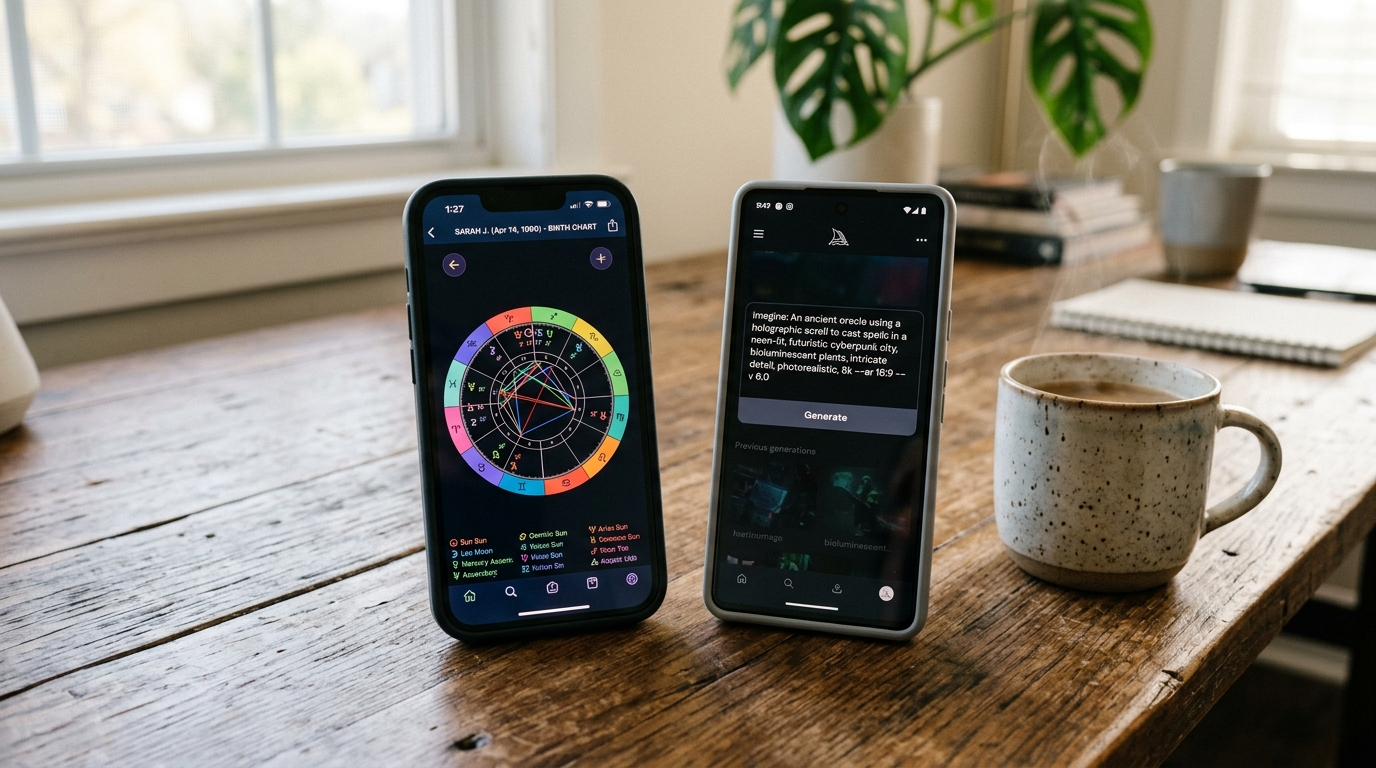
Co-Star is not a simple horoscope app. It uses a combination of AI and human writers to generate personalized birth charts, compatibility assessments, and daily readings based on a user's astrological data. Users share their charts with friends in a social feed — think Spotify Wrapped, but for your star sign every day. The app has cultivated a devoted Gen Z following and a distinctive, slightly cryptic brand voice that its users love.
Why an AI Image Company Buys an Astrology App
Midjourney has a problem that most startups would envy: it has never needed a stand-alone app. The company operates almost entirely through Discord, where users type prompts into a text channel and receive generated images in return. It's a frictionless experience for power users but a non-starter for the mass market. You cannot find Midjourney in the App Store. You cannot sign up for Midjourney without a Discord account. That limits the company's addressable users to people who already know what Discord is and how to use it.
Co-Star, by contrast, is a polished consumer app with a loyal user base, a distinctive brand, and a team that knows how to build for mobile. The 24 employees joining Midjourney bring consumer app DNA that Midjourney simply did not have in-house.
But the acquisition is about more than just hiring a product team. Co-Star's core competency — generating personalized, personality-driven content that users feel a genuine connection to — is exactly the direction AI is heading. The first wave of AI products was about capability: how fast can you generate, how accurate are your answers, how many tokens can you process. The second wave is about personality: does the AI have a voice that people want to talk to, a style they enjoy, a brand they trust.
Midjourney has already been experimenting in this direction. The company launched a medical imaging arm (Ultrasonic CT, which can generate full-body ultrasound scans from text) and even a physical spa. These moves look scattershot on paper — image generation, medical imaging, astrology, spa — but they share a common thread: Midjourney is building a portfolio of AI-powered experiences that go beyond the text-prompt-in-Discord model.
The Bigger Picture
The Midjourney-Co-Star deal is part of a broader trend in AI. Cognition Labs, the company behind the coding agent Devin, recently acquired Poke, a startup focused on AI personality and conversational style. The thesis is the same: as AI agents become ubiquitous, the differentiation will shift from raw capability to personality, tone, and the quality of the interaction.
"AI personality is becoming a competitive advantage," TechCrunch noted in its coverage of the Cognition-Poke deal. That sentence applies equally to Midjourney buying Co-Star. An astrology app is, at its core, a personality engine — it generates content that feels personal, meaningful, and emotionally resonant, even though the user knows on some level it's algorithmic. Midjourney wants to bottle that feeling.
The Skeptical Take
Is buying an astrology app the most efficient path to building a consumer AI brand? Probably not. The deal is unusual — Midjourney has never raised venture capital and operates as a bootstrapped company, making an acquisition of any kind notable. Co-Star's 4.3 million monthly active users is a respectable number but not a transformative one.
There is also a risk of brand confusion. Midjourney's identity is tied to visual generation — "making things look beautiful." Co-Star's identity is tied to personality and belief — "making things feel meaningful." These are different muscles, and it's not obvious that the same company can flex both effectively.
But that risk is also the point. The companies that define the next phase of AI will be the ones that figure out how to make AI feel like more than a utility. Midjourney is betting that Co-Star's team, its brand, and its understanding of what makes users come back day after day can help crack that code. Whether astrology is the right vehicle for that bet is debatable. That the bet needs to be made at all is not.
Sources
- Midjourney acquired the astrology app Co-Star — TechCrunch
- Midjourney bought the astrology app Co-Star — The Verge
- AI Lab Midjourney Eyes Suite of Apps After Buying Astrology Startup Co-Star — Bloomberg
- Midjourney buys Co-Star to seed a consumer app empire — Startup Fortune
- Why Cognition bought Poke: AI personality is becoming a competitive advantage — TechCrunch