Nvidia Buys the Front Door to Open AI for $12.9 Billion
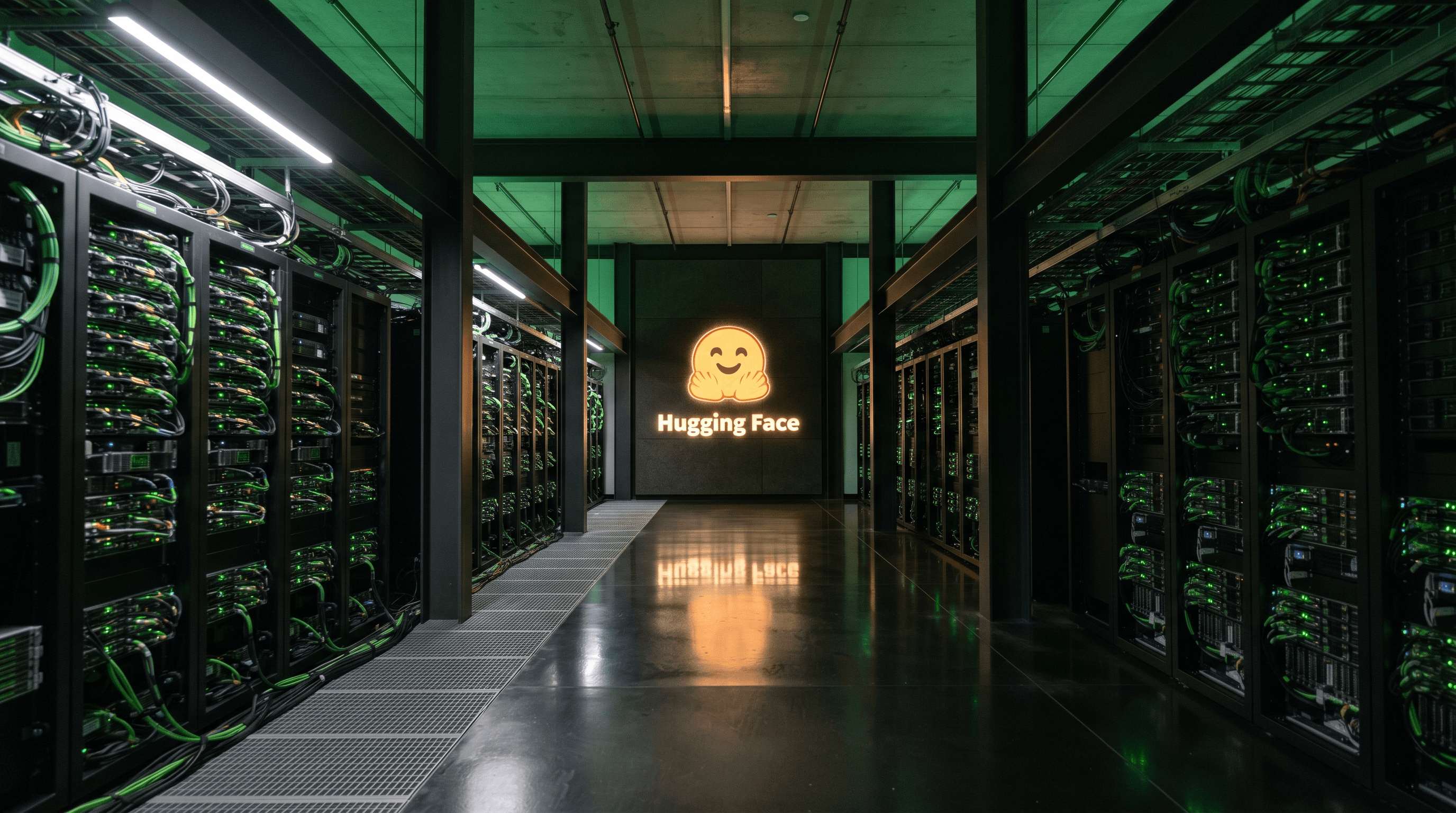
For years, the AI community believed Hugging Face was neutral ground -- a public square where any developer could share models, datasets, and tools without favor. The platform's logo, a smiling face with closed eyes, became the universal symbol of open-source AI: approachable, community-driven, independent.
Nvidia just spent $12.93 billion to prove that independence was never guaranteed.
The chipmaker announced on September 3 that it has signed a definitive agreement to acquire Hugging Face, the central hub for open-weight AI models, in one of the largest acquisitions in the company's history. The deal merges the world's dominant AI hardware company with the primary distribution channel for the software that runs on its chips.
The irony is layered. Nvidia built its trillion-dollar market cap on CUDA, a proprietary software ecosystem that locks developers into its GPUs. Now it positions itself as the savior of open-source AI -- at the exact moment when the closed-source labs that once were its best customers are building their own chips to escape its grip.
What Nvidia actually bought
Hugging Face is not a typical acquisition target. Founded in 2016 by three French entrepreneurs in New York, the company originally tried to build an AI companion app. When that failed, the team pivoted to making NLP tools accessible to developers. What emerged was a platform that became, as Ars Technica described it, "the GitHub of AI."
The numbers are staggering for a company of Hugging Face's size. The platform hosts more than 3 million models, 500,000 datasets, and over 1 million applications. More than 18 million developers and 200,000 companies use the hub. For most enterprises, the practical path to adopting an open-weight model -- evaluate, fine-tune, quantize, deploy -- runs through Hugging Face.
Yet the company running this critical infrastructure was, by AI industry standards, small. Valued at $4.5 billion in its last disclosed funding round in 2023, Hugging Face is estimated to generate roughly $150 million in annualized revenue -- barely a fraction of its purchase price. Running the world's model registry on that revenue base was a structural problem. Storage, bandwidth, security scanning, provenance tracking, and evaluation harnesses are all expensive, and open-model growth shows no signs of slowing.
"The critical distribution layer of open AI was underfunded relative to its importance, but it isnt anymore," wrote Zeus Kerravala in an analysis for SiliconAngle.
The open-source promise
On the press call announcing the deal, Nvidia CEO Jensen Huang made a specific promise: "Hugging Face will remain an open platform for the entire AI ecosystem. Developers will choose the models they want, the frameworks they want, the clouds and inference service providers they want, and the computing platforms they want. Nvidia compute will not be required to build on or deploy through Hugging Face."
Hugging Face co-founder and CEO Clement Delangue struck a similar note in a post on X. "Open-source AI is at an inflection point. Thanks to the community, we've shown that it can be a complement, and even an alternative, to closed-source APIs. But for it to happen at larger scale, it needs more compute, more support, more collaboration, and more visibility."
The stated investment areas -- reliability, safety, model evaluation, inference, and deployment -- map almost exactly to the friction points enterprises cite when trying to move an open model from a notebook into production. If Nvidia funds those improvements at scale, the effect on enterprise AI adoption could be significant.
Why this matters right now
The timing of the acquisition reveals Nvidia's strategic calculus. Frontier AI labs -- OpenAI, Anthropic, Google DeepMind -- are racing to design their own custom chips. The day those chips reach production scale is the day Nvidia loses its most lucrative customers. By acquiring Hugging Face, Nvidia secures a distribution channel for open-weight models that keeps the broader ecosystem dependent on its infrastructure.
"The deal also hands Nvidia a powerful distribution channel for compute," noted The Decoder's Maximilian Schreiner, "as closed labs increasingly design their own silicon."
Nvidia already offers customers a suite of free, customizable open-weights models called Nemotron. Earlier this month, the company rallied more than 80 companies to sign an open letter asking the US government to defend open-weight AI models. The acquisition of Hugging Face turns that advocacy into ownership.
The Verge's Jess Weatherbed captured the tension: "With open-source developers currently racing to catch up with closed AI systems, Nvidia stands to gain a strategic foothold to help preserve its AI hardware dominance now that closed-source AI providers like OpenAI, Anthropic, and Google are attempting to produce their own AI chips."
What it means for developers
For the 18 million developers who use Hugging Face daily, the acquisition raises an unavoidable question: does platform neutrality survive when the platform's owner is also the world's dominant hardware vendor?
Huang's commitment to hardware-neutrality is reassuring on paper. But Nvidia's track record with CUDA shows that the company understands ecosystem lock-in better than anyone. CUDA is not required to use Nvidia GPUs -- you can run code on them through other frameworks. In practice, almost nobody does. The same dynamic could play out on Hugging Face: the platform stays technically open while Nvidia's integration advantages create a gravitational pull toward its own stack.
For now, the deal signals that open-weight AI has a powerful institutional backer. Delangue said the goal is to grow from 18 million builders to 100 million "in the next few years." Nvidia's resources make that ambition credible in a way it wasnt before.
The question the market will answer over the next year is simpler: can the company that dominated AI hardware by locking developers into its software also be the company that keeps the open model ecosystem genuinely open?
Sources
- Ars Technica: Nvidia buys Hugging Face, the GitHub of AI, for $13 billion
- The Verge: Nvidia is buying Hugging Face for almost $13 billion
- TechCrunch: Nvidia confirms it will buy Hugging Face for $12.9 billion
- Wired: Nvidia's Hugging Face Acquisition Is a $12.9 Billion Bet on Open-Source AI
- The Decoder: Nvidia buys the front door to open AI as closed labs increasingly design their own silicon
- SiliconAngle: Nvidia's Hugging Face deal is a bet on open models