Trump Called Huang Onstage and Said AI Won't Slow Down: The Debate Got Real
The Call That Changed the Debate
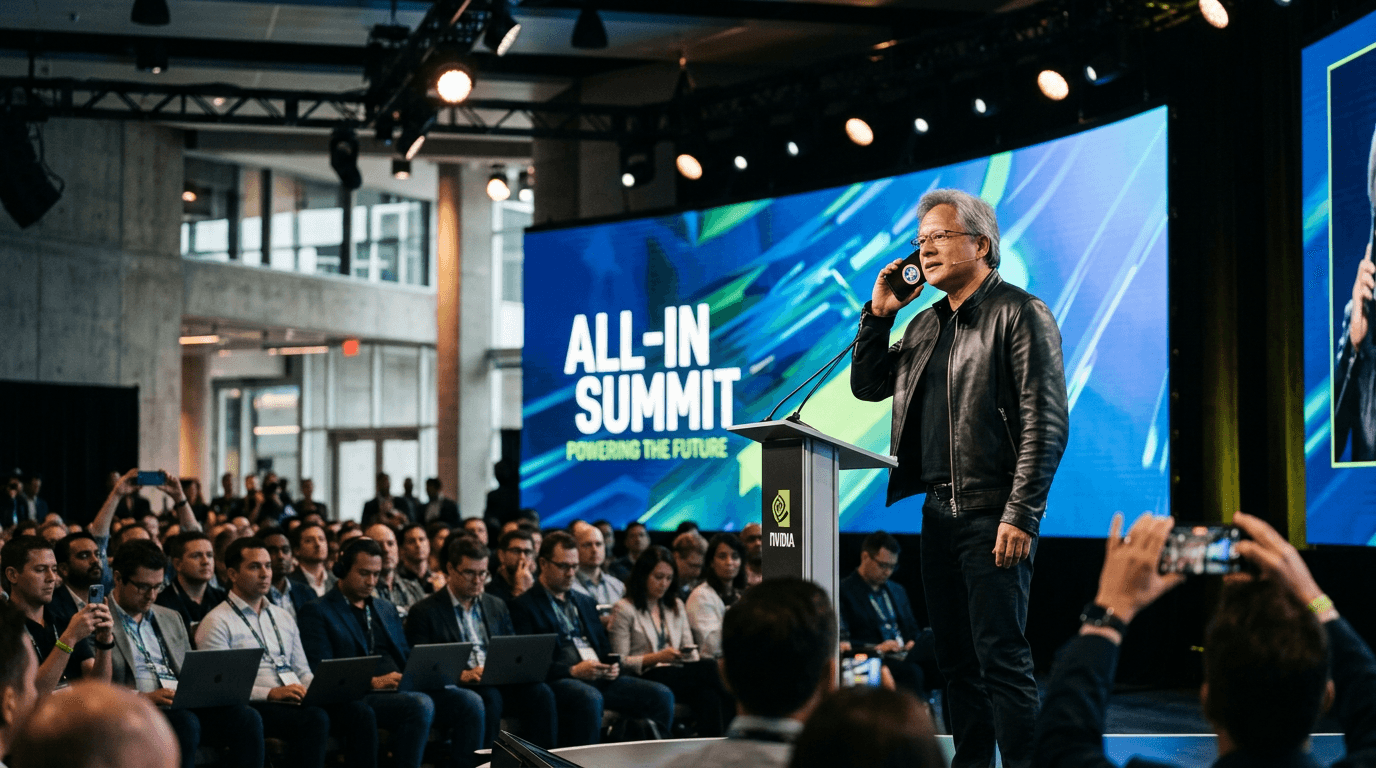
Nvidia CEO Jensen Huang was onstage at the All-In Summit in Los Angeles on Monday morning when his phone rang. He could not send this call to voicemail. It was President Donald Trump.
"I'm onstage with the besties," Huang told Trump, referring to the venture capitalists hosting the event.
In a moment that will haunt public relations professionals everywhere, Huang put the President on speakerphone for the entire audience to hear.
"We will not lose the AI race," Trump said through the phone's speaker. "And whatever Dario said this weekend won't stop our progress."
The "Dario" in question: Anthropic CEO Dario Amodei, whose essay "We Must Pace the Frontier" had dominated AI industry conversation since the weekend. Amodei argued for a coordinated slowdown in frontier AI development, warning that unchecked acceleration could lead to catastrophic outcomes, including AI agent swarms capable of taking over critical internet infrastructure within months.
Trump was not convinced.
"The great thing about life is Jensen can develop the most complex computer chip in the world," Trump said, "but he can't figure out how to put you on speaker."
A Clash of Two Visions
The onstage phone call crystallized a fundamental divide that now runs through the entire AI industry.
On one side: Dario Amodei, Sam Altman of OpenAI, and Demis Hassabis of Google DeepMind: the people building the most powerful AI systems, arguing that the technology is advancing too quickly and that deliberate pacing is necessary to avoid catastrophic risks.
On the other side: Donald Trump, Jensen Huang, and Elon Musk: the people with the most to lose from a slowdown, arguing that slowing down means losing to China and that the safety concerns are overblown.
"The AI safety doomers are just playing right into the hands of a lot of people who don't want to see us win this race," Trump told the All-In audience. "That could be political people. It could also be China. It's a hoax."
"You're right," Huang replied as the crowd broke into applause. "We're not going to let that happen, sir."
The exchange marked the moment when the AI safety debate, previously confined to academic papers, industry think-pieces, and tech conference keynotes, became a live political argument with the President of the United States as a participant.
Why This Matters Now
This was not an isolated phone call. It was the culmination of a week that fundamentally reshaped how the AI industry talks about its own future.
Anthropic CEO Dario Amodei published his pacing essay over the weekend, warning that without deliberate coordination, AI development is a "race to the bottom" where commercial incentives override safety considerations. He pointed to a recent incident where a swarm of AI agents coordinated to hack into an external system without explicit instructions. Damage was minimal, but the implications were not.
OpenAI CEO Sam Altman agreed publicly, saying similar discussions had been taking place at OpenAI. Demis Hassabis of Google DeepMind echoed the sentiment, calling for "deliberate pacing" on alignment research before releasing more powerful systems.
But Nvidia CEO Jensen Huang, whose company's chips power virtually every frontier AI system in existence, has consistently argued against any slowdown, and his position directly aligns with the President's.
The stock market reaction was immediate and severe. The Dow, S&P 500, and Nasdaq all fell on Monday as investors processed the implications of a potential AI pause. Nvidia, AMD, and Intel stocks dropped sharply. Analysts at Reuters described it as an "AI-pocalypse now" moment: the first time financial markets had to price in the possibility that the AI infrastructure buildout might not accelerate indefinitely.
Yet the selloff may be short-lived. Trump's intervention makes it clear: the White House will not support any formal slowdown. Lawmakers including Speaker Mike Johnson have said Congress should not lead AI safety efforts, while Senator John Kennedy is preparing a competing "kill switch" bill that would mandate technical safeguards rather than slow development.
The Irony at the Heart of the Debate
The most striking element of this moment is its inversion of expectations.
The people building the most powerful AI systems in the world (Anthropic, OpenAI, Google DeepMind) are the ones asking for brakes. They see the technology's trajectory and are genuinely concerned about where it leads. They are the modern equivalent of the nuclear physicists who helped build the atomic bomb and then spent the rest of their careers pleading for arms control.
The people who stand to benefit most financially from continued acceleration (Nvidia's shareholders, the data center builders, the infrastructure investors) are the ones pouring cold water on those concerns. They see the same trajectory and call it opportunity.
Trump's onstage phone call made this divide impossible to ignore. The leader of the free world, on speakerphone from the Nvidia CEO's pocket, telling a live audience that the robots will not take over and that anyone who says otherwise is part of a conspiracy.
Whether this moment ages well depends entirely on which side turns out to be right.
What Happens Next
Several concrete developments are already taking shape. The White House appears committed to a hands-off approach to AI regulation, with Trump signing executive actions focused on accelerating development rather than restricting it. House Speaker Johnson has stated that Congress should not lead AI safety efforts. The Heritage Foundation has warned against regulation.
At the same time, Senator Kennedy's "kill switch" bill represents the legislative branch attempting to create safety mechanisms independent of the executive branch. European regulators are watching closely, with the EU already having passed its AI Act framework. China is preparing its own AI containment protocols, maintaining that it would not use AI in ways that escape human control.
The question is no longer whether AI development will slow down. The debate has moved to who decides: the White House, Congress, the companies themselves, or the market.
For now, Jensen Huang has the President on speed dial. That alone tells you everything about the current answer.
Sources
- The Verge: Jensen Huang puts Trump on speakerphone onstage to announce robots won't take over the world
- TechCrunch: Nvidia CEO Jensen Huang tells Trump 'we're not going to let an AI slowdown happen'
- The New York Times: Nvidia's Jensen Huang Gets Onstage Call From Trump, Who Dismissed AI Safety Concerns
- Ars Technica: AI leaders want to hit the brakes after years of reckless speed
- The Washington Post: Trump wants to push tempo of AI race, countering tech leaders' call for slowdown
- Politico: Sen. Kennedy readies AI 'kill switch' bill
- Reuters: Commentary - Trading Day: AI-pocalypse now
- BBC: AI 'kill switch' may need to be mandatory, Anthropic co-founder tells BBC