Workers Are Bargaining With the Bots Now — and Winning Contract Clauses No One Saw Coming
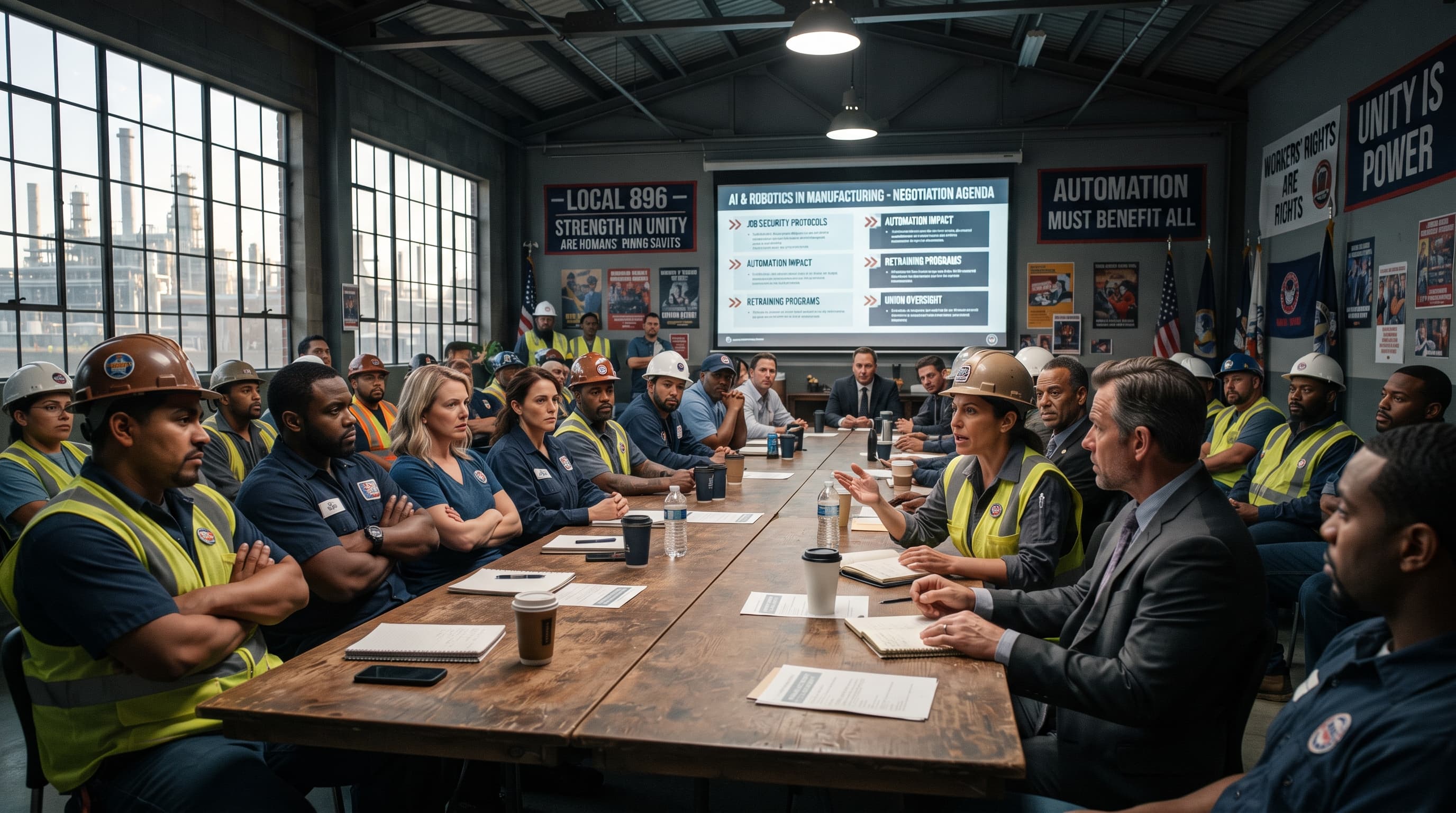
On a Tuesday morning in July 2026, 45,000 Hyundai autoworkers walked off the job at the world's largest automotive plant in Ulsan, South Korea. Their union's stated grievance: wages, bonuses, retirement age. But the subtext — the thing that gave the strike its edge — was something no previous auto industry walkout had ever centered on.
The company had plans to deploy 25,000 humanoid robots in its US factories starting in 2028. The union wanted a say in how that happened.
Hyundai Motor Company issued a statement insisting that "potential deployment of robots in Korean production facilities is not part of the current labor-management discussions." But the fact that the union had to ask — that the question of robot deployment was even on the table in a strike negotiation — signals a fundamental shift in what organized labor is negotiating about.
The next labor negotiation isn't just about wages anymore. It's about who controls the bots.
The 28-Hour Week Trade
The Hyundai strike is only the most dramatic example of a broader trend unfolding across industries and continents. In Australia, dock workers at DP World terminals are demanding a 28-hour work week — with no reduction in pay — as their employer introduces automation that can move shipping containers faster than any human crew. The Maritime Union of Australia frames the demand not as a luxury but as a direct exchange: if the company wants the productivity gains from automation, the workers want a share of the time those gains create.
"Wharfies" — Australian dock workers — have been among the most aggressive in linking automation to shorter hours. Their argument is straightforward: machines that handle the work should mean humans work less, not that humans lose their jobs entirely. The concept has drawn international attention, with labor economists pointing to it as a potential template for how unions might reframe automation from a threat into a negotiation lever.
Nurses vs. the Algorithm
In California, Kaiser Permanente nurses have been fighting a different kind of AI battle. The technology in their workplaces isn't a humanoid robot — it's algorithmic scheduling, automated patient monitoring systems, and AI-driven performance metrics that the nurses say are degrading patient care.
The nurses' union has pushed back against systems that track how long they spend with each patient, arguing that the algorithms optimize for throughput, not outcomes. In contract negotiations, they've demanded the right to review and challenge AI-driven decisions about staffing levels and care protocols. The conflict mirrors a growing trend in healthcare: as hospitals adopt AI tools for everything from scheduling to diagnosis, the people delivering care want a seat at the table when those tools are designed and deployed.
The fight is emblematic of what labor researcher and Equitable Growth analyst Kate Bahn calls "the next frontier of collective bargaining." She notes that traditional labor contracts were written for a world where technology was a tool that workers operated — not a system that operated on them.
Who Decides What AI Can Do
The question at the heart of every union-AI negotiation is deceptively simple: who decides? When a port introduces automated cranes, who gets to set the staffing level? When a hospital rolls out AI monitoring, who verifies it doesn't penalize nurses for actual care? When a factory deploys humanoid robots, who negotiates the terms of coexistence?
The United Auto Workers under Shawn Fain has explicitly named AI as a bargaining priority. "We are in a fight for humanity," Fain warned in June 2026, framing automation not as an inevitability to accommodate but as a management decision that workers have a right to contest. The UAW's position is that any new technology that changes how work is done must be subject to collective bargaining — not implemented unilaterally and negotiated around afterward.
This principle has already produced results in other sectors. Hollywood writers secured landmark AI protections in their 2023 contract, defining what AI can and cannot do in scriptwriting. Tech workers at the University of California system unionized in part over AI anxiety, winning the right to review new AI tools before deployment. Journalists at ABC and other outlets have pushed contract language requiring advance notice and negotiation before AI is introduced into newsroom workflows.
The Challenge of Enforceability
For all the momentum, union AI clauses face a credibility problem: how do you enforce a contract provision about a technology that changes every six months? Most existing AI language in union contracts is broad — requiring "notice" and "consultation" before new technology is introduced — rather than specific prohibitions. Employers can argue that a new AI system is the same technology, just upgraded, and bypass the clause entirely.
Some unions are addressing this by demanding tighter language. The AFL-CIO has published principles calling for "meaningful worker input" into AI deployment, including the right to reject systems that cannot be audited for bias or safety. Labor advocacy groups have also pushed for state-level legislation requiring AI impact assessments before deployment in workplaces — a regulatory backstop for the negotiating table.
A Grounded Take
The wave of union-AI bargaining is real, but it's worth noting what it hasn't yet achieved: a major contract provision that actually stopped or substantively altered an employer's AI deployment at scale. The dock workers' 28-hour week demand is aspirational, not enacted. The Hyundai union's concerns about humanoid robots were publicly disclaimed by the company. The Kaiser nurses are still fighting algorithmic scheduling.
What has changed is the conversation. A year ago, AI was barely on the bargaining table in most industries. Today, it's a standard issue in major contract negotiations, and the AFL-CIO, UAW, the Teamsters, and the Communications Workers of America have all made it a strategic priority. Whether those negotiations produce enforceable limits — or merely aspirational language — will determine whether the "bargaining with the bots" era is a genuine shift in labor relations or a moment of concern that failed to translate into lasting power.
Sources
- Hyundai claims humanoid robot plan is not part of talks with striking workers - Ars Technica
- Australia dock workers call for 28-hour week in AI talks - BBC
- UAW's Shawn Fain warns of AI threat: 'We are in a fight for humanity' - The Detroit News
- Kaiser nurses say technology is making their jobs — and patient care — worse - CalMatters
- Unionized workers are bargaining with the bots - Axios
- UC tech workers unionize as AI anxiety grows across industry - San Francisco Chronicle
- How union contracts are protecting U.S. workers - Equitable Growth
- Four Union Strategies to Fight on A.I. - Labor Notes