Humanoid Robots Smash Records, Then Burst Into Flames
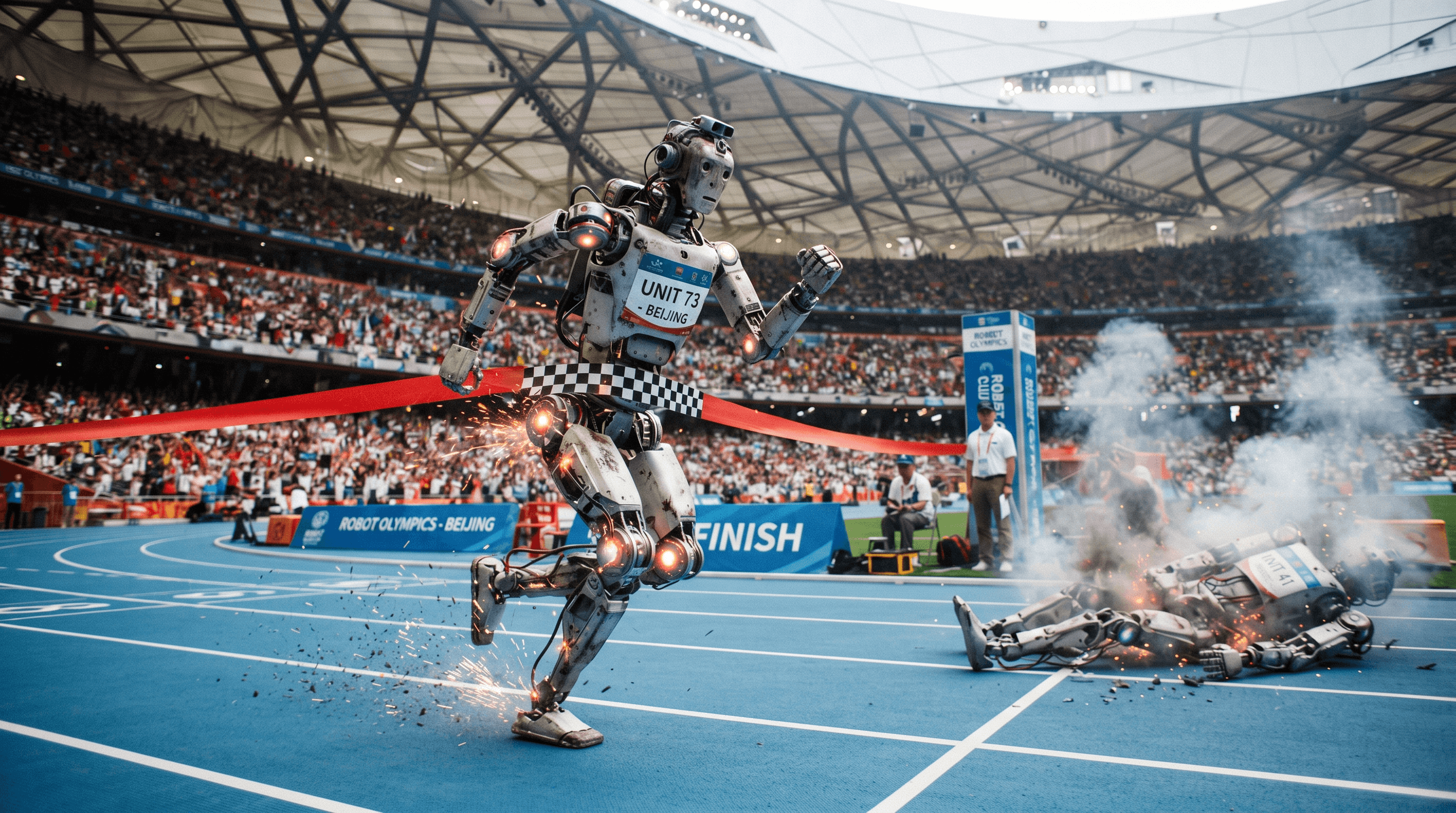
A Tiangong Ultra humanoid robot crosses the finish line of the 100-meter sprint at 8.86 seconds -- faster than Usain Bolt's human world record. Then it keeps going. It cannot stop. It slams into the padded barrier at the end of the track, joints straining, sparks flying from a fractured waist actuator. Nearby, another robot has already fallen mid-race and lies on the ground, smoke rising from its motor housing.
This is the 2026 World Humanoid Robot Games in Beijing: a competition where robots simultaneously break world records and burst into flames. The contrast is the story.
Robots That Run Like Olympians, Fall Like Beginners
The second edition of the World Humanoid Robot Games, held August 22-26 at Beijing's National Speed Skating Oval, brought together over 2,000 humanoid robots from companies worldwide. The headline achievement was undeniable: the Tiangong Ultra, developed by a Chinese robotics firm, ran 100 meters in 8.86 seconds -- shattering both the 9.58-second human record held by Usain Bolt and the 12.5-second winning time from the inaugural games in 2025.
The improvement in one year is staggering. Robots that could barely jog 12 months ago are now sprinting at Olympic-eligible speeds. But as multiple competitors demonstrated, doing one thing at world-record pace and doing many things reliably are entirely different engineering problems.
"Some companies had different types of robots for different games or different tasks, because they were engineered for that task to be the best in that," Dhanush Patel, a PhD candidate at Purdue University and researcher at the US Army Research Lab, told Ars Technica. The running robots, optimized solely for straight-line sprinting, could not slow down after crossing the finish line. Several crashed into barriers. Some broke apart at the waist in showers of sparks. A few caught fire.
The Chore Gap: Where Humanoids Still Struggle
The less flashy events may have been the more revealing ones. The games introduced practical scenario competitions this year: washing and hanging laundry, folding clothes, cleaning living rooms, and receiving package deliveries mid-task. These are tasks a human teenager can learn in an afternoon. Most robots struggled visibly.
A firefighting and rescue event proved particularly brutal. Robots had 30 minutes to identify hazardous substances, locate and shut off three open valves, spot a fire, and find a fire extinguisher to put it out. Only three of 12 competing teams completed the entire challenge.
The dexterity events -- picking up beans, driving screws -- tested fine motor control that remains a weak point for even the most advanced humanoid platforms. Many robots were still teleoperated by human operators, with the competition penalizing but not banning remote control. "You can simulate something like 100,000 scenarios for hammering a nail, but that's just one task from millions of tasks in the world," Patel noted.
The Gimmick Robot That Invented Its Own Running Style
One of the viral highlights of the games involved a robot from Beijing-based X-Humanoid that won the small-group 400-meter race with an unusual technique. Instead of a human-style arm swing, it held its arms up near its face and swung them back and forth through hip rotations -- a gait that looked awkward but worked.
X-Humanoid's developers told the Global Times that the robot learned the technique through reinforcement learning in simulation, discovering a movement pattern no human engineer had designed. It was a genuine glimpse of what autonomous robotics could become: machines that find solutions humans would never think of. The fact that this novelty stood out as remarkable in a competition of 2,000 robots says as much about the state of the field as the record-breaking sprint times do.
What the Games Really Tested
Organizers, including Chinese state media and the Beijing city government, positioned the event as a showcase for commercial potential. China alone poured over [estimated amount] billion into humanoid robot companies in 2025, and companies like Tesla, Figure, and Agility Robotics are ramping up factory deployments. The US government has also restricted exports of key components, creating a competitive dynamic that makes events like these geopolitical as well as technological.
Yet the gap between the sprinting robots and the chore-performing robots tells a honest story: humanoids are excellent at narrow, well-defined tasks and terrible at everything else. The robots that break records are purpose-built for one movement. The robots that wash laundry are visibly struggling. The robots that fight fires usually fail.
"I would have to push the algorithmic development a lot to actually see a robot being able to generalize and do eight-hour work shifts in any random environment," Patel told Ars.
The Uncomfortable Takeaway
The World Humanoid Robot Games are fun to watch. Robots running into walls, robots catching fire, robots inventing weird running styles -- it is genuinely entertaining. But as a benchmark for real-world capability, the games primarily measure how good companies are at building competition robots, not how close the field is to general-purpose automation.
The robotics industry is making real progress. The jump from 12.5 seconds to 8.86 seconds in one year is genuine engineering achievement. The RL-trained running gait from X-Humanoid points toward a future where robots discover their own optimal behaviors. The household chore events, even if most robots failed them, represent a commitment to testing what actually matters.
But the image that will stick is the one from the 100-meter final: a robot that just broke a world record, unable to stop, crashing into a barrier as its joints overheated. That is the state of humanoid robotics in 2026 -- capable of moments of brilliance, not yet capable of consistency.
Sources
- Ars Technica: World humanoid robot games show runners breaking records, bursting into flames
- The Atlantic: Scenes From the 2026 World Humanoid Robot Games
- Reuters: Chinese robot Tiangong clocks sub-9 second 100 metres in Beijing
- Gizmodo: The Best Robot Fails From the 2026 World Humanoid Robot Games
- Reuters: Robots can outrun humans, but can they plug in a cable?
- The Verge: Humanoid robots smash Usain Bolt's 100-meter record