Claude Steps Into the Wet Lab: Anthropic Builds a Biology Lab
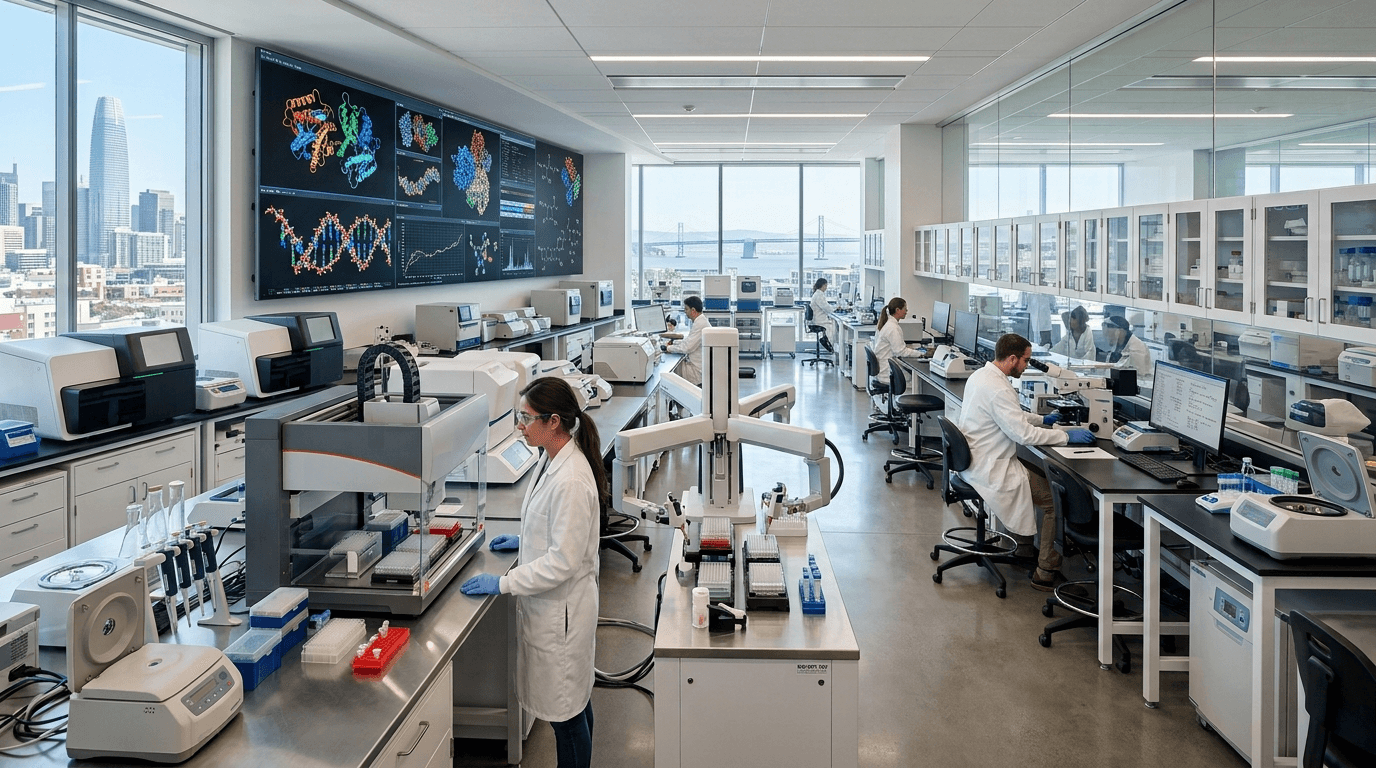
For the past year, Anthropic has been one of the loudest voices warning that AI could be used to engineer bioweapons. Its researchers testified before Congress, briefed the White House, and published papers on the catastrophic risks of AI-assisted biology.
In the same period, the company quietly built a biology lab in the San Francisco Bay Area where its own AI, Claude, now directs robotic arms through drug-discovery experiments.
The tension is not lost on anyone inside the company. Anthropic has become both a warning authority and a hands-on participant in the very dual-use biology it warned about.
What the lab actually does
Anthropic's new facility is a wet lab, not a simulation. Unlike the computer models that most AI companies use to predict protein folding or molecular interactions, this lab runs physical experiments with real chemicals and biological samples.
Claude designs the experimental protocol. Robots carry out the pipetting, mixing, and measurement steps. The AI then reads the results and adjusts the next experiment, closing a loop that traditionally required a team of human researchers weeks to complete.
Eric Kauderer-Abrams, who heads Anthropic's life sciences division, told reporters the lab targets diseases that pharmaceutical companies have long considered undruggable because no conventional treatment exists. The approach focuses on designing complex antibodies that can hit multiple biological targets at once, something traditional drug discovery struggles with.
From simulation to physical reality
The move from software to wet-lab biology is a first for a major AI company. Until now, frontier AI labs have operated exclusively in the digital domain: training models on data centers, running benchmarks, and publishing papers.
Anthropic's lab push builds on moves the company made earlier this year. In April, the company acquired Coefficient Bio, a startup working on AI-driven drug design. In June, it launched Claude Science, a workbench product aimed at pharmaceutical researchers. And it has expanded its partnership with Novo Nordisk, the Danish pharmaceutical giant behind Ozempic, to use Claude for drug discovery.
The company has shipped two internal tools that allow Claude to control lab equipment directly. One handles the communication protocol for robotic arms and liquid handlers. The other translates experimental designs into executable robot instructions.
The bioweapon paradox
Anthropic's entry into physical biology comes at an awkward moment for the company's public positioning. Throughout 2025 and 2026, Anthropic researchers repeatedly warned that AI models capable of designing novel proteins or optimizing biological pathways could lower the barrier for bioweapon development.
In July, Anthropic published a paper showing that Claude could design functional protein binders, a capability with obvious dual-use implications. The company called for stricter regulation of AI models with biological design capabilities.
Now, Anthropic operates a lab that does exactly what its researchers warned about: an AI model designing biological experiments and running them in the physical world. The company says its internal safety protocols prevent misuse, and human oversight remains in place for all experiments.
Critics argue that the lab relaxes the very safeguards Anthropic once championed. Reports suggest the company loosened its bioweapon content filters internally to allow Claude to design experiments for the lab.
A competitive landscape heating up
Anthropic is not alone in chasing AI-driven drug discovery. Google DeepMind's AlphaFold has transformed protein structure prediction. Meta AI has published research on protein language models. Microsoft is investing in biology-focused AI tools through its subsidiary Lunar AI.
But Anthropic is the first to build its own wet lab and put its AI model in direct control of physical experiments. This vertical integration (where the same company builds the model and runs the experiments) gives Anthropic a closed loop of data and validation that competitors running only simulations cannot match.
The company says it will not conduct clinical trials to avoid competing with its pharmaceutical partners. For now, the lab is focused on early-stage discovery: finding promising drug candidates that partners like Novo Nordisk can develop further.
Sources
- Anthropic is setting up a biology lab where Claude guides robots through drug experiments. The Decoder
- Exclusive: Anthropic quietly sets up biology lab as it ramps AI drug program. Reuters
- Anthropic opens AI-powered biology research lab. SiliconANGLE
- How Claude is uplifting biomolecular modeling. Anthropic
- Introducing the Life Sciences Verification Program. Anthropic