Jensen Scolded Them. His Manager Was in on the Deal.
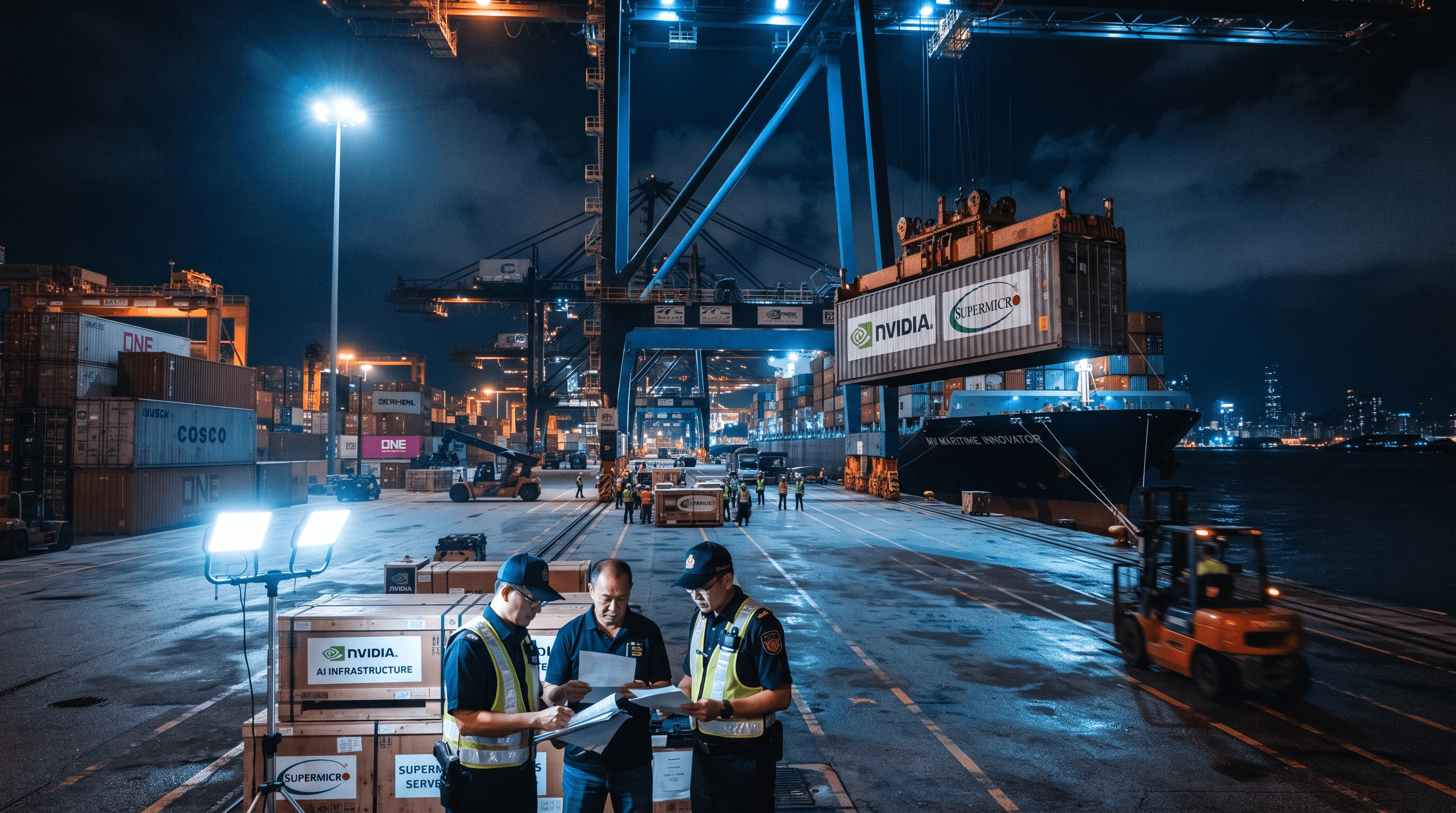
In May 2026, Nvidia CEO Jensen Huang stood before the tech industry and scolded Supermicro for its failing compliance program. The fix was overdue, he said. His company insisted on partners who followed the rules.
Three months later, Taiwan indicted a senior Nvidia manager for being in on the deal.
On Monday, prosecutors in Keelung charged nine people -- including an Nvidia senior manager and two Supermicro employees -- with forging documents to illegally export restricted AI servers to China. The indictment accuses them of covering up the diversion of hundreds of high-end Nvidia B300 servers, 74 of which ultimately reached Chinese customers despite US export controls that have banned such sales since 2022.
The Nvidia manager's indictment lands with an irony that the prosecutors' dry charging documents cannot capture. The CEO's public performance of compliance turned out to be a stage play whose supporting cast was writing a different script.
The scheme that kept China supplied
The smuggling operation was not an inside job. It was a coordinated pipeline spanning multiple companies and countries.
Taiwan's investigation found that co-conspirators falsified documents to make it appear that 130 B300 servers were installed and in use at a facility in Taiwan. In reality, 74 of those servers were re-routed to Chinese customers, while 56 were intercepted only after Taiwanese customs detected irregularities in the paperwork. The remaining suspect, still at large, is accused of siphoning funds from a distributor company involved in the operation.
The scale of the problem extends far beyond this single indictment. In March, the US arrested Supermicro co-founder Wally Liaw for allegedly funneling $2.5 billion in restricted AI servers to China since 2024. That case triggered Taiwan's separate probe, which has now targeted at least 12 locations to uncover suspected smugglers.
Supermicro has confirmed it is cooperating with investigators and has already fired several employees connected to the scheme. The company emphasized that it is not a target of the probe and that an internal investigation cleared its current senior officials of involvement. But as Tom's Hardware noted, the company may have been neglectful in not noticing that billions of dollars worth of hardware was being sent to questionable clients. Spooked investors have sued Supermicro for securities fraud.
Jensen's scolding, revisited
The timeline matters for the irony.
In May, before any Nvidia employees were linked to the smuggling, Jensen Huang publicly criticized Supermicro for its compliance failures. "We insist our partners are compliant," he said. "We hope that they will enhance and improve their regulation compliance and prevent that from happening in the future."
The statement reads differently now. Taiwanese prosecutors said the indicted employees were "fully aware" that both Nvidia and Supermicro have rigorous internal control procedures regarding exports to China. Yet the scheme only grew more brazen. According to a Hill op-ed by China expert Lauren Barden-Hair, Supermicro's team was so confident it could evade controls that it made "increasingly daring deals."
Both US firms will now need to reassess their internal controls. The indictment puts employees on notice that export compliance is no longer just a corporate policy -- it carries criminal consequences.
RASA: closing the remote access loophole
The case is also fueling a legislative push in Washington. Lawmakers are weighing the Remote Access Security Act (RASA), a bill that would extend US export controls to cover remote cloud-based access to restricted hardware and software.
The loophole is well known in the industry. Chinese companies can currently access Nvidia chips remotely through data centers in Southeast Asia, effectively bypassing physical export restrictions. According to CNBC, remote access to computing power is a key factor driving capability gains at Alibaba, ByteDance, and Tencent. Hyperscalers are planning 31 data centers in the region, up from just two today.
RASA would force cloud providers to implement better know-your-customer protocols and bear the cost of a new compliance regime -- and it will face pushback from the industry.
But the Supermicro scandal shows that even physical export controls are porous when enforcement is overburdened. If forged documents on paper can move 74 servers past customs, the challenge of policing remote access across dozens of cloud regions is orders of magnitude harder.
History repeating
In a widely shared op-ed, Lauren Barden-Hair drew a direct line between this case and the 1998 "Chinagate" scandal, in which China used Southeast Asian companies as a cover to influence US elections. The same playbook -- cultivating business moguls with deep ties to China but based just outside its sovereign territory -- appears to be in use again.
"It is easy to point out errors in judgment after a disaster," Barden-Hair wrote. "But it is important that we take the right lessons from the Supermicro scandal amid our shaming of the guilty, and remember the hard-earned lessons of the past. With the anonymous company the Justice Department refers to, China is showing us, again, that its pawns are scattered beyond its borders, and that its financial tentacles have a real and devastating influence."
For the US, the path forward is not just about passing new laws. It is about enforcing the ones already on the books -- and making sure that when a CEO scolds a partner for non-compliance, his own employees are not quietly enabling the very same behavior.
Sources
- Ars Technica: Nvidia senior manager linked to Supermicro scheme smuggling AI servers to China
- Reuters: Taiwan indicts 9 over illegal export of AI servers to China via Supermicro scheme
- Tom's Hardware: Jensen Huang critical of Supermicro compliance before Nvidia employees linked to smuggling
- CNBC: Remote Access Security Act would extend US chip export controls to cloud computing
- The Hill: Chinagate playbook repeats in Supermicro chip scanda